






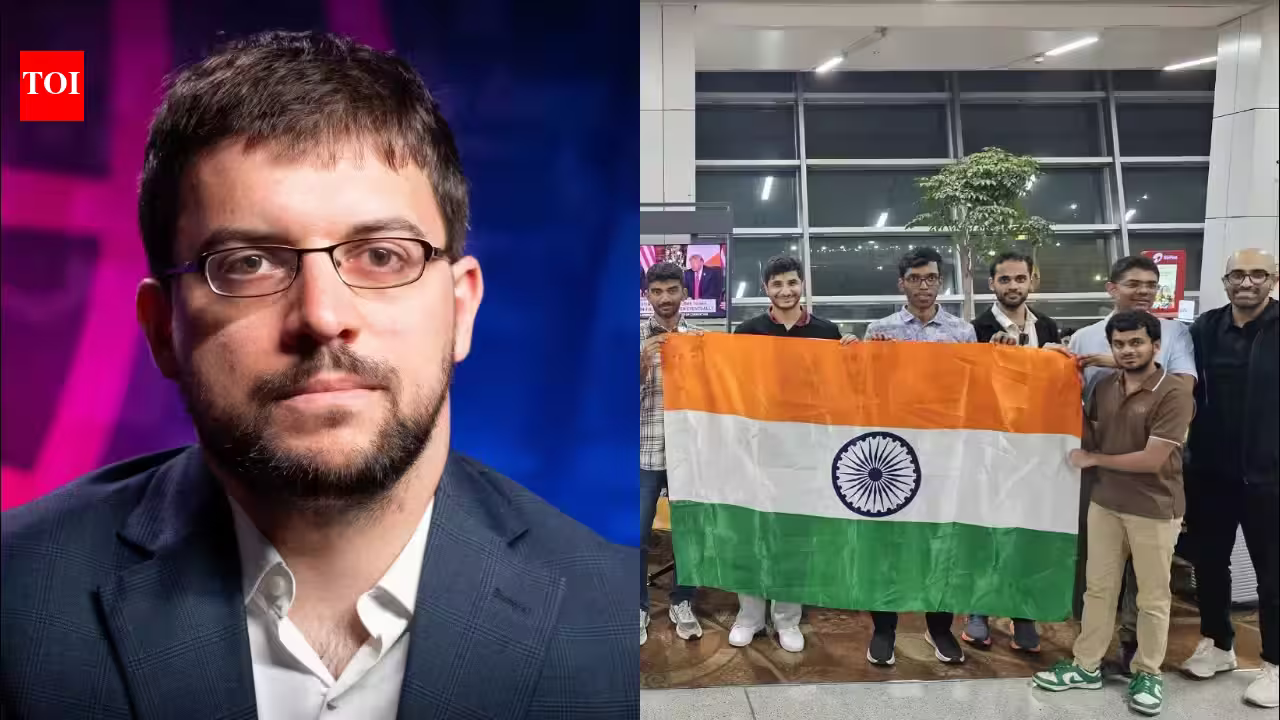
NEW DELHI: The 46th Chess Olympiad has commenced with a resounding statement of intent from the French contingent, who opened their campaign on Wednesday with a clinical 4-0 sweep over Tunisia. While the result signals a strong start for the European side, the team’s spearhead and Board 1 representative, Maxime Vachier-Lagrave—affectionately known as “MVL”—was notably absent from the opening skirmish. After a grueling schedule in India’s Global Chess League (GCL), the decision to rest the grandmaster was a strategic masterstroke, ensuring his readiness for the high-stakes rounds looming ahead.
France enters this year’s tournament with a well-balanced roster. Alongside Vachier-Lagrave, the squad boasts the tactical acumen of Étienne Bacrot, the steady presence of Maxime Lagarde, the rising talent of Jules Moussard, and the prodigious youngster Marc’Andria Maurizzi, all under the tactical guidance of captain Sébastien Mazé.
The View from the Top: Assessing the Field
Despite the depth of the French lineup, Vachier-Lagrave refuses to indulge in the typical pre-tournament bravado often seen in elite sports. When asked about France’s championship aspirations in Samarkand, the grandmaster offers a refreshing, grounded perspective.
“We’re nowhere near favourites,” Vachier-Lagrave told TimesofIndia.com in an exclusive interview. “But we have a good solid team, and I think everyone’s really motivated. So that’s all I can say, and we’re hoping for the best.”
When pressed to identify the true titans of the field, MVL was quick to highlight four nations that currently stand a tier above the rest. “There are three main favourites, I think. Even four, I would say. USA, India, China, and Uzbekistan,” he stated. By excluding his own team from that elite quartet, Vachier-Lagrave is not succumbing to pessimism; rather, he is exhibiting the same unsentimental clarity that has defined his two-decade tenure at the pinnacle of international chess. It is a calculated, pragmatic approach—one that prioritizes objective reality over motivational rhetoric.
A Legacy Rooted in Passion
The journey to Board 1 began in childhood for the 35-year-old. Recalling his introduction to the game, Vachier-Lagrave notes that his professional ascent was born from the simple, universal joy of victory. “I learned the rules at five years old, and gradually I enjoyed the game more and more and started winning,” he reflected. “The more you win, the more you want to play.”
Yet, even he admits that the trajectory of his life was not a certainty. “I didn’t know at the time that I would still be doing basically only that as my profession thirty years later,” he confessed. While he admits to the occasional shadow of doubt that accompanies any high-pressure career, he maintains that choosing the path of a professional grandmaster was ultimately a “great decision.”
The Philosophy of Resilience
MVL’s longevity in a sport as volatile as chess is credited to his internal philosophy regarding setbacks. For the Frenchman, progress is rarely a linear trajectory. “An improvement curve cannot be a straight line,” he explains. “It has some ups and downs. You just need to always be looking forwards for the ups.”
He advises peers and aspiring players alike to treat moments of failure as data points for growth rather than crises of confidence. “It’s just important not to focus on those moments. But to learn the lessons that need to be learned, and to focus on the moments of enjoyment.”
Beyond the Board
Vachier-Lagrave’s recent stint in India with the Mumba Masters, who secured a fourth-place finish in the GCL, was an exhausting affair. He spoke with a touch of humor regarding the unique challenges of touring the subcontinent, noting, “Every time I come to India, in the morning I feel very tired, no matter how I slept.”
Between his professional duties and travel, Vachier-Lagrave finds solace in a variety of pastimes. His downtime is often spent playing board games with friends or engaging in physical activity, such as padel, to maintain a balance between mental rigor and physical fitness. When forced into isolation, he retreats into the logic-based world of variant sudoku—a testament to a mind that finds comfort in complex, structured challenges even during his leisure time.
As the Chess Olympiad progresses, the eyes of the sporting world will remain on Samarkand. France may not carry the “favourite” tag according to their own Board 1 player, but if history is any indication, Vachier-Lagrave will approach every match with the same cold, analytical focus that has cemented his place among the world’s elite—regardless of what the pundits say.
Disclaimer: This content is auto-generated for informational purposes only.
Source: Read Original News