







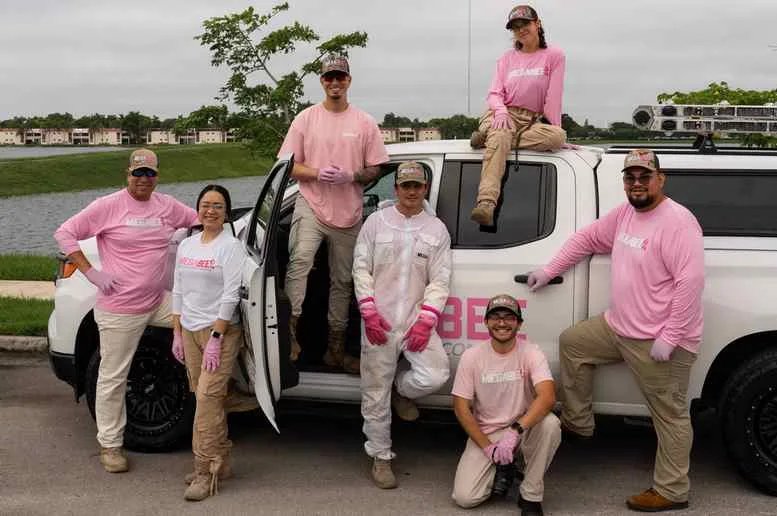
In South Florida, the familiar sight of yellow uniforms belonging to Mega Bee Rescues & Pest Control has undergone a striking transformation this October. From specialized bee removal gear to everyday pest control attire, the family-owned firm has swapped its signature branding for vibrant pink. While the aesthetic change is eye-catching, the motivation behind the move is deeply personal, stemming from a team member’s recent loss to breast cancer.
The company’s “Mega Bee Goes Pink” initiative serves as a poignant reminder of how small, local businesses can leverage their physical presence to facilitate community-wide support for major health causes.
## Beyond Traditional Marketing: Using Real-World Interactions to Drive Change
In an era where digital awareness is often reduced to social media hashtags or static profile banners, Mega Bee is taking a decidedly physical approach. By embedding the campaign directly into their service calls across Miami-Dade and Broward counties, the company is turning every attic inspection or hive removal into a touchpoint for breast cancer awareness.
This strategy utilizes the concept of “contextual engagement.” When technicians arrive on-site wearing pink, it naturally sparks curiosity and conversation among homeowners. These interactions shift the focus from simple maintenance to human connection. By providing “Your Service Went Pink Today” cards, the company ensures that their impact extends beyond the immediate service call, empowering customers to contribute directly to the Susan G. Komen organization.
## Scaling Social Impact via Local Operations
For a small enterprise, scaling social impact requires a seamless integration of operations and philanthropy. Mega Bee has committed 5 percent of all revenue from pest control and bee removal services throughout October to breast cancer research.
This model demonstrates a scalable framework for small businesses: by linking charitable contributions to routine service metrics, companies can maintain consistent support levels that fluctuate in tandem with their business performance. It also transforms the technician’s role, shifting their identity from a service provider to a local brand ambassador who carries the weight of a larger mission. This level of intentionality is increasingly becoming a benchmark for how local businesses interact with their regional communities, moving away from passive sponsorship toward active, mission-driven operational cycles.
## The Role of Awareness in Localized Ecosystems
The success of the “Mega Bee Goes Pink” initiative highlights the power of grassroots communication in a digital-first world. While national organizations dominate the conversation around breast cancer, local companies serve as the essential connectors that bring these issues into the domestic sphere.
“We didn’t want this to be about putting a pink ribbon on our logo for October and calling it a day,” said CEO Jean Navarro. The philosophy here is rooted in the idea that localized awareness is more effective at driving engagement than broad-spectrum digital campaigns. By meeting people at their doors—in their own homes—the team at Mega Bee has successfully bridged the gap between professional service and communal empathy.
As the company continues its operations through the remainder of the month, the initiative serves as a case study in how business entities can utilize their existing workforce and daily workflows to address critical social issues. By choosing to turn their professional identity into a vehicle for advocacy, the team at Mega Bee is proving that even the most specialized local service companies can play a pivotal role in the fight against breast cancer, transforming everyday interactions into opportunities for meaningful progress.
Disclaimer: This content is auto-generated for informational purposes only.
Source: Read Original News