







Long-Duration Storage Key to India’s 500 GW Clean Energy Ambitions
NEW DELHI | October 30, 2026
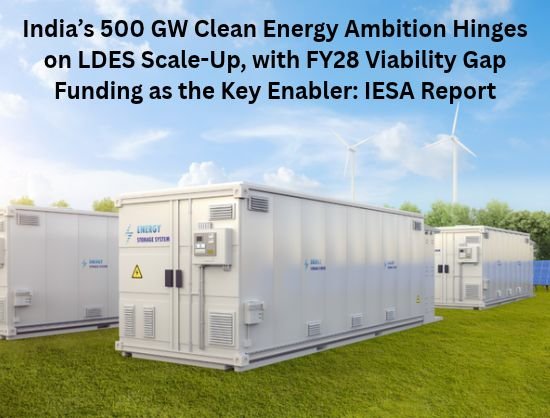
India’s ambitious journey toward securing 500 GW of non-fossil fuel energy capacity by 2030 faces a critical juncture. As the nation scales its solar and wind infrastructure, a new report from the India Energy Storage Alliance (IESA), in partnership with Customized Energy Solutions (CES), emphasizes that the rapid deployment of long-duration energy storage (LDES) is no longer optional—it is a necessity for grid survival.
Addressing the Curtailment Crisis
The transition to a renewable-heavy power grid is currently hindered by significant inefficiencies. According to the IESA report, “Long-Duration Energy Storage: Global Outlook and India’s Deployment Pathway,” India’s energy landscape suffered a major setback in 2025, with 2.3 terawatt-hours (TWh) of solar energy curtailed over just eight months. This wastage is largely attributed to grid constraints and a lack of adequate storage to absorb surplus energy during peak generation hours.
As renewable penetration deepens, the inability to store excess power means that much of India’s clean energy potential remains trapped. LDES systems are identified as the primary solution to capture this surplus, allowing the grid to stabilize supply during periods of high demand or low renewable generation.
The Scaling Challenge
The global perspective on storage is equally daunting. The Long Duration Energy Storage Council estimates that the world will require roughly 8 terawatts (TW) of LDES capacity by 2040 to meet climate targets. With global operational capacity sitting at just 117 GW as of 2025, the industry faces a massive 50-fold scaling requirement. While the potential for system-wide savings is estimated at USD 540 billion annually, the current pipeline of projects accounts for only 3% of the required global target, highlighting a significant investment gap.
“Long-duration energy storage is the linchpin that will enable us to maximize renewable utilization, enhance grid stability, and build resilience into our power system,” said Debmalya Sen, president of IESA. He urged for more robust policy frameworks and technology-neutral investments to turn these goals into reality.
Domestic Priorities and Policy Gaps
In India, the Central Electricity Authority (CEA) has signaled a target of 34.5 GWh of battery energy storage system (BESS) capacity by FY2027. While 9.3 GWh has already been commissioned, the remaining pipeline is heavily skewed toward short-duration storage solutions. IESA notes that while these systems serve immediate needs, they fall short of the multi-hour, or even multi-day, storage capabilities required for a truly flexible grid.
To bridge this, the report points to diverse technological pathways, including flow batteries for 8–12 hour cycles, iron-air batteries for multi-day storage, and the continued integration of pumped hydro and thermal energy storage.
However, industry experts point to two major roadblocks: the absence of a formal legal definition for LDES and the lack of a dedicated funding mechanism for projects exceeding eight hours of storage.
The Road to FY2028
The IESA is calling for urgent regulatory intervention to address these gaps. A central pillar of their recommendations is the proposed FY2028 viability gap funding (VGF) framework. By providing financial support to bridge the economic gap in long-duration projects, the government could catalyze private investment and move the needle from theoretical planning to large-scale deployment.
Ultimately, as India shifts its focus from merely adding generation capacity to ensuring the dispatchability and reliability of its power grid, the success of its 500 GW target will depend on how quickly it can adopt and finance long-duration storage technologies.
Disclaimer: This content is auto-generated for informational purposes only.
Source: Read Original News