







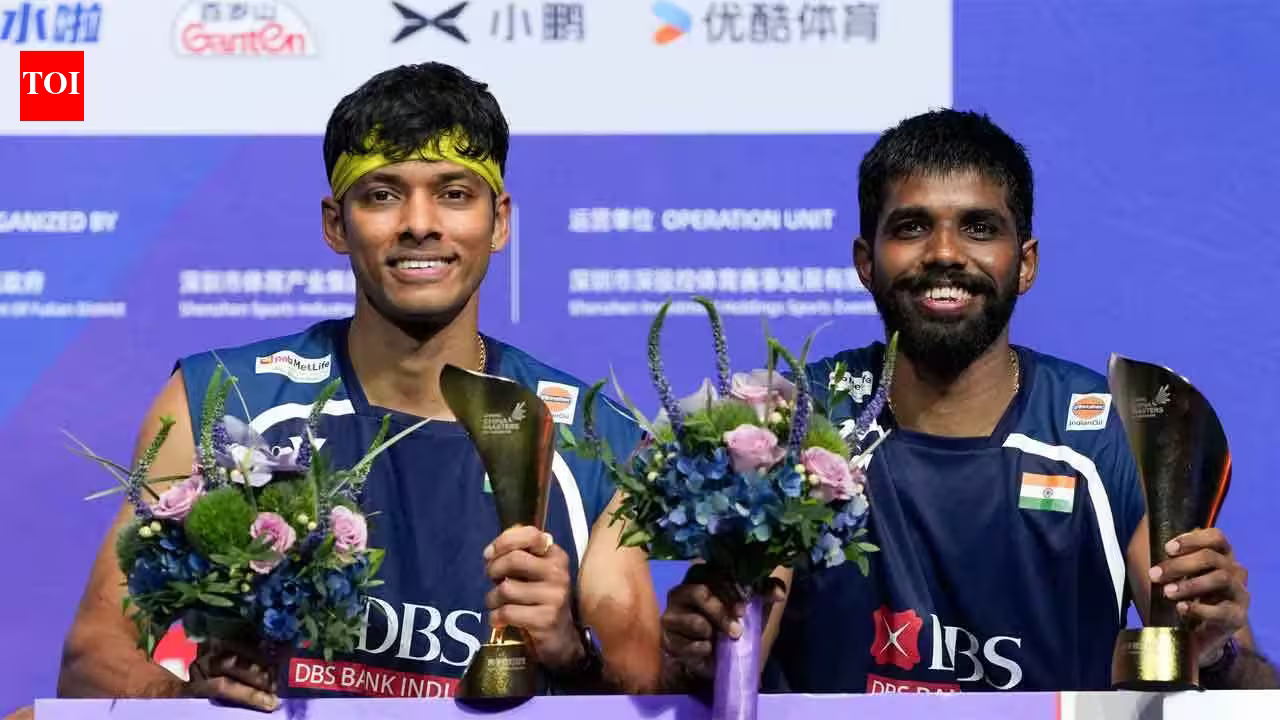
SHENZHEN — Satwiksairaj Rankireddy and Chirag Shetty have built a career on the philosophy of the hard way. They are masters of the slow burn, a duo that routinely finds themselves backed into a corner, forced to regroup, and ultimately finding an improbable path to victory. On Sunday in Shenzhen, that familiar script delivered one of the most defining triumphs of their season.
In a dramatic turnaround, the Indian pair rallied from a lopsided opening set to defeat China’s He Ji Ting and Ren Xiang Yu 11-21, 21-13, 21-17, capturing their maiden China Masters Super 750 title. The victory served as a definitive exorcism of demons past, effectively ending a frustrating streak of two previous final defeats at the tournament and providing a massive psychological boost on the road to the Asian Games.
‘Shenzhen gives us confidence’
The China Masters has long been a curious, bittersweet fixture in the pair’s trajectory. Despite previous final heartbreaks in 2023 and 2025, the venue remains a place where the duo feels inexplicably at home.
“We weren’t thinking about the fact that we have lost two times in the final there. We were thinking that we have played two finals there,” Satwik said reflecting on the win. “It is kind of like the French Open for us—we feel very comfortable, the stadium feels good, the atmosphere feels good.”
For the 26-year-old, the win was a testament to persistence. Entering the tournament, the team was far from peak condition. Satwik continues to navigate the complexities of a chronic shoulder injury, while Chirag has been managing persistent lower-back issues for over a year and a half. Despite the physical limitations, the duo’s intent remained unwavering.
“We always go with the same intent. Whenever we get a chance, we grab that,” Satwik noted. “The only concern was whether the body is cooperating or not. If it wasn’t, we were prepared to take a step back because of the looming Asian Games, but we felt pretty much confident throughout the week.”
That confidence was put to the ultimate test in the final. The Chinese duo dictated the pace in the opening game, using relentless flat exchanges that stifled the Indians’ ability to set up their trademark power game. However, the difference between the World Championships and this tournament was clear: instead of succumbing to the pressure, the Indians began to dictate the mid-court, slowly stripping away their opponents’ rhythm and allowing Satwik’s lethal attack to re-emerge.
The difference from World Championships
The victory is made all the more impressive when viewed against the backdrop of their recent performance at the World Championships in New Delhi. Just two weeks ago, the pair left that tournament devastated after surrendering a commanding position in the quarterfinals—a performance they now attribute primarily to a lack of match rhythm rather than a mental collapse.
“I think it was mainly physical,” Satwik explained. “We became much better after the World Championships. We got time, we got off, and adjusted.”
The BWF calendar, which crammed a grueling Super 750 event into a window just two weeks after the World Championships, left little time for proper recovery. “The World Championship was difficult for us because we didn’t have much time on the court,” Satwik added. “We played one match, then we played quarterfinals right away. Our body didn’t cope as well.”
Chirag echoed this sentiment, highlighting that the lack of competitive minutes after a three-month hiatus caused their initial performance to be “scratchy.” In Shenzhen, however, the court time was a blessing in disguise. Barring their opening-round match, the duo was pushed to three games in every single encounter. Despite the punishing schedule—four consecutive three-setters—their bodies held up far better than they had in Delhi. That endurance, they believe, was the direct result of the extra week of focused training leading into the China Masters.
Perfect timing before Asian Games
With the trophy secured, the focus for the duo now shifts rapidly toward the Aichi-Nagoya Asian Games, starting September 19. The pressure of defending their men’s doubles gold and the team silver weighs heavily, but the pair approaches the challenge with a renewed sense of stability.
“We have 10 days to go before we head to Japan,” Chirag said, noting that they were already looking past the celebratory mood. “Today was an off day. We came in only early this morning, so we couldn’t really sleep as much. Tomorrow, we are back on court training for the Asian Games.”
As they pivot from the celebratory courts of Shenzhen to the high-stakes environment of the Asian Games, Satwik and Chirag have proven once again that they are not just competitors; they are survivors. Having successfully turned a potential injury-plagued season into a triumph of resilience, the pair heads to Japan not just as contenders, but as a duo that has learned exactly how to weather the storm and emerge on the right side of the scoreboard.
Disclaimer: This content is auto-generated for informational purposes only.
Source: Read Original News