







At this year’s Meta Connect event, Meta unveiled a significant expansion of its wearable hardware portfolio, headlined by a new class of virtual reality glasses that shift the form factor away from bulky headsets toward a more streamlined, lightweight design. The announcement also included a variety of smart glasses, AI-integrated peripherals, and updates to existing product lines, signaling Meta’s push to make immersive computing and artificial intelligence more accessible for daily use.
The New Meta VR Glasses
The most notable reveal was the Meta VR Glasses, a device that effectively miniaturizes virtual reality technology into a frame resembling traditional smart glasses. By offloading primary hardware components—including the processor, battery, and storage—to a tethered, pocket-sized compute puck, Meta has achieved a weight of just 100g. This is significantly lighter than the Meta Quest 3, allowing for a form factor that lacks the traditional heavy straps and facial interfaces found on standard VR headsets.
Under the hood, the device is powered by the Qualcomm Snapdragon Reality Elite chipset, supported by 12GB of RAM and 128GB of storage. The visual experience is delivered through a 5K micro-OLED “Infinite Display,” which provides a resolution of 2412 x 2288 pixels per eye at a refresh rate of up to 120Hz. Launching in spring 2027 with a price point of $1,299, the device targets a middle ground between entry-level VR and premium enterprise-grade hardware. Beyond gaming, the glasses support productivity workflows by connecting to Mac and Windows laptops, serving as a virtual external monitor with supplemental input capabilities like a virtual surface keyboard.
Expanding the Smart Glasses Ecosystem
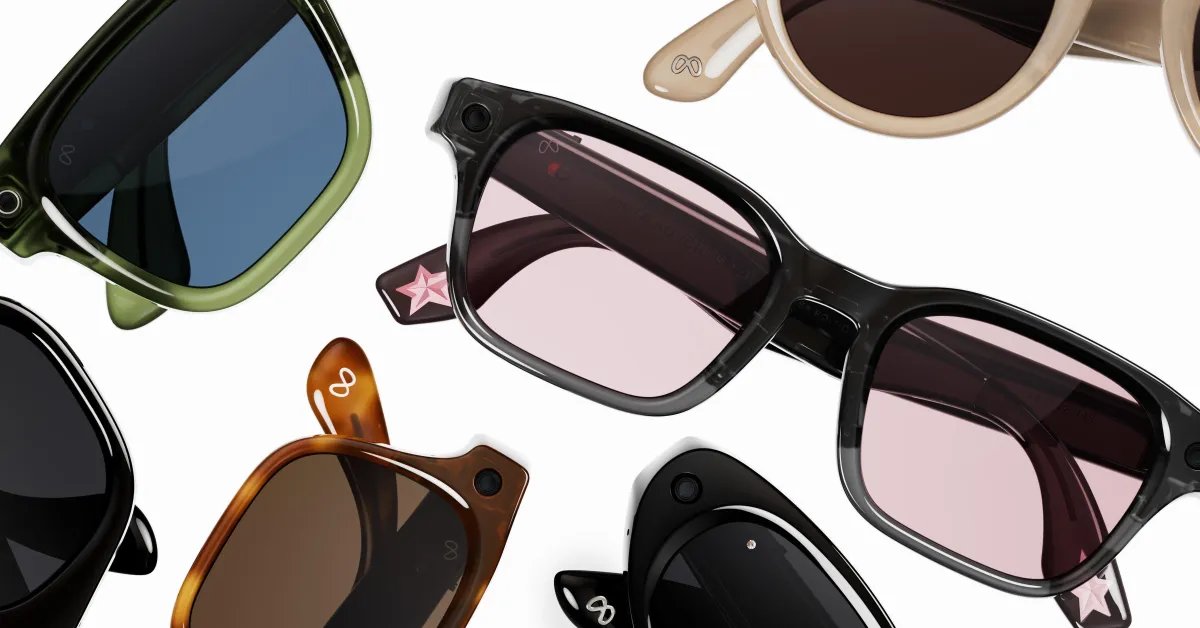
Meta is diversifying its smart glasses category by introducing audio-only models that omit integrated cameras. The Ray-Ban Meta Audio glasses address previous privacy and harassment concerns associated with wearable recording devices while retaining core functionalities like audio playback, hands-free calling, and interaction with AI assistants. Weighing only 43g, these glasses offer 12 hours of battery life, which extends to 48 hours when using the included charging case. They will be available starting October 13th at $349 across a wide variety of lens and frame configurations.
Simultaneously, Meta has refreshed its primary Ray-Ban Meta line with the third-generation glasses. These updates include a more compact design, a battery life boost to nine hours, and an enhanced six-microphone array capable of suppressing 90 percent of ambient noise. The introduction of a customizable action button allows for faster interaction with the Meta AI assistant. These glasses will offer even broader customization, with 27 total combinations of frames and lenses.
New Affordable Options and Regional Growth
To capture a broader market, Meta is introducing a new entry-level model, the Meta Adventurer, starting at $249. This device focuses on basic utility with a streamlined aesthetic. To complement this, Meta has launched a “Mix & Match” customization program, allowing users to select specific frame materials, lens types, and case colors.
The reach of these wearables is also expanding globally. Meta announced that its smart glasses are now available in Singapore, South Korea, Mexico, and the United Arab Emirates, with an upcoming launch scheduled for Brazil. The company continues to bolster its fashion-forward approach by expanding its EssilorLuxottica collection, adding the Capri and Nova styles, and continuing its collaborative efforts, such as the new collection with Lisa of Blackpink.
Enhanced Functionality for Ray-Ban Meta Display
Following the initial success of the Ray-Ban Meta Display, the device is entering new markets, including the UK, Canada, France, Italy, and Germany. Accompanying this regional rollout are software enhancements designed to improve the day-to-day utility of the hardware.
Meta is introducing a new Explore app, which acts as a hub for users to discover experiences and services specifically optimized for the smart glasses. Features such as photo editing, an improved calendar integration, and mirrored smartphone notifications are intended to reduce the reliance on secondary devices. Additionally, Meta is bringing a version of the “hologram” feature—a photorealistic digital avatar system—to the display glasses, starting with an early access phase on WhatsApp for users in the US.
The Future of Muse AI and Wearables
Central to the intelligence of these devices is the Muse AI agent, which is slated for integration across Meta’s wearable lineup. Designed to be a proactive assistant, the future capabilities of Muse include assisting with personal tasks such as nutritional logging, appointment scheduling, and providing real-time purchasing guidance by identifying products in the user’s field of view. To further this ecosystem, Meta teased a new standalone gadget called the Muse Charm. Looking much like a modern, AI-powered evolution of the Tamagotchi, the pocket-sized device will house the Muse agent and is expected to ship in time for the upcoming holiday season. By blending portable hardware with continuous AI assistance, Meta aims to transition its wearables from simple accessories into essential tools for information management and daily productivity.
Disclaimer: This content is auto-generated for informational purposes only.
Source: Read Original News