







Expanding the Switch 2 Ecosystem with the Basecase
The market for portable gaming console accessories is often crowded with rushed, low-quality plastic shells that prioritize speed to market over structural integrity. As manufacturers scramble to support the Nintendo Switch 2, many users have encountered poorly fitting cases and fragile attachment points. However, a notable entry has arrived from Mechanism, a manufacturer recognized for its specialized mounting hardware. The newly released $49 Basecase is a modular, protective snap-on shell that distinguishes itself through precision engineering and a forward-thinking approach to user customization.
Unlike standard hardshell cases that merely offer scratch protection, the Basecase is designed as a foundational component for a broader ecosystem. It integrates directly with Mechanism’s established line of mounts, such as the Basegrip, which enables the console to be secured to walls, pillows, or adjustable monitor arms. By combining physical protection with a modular attachment system, Mechanism offers a solution for users who want their console to transition seamlessly from a handheld device to a fixed, ergonomic workstation.
Precision Fit and Structural Integrity
One of the primary failure points in previous generation console cases is a lack of structural tension, often leading to consoles slipping out of their housing. Mechanism addresses this by implementing a clamping mechanism near the console’s bottom USB-C port. This ensures the unit remains flush against the frame, preventing the dreaded “flex” found in thinner, injection-molded alternatives. Furthermore, the design maintains full accessibility to all critical ports, buttons, and cooling fan vents, ensuring that the performance of the hardware is never throttled by restricted airflow.
Safety is further enhanced by the inclusion of a rubber lip on the Joy-Con grips. This design feature wraps around the inner colored section of the controllers, providing a secure anchor that prevents the console from detaching if a user accidentally lifts the device by only one controller. This level of attention to detail addresses a common design flaw seen in earlier competitor products, providing peace of mind for users who frequently swap between handheld and docked play.
The Rise of Modular Customization
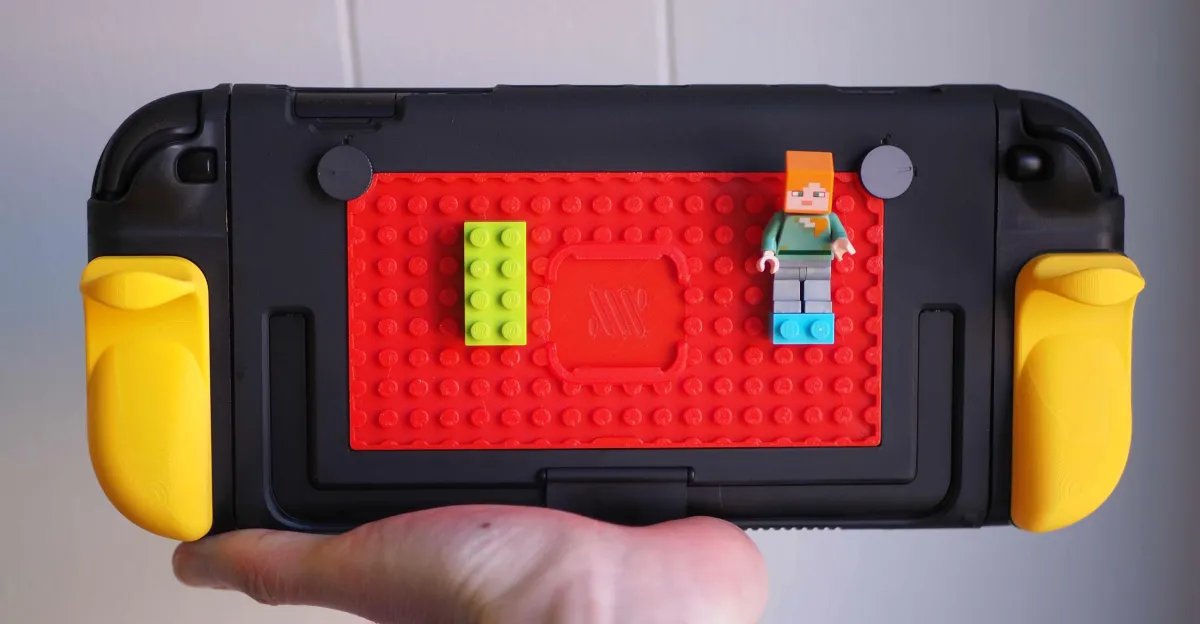
The most distinctive feature of the Basecase is its commitment to modularity via 3D printing. The rear plate of the shell is designed to be user-removable, allowing owners to swap the factory back panel for custom, 3D-printed alternatives. This shift toward community-driven hardware design is facilitated by Mechanism’s decision to publish their design files on platforms like Makerworld and Printables.
The utility possibilities are significant. Because the rear plate is essentially a blank canvas, users can print custom attachments that suit specific needs, such as dedicated housings for game cartridges or even surfaces that accommodate structural components like Lego pegs. This flexibility extends to the Joy-Con grips, which are also swappable. By providing two distinct sizes, Mechanism accommodates various hand shapes, reducing ergonomic strain during longer gaming sessions. Advanced users can even experiment with bespoke grip shapes—such as those featuring finger rests—to refine their personal comfort levels.
Docking and Hardware Compatibility
The physical dimensions required for a protective, modular shell necessarily prohibit the use of the original Nintendo dock. To bridge this gap, Mechanism provides a dedicated dock adapter. Instead of relying on a cradle-style dock, the system utilizes a specialized female-to-male USB-C extension cable. This allows the user to route the video signal from the console to the dock while the Basecase remains firmly attached.
While the installation of this adapter requires a deliberate effort to maneuver the cable into the dock’s video-out port, it serves as a reliable workaround for users who do not want to remove the protective shell every time they transition to a television. Notably, for users who already utilize third-party USB-C docking stations—such as those produced by Jsaux or Genki—this adapter may be unnecessary, as the form factor of those docks often provides more room for shells compared to the proprietary Nintendo dock.
A Sustainable Path for Accessory Design
The trajectory of the Basecase suggests a shift in how accessory makers view their relationship with the gaming community. Rather than producing a static product that becomes obsolete the moment a newer version is released, Mechanism has created a platform that encourages iterative improvement. By sharing the CAD data for their components, they allow the user base to solve specific ergonomic or storage challenges through additive manufacturing.
For those already invested in the Mechanism ecosystem of mounts, the Basecase is a logical addition. For newcomers, it offers a robust, high-quality alternative to mass-produced plastic cases that frequently compromise the aesthetics and functionality of the console. By focusing on mechanical reliability—specifically regarding the grip attachments and the snugness of the shell—the Basecase sets a high bar for future console accessories. As 3D printing continues to become more accessible, the ability to modify the physical characteristics of a handheld console case will likely become an expectation rather than a niche luxury, positioning the Basecase as a frontrunner in a new era of modular gaming hardware.
Disclaimer: This content is auto-generated for informational purposes only.
Source: Read Original News