






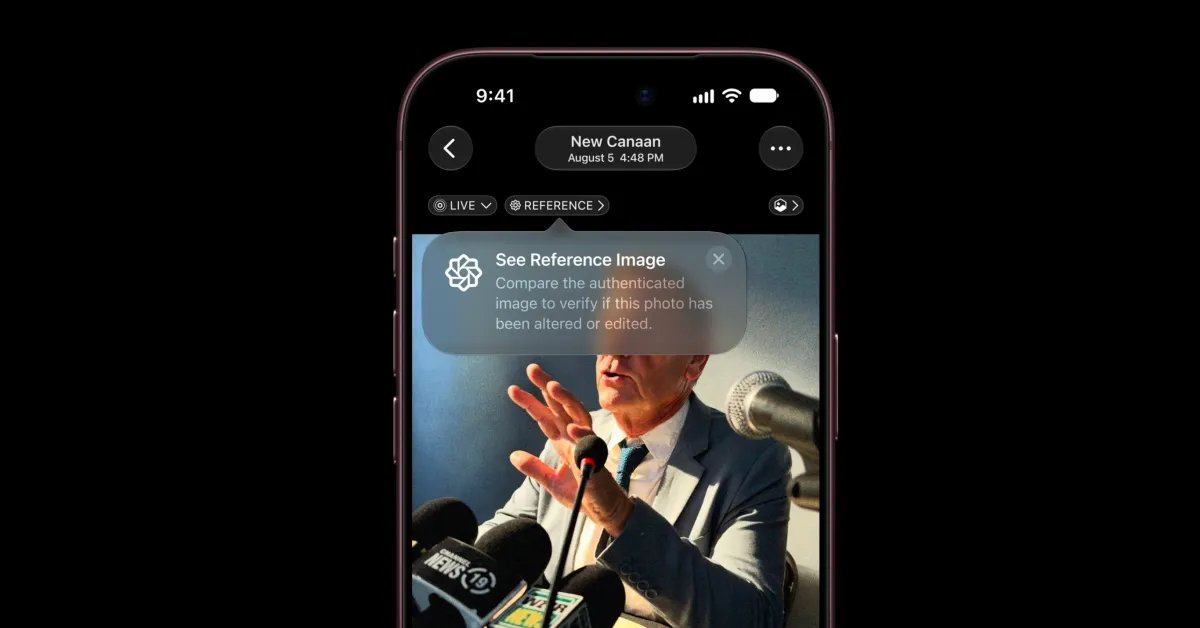
In an era where synthetic media and generative artificial intelligence make it increasingly difficult to distinguish reality from fabrication, Apple has introduced a sophisticated solution. The iPhone 18 Pro debuts the Reference Image camera mode, a feature designed to provide verifiable proof that a photograph was captured by genuine hardware rather than generated by software. Detailed in a recent technical white paper, this development represents a significant shift in digital media integrity.
The Motivation for Verified Photography
Apple developed the Reference Image mode in direct response to the diminishing barrier of entry for creating and manipulating images. While industry-wide standards like the Coalition for Content Provenance and Authenticity (C2PA) offer a framework for tracking media history, Apple identified vulnerabilities in those systems. Specifically, existing standards can often be compromised at various points throughout the editing and distribution chain, allowing bad actors to strip metadata or falsify provenance information.
To address these vulnerabilities, Apple created a chain-of-verification system rooted in hardware. By controlling the entire pipeline from sensor initialization to the delivery of the final image, the company aims to ensure that “Reference Images” remain tamper-proof. This process is reinforced by quantum-secure defenses, ensuring the integrity of the image remains intact even in the face of future, more powerful computing threats.
Hardware-Rooted Trust and the Secure Enclave
The process begins long before a user taps the shutter button. When an iPhone 18 Pro is manufactured, each camera sensor initializes a unique signing key pair. The private key is stored securely within the sensor hardware, while the corresponding public verification key is registered in the device’s hardware manifest. This creates an immutable link between the physical lens sensor and the device’s unique identity.
When a user engages the Reference Image mode, the camera sensor signs the raw pixel data and sensor-specific metadata immediately upon capture. This happens before the data is handed off to the iOS operating system for general processing. By binding the content to the sensor at the point of origin, Apple ensures that the provenance of the file is established at the hardware level, making it nearly impossible for malicious third-party software to inject or alter the initial data stream.
The Secure Enclave serves as the internal gatekeeper, managing the metadata that originates outside the primary camera sensor. By correlating the sensor’s signature with the Secure Enclave’s authentication, the system verifies that the image was indeed captured by a verified, uncompromised iPhone unit.
Establishing Secure Temporal Bounds
A critical challenge in verifying any image is determining exactly when it was taken. Operating system clocks are susceptible to tampering, meaning a standard metadata timestamp cannot always be trusted. Apple resolves this by utilizing cryptographic timestamps.
Instead of relying on a local system clock, the iPhone 18 Pro receives secure timestamp tokens from Apple’s servers. The device fetches a token to serve as the start of a “capture window” and another once the photo is taken to set the end of that window. This creates a verifiable temporal boundary that proves the image was created within a specific timeframe. These tokens are processed and verified within Apple’s Private Cloud Compute infrastructure, ensuring the authenticity of the timing information without compromising user privacy.
Privacy Preservation in Sensitive Environments
A common criticism of provenance systems is that they may inadvertently expose sensitive data about the photographer or their location. Apple has designed the Reference Image framework to function without revealing the identity of the person behind the lens or the specific serial number of the device used.
The system is built to provide verification while maintaining anonymity. This is particularly relevant for journalists, activists, and photographers operating in high-risk zones. In such environments, the ability to prove that an image is an authentic representation of reality is vital, but so is the ability to protect the source of that image. By separating the cryptographic proof of authenticity from the personal identity of the user, Apple allows for the verification of content without sacrificing personal safety.
Verification and Revocation
The system remains dynamic through a robust revocation model. If a camera sensor is found to be malfunctioning or if a device is identified as compromised, the associated key can be revoked. Once revoked, the Private Cloud Compute infrastructure will cease signing any Reference Images produced by that specific sensor.
Because Apple devices regularly fetch updated revocation lists, the integrity of the ecosystem remains high even as individual devices or sensors encounter issues. When a user shares a Reference Image, observers can check it against the current ledger of verified, non-revoked hardware. This creates a high-assurance system that balances the need for security, privacy, and technical accuracy. By integrating these methods into the hardware of the iPhone 18 Pro, Apple is establishing a new paradigm for photographic trust in a digital world.
Disclaimer: This content is auto-generated for informational purposes only.
Source: Read Original News