









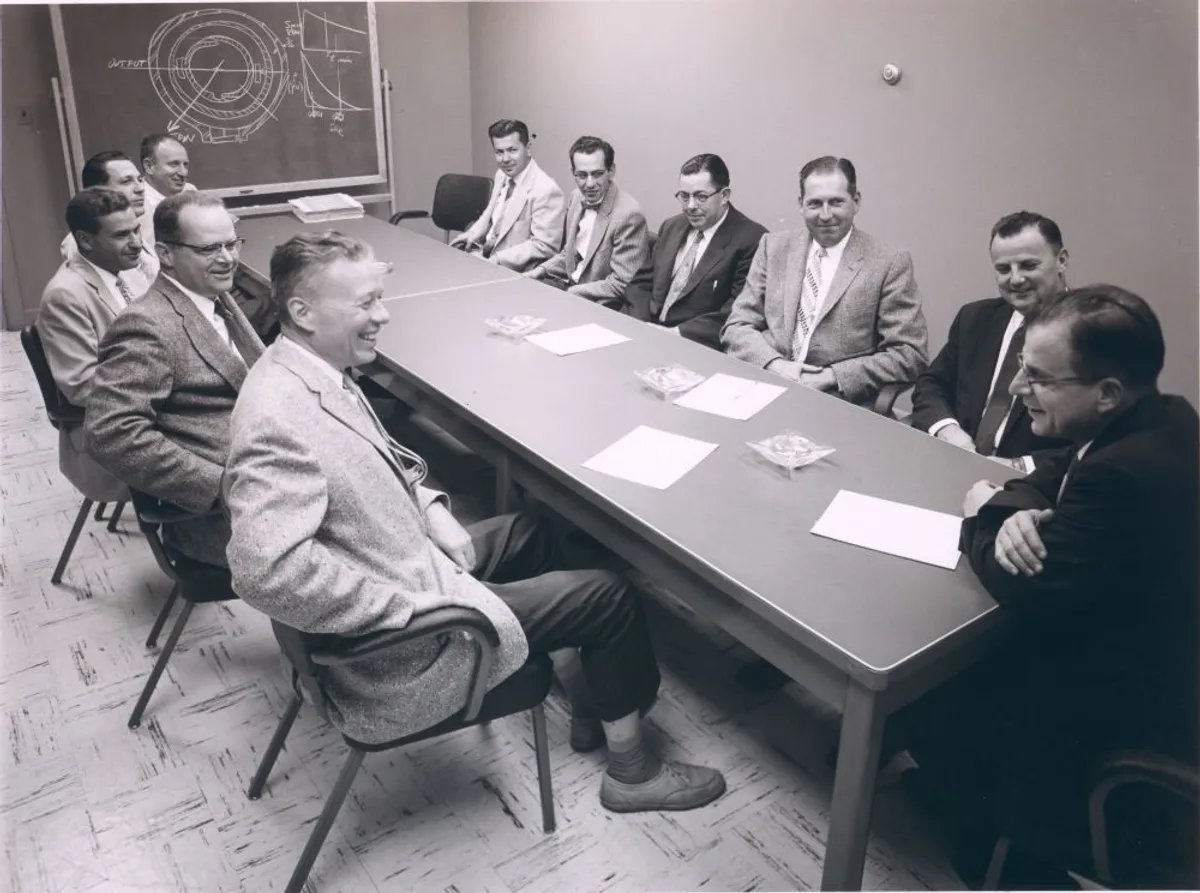
New Hampshire’s industrial landscape is anchored by a titan of aerospace and defense, BAE Systems, a company whose roots reach back to the dawn of modern electronic warfare. While the firm is currently recognized as the state’s largest manufacturer—employing 6,500 people across massive facilities in Nashua, Hudson, Manchester, and Merrimack—its history serves as a fascinating timeline of American technological innovation, bridging the gap between Cold War survival and the modern digital era.
## From Cold War Defense to the Birth of Gaming
The company began as Sanders Associates, founded by engineers who defected from Raytheon with a singular mission: to pioneer dedicated electronic warfare systems. Their early success was built on “Project Tinker Toy,” an initiative that produced 40,000 sonobuoys designed to track underwater threats. As the Cold War intensified, their expertise became indispensable. Notably, when a U-2 spy plane was downed over the Soviet Union in 1960, the company was tapped to engineer electronic countermeasure systems that remain a vital part of the U-2’s operational legacy today.
Perhaps most surprising to the modern consumer is the company’s unexpected contribution to the entertainment sector. Decades of work on space-age electronics and signal processing led to the invention of the first home video game consoles. This legacy has come full circle, according to industry veteran Richard Ashooh. Today, the gaming industry—driven by the need for high-speed graphics and complex physics simulations—has fostered breakthroughs in processors and computer chips that defense companies now leverage to build the next generation of military hardware.
## Innovation at the Microchip Level
BAE Systems’ dominance in the defense sector is largely sustained by its commitment to vertical integration. The company operates the Richard Reed Microelectronics Center in Nashua, a 110,000-square-foot facility accredited by the Department of Defense. By fabricating their own semiconductor chips, the company maintains a critical “discriminator” in the industry, ensuring that their sensors, jammers, and decoys—such as the POET (Primed Oscillator Expendable Transponder)—operate with unrivaled precision.
These innovations are not mere laboratory curiosities; they are proven lifesavers. Three of the company’s signature products, including the AN/ALE-55 Fiber-Optic Towed Decoy, are currently on display at the Smithsonian National Air and Space Museum. These systems were engineered with a philosophy established by the founders: to create technology that explicitly shields service members from hostile fire.
## Economic and Strategic Impact
The company’s corporate journey has been marked by high-profile acquisitions. Lockheed bought the firm in 1986, preserving the “Sanders” name, before selling to BAE Systems in 2000 for $1.67 billion. Throughout these transitions, the original Canal Street facility has remained an active hub of manufacturing.
The importance of this work has not gone unnoticed by New Hampshire leadership. Gov. Kelly Ayotte, who previously served on the company’s board, emphasizes that the firm’s work is essential to national security. With over 2 million square feet of lab and manufacturing space across the state, BAE Systems continues to act as a pillar of the regional economy. As global threats evolve in complexity, the integration of advanced artificial intelligence and high-performance computing into their legacy electronics ensures that the “Sanders” spirit—a blend of rapid, creative problem-solving and rigorous engineering—remains at the forefront of the defense tech industry. Whether through the production of advanced sonobuoys or the development of secure, sovereign microchips, the company continues to play a quiet but pivotal role in maintaining the nation’s technological edge.
Disclaimer: This content is auto-generated for informational purposes only.
Source: Read Original News