






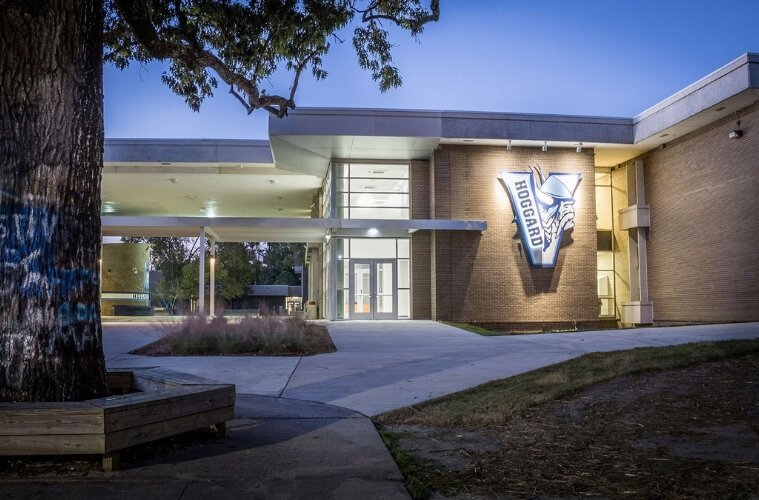
Hoggard High School in Wilmington, North Carolina, will shift to remote learning beginning Monday, September 28, as contractors undertake campus-wide cleaning and rigorous environmental inspections. This transition marks the latest escalation in a persistent mold crisis that has plagued the five-building campus since before the start of the academic year, triggering a wider debate over the balance between energy conservation and structural integrity in aging school facilities.
The situation at Hoggard, which has also seen mold issues at nearby Laney High School and Noble Middle School, serves as a case study in the risks of deferred maintenance. District officials have pointed to a combination of HVAC failures, record-setting summer humidity, and the long-standing practice of raising building temperatures during unoccupied summer months to reduce energy expenditures. While cutting costs is a priority, the current crisis suggests that when buildings are left to “sit” without adequate climate control, they become prime breeding grounds for biological growth.
The scale of the disruption at Hoggard is significant. Opened in 1967 for a population of roughly 1,000, the school now serves over 2,100 students. Despite a $16.4 million renovation and expansion project completed in 2017, the school remains vulnerable to environmental hazards. Officials have noted that the current HVAC system lacks independent humidity controls, complicating efforts to manage the moisture levels necessary to prevent mold. As of mid-September, remediation costs had already reached approximately $470,000, a figure expected to rise as inspectors move through individual classrooms and auxiliary spaces.
The progression of the crisis highlights a reactive, rather than proactive, maintenance culture. Staff identified initial mold issues in the JROTC and arts wings in late August. By September 4, the cafeteria was shuttered due to ceiling discoloration, forcing students to relocate to the gym. Subsequent reports of mold in science classrooms pushed the district to authorize emergency containment, the procurement of nearly $50,000 in dehumidifiers, and a long-term plan for systemic HVAC replacement.
Industry experts and EPA guidance suggest that the solution lies in a more disciplined operational strategy. The EPA recommends maintaining indoor relative humidity levels below 60%—a goal that requires consistent monitoring rather than passive energy-saving setbacks. For school districts, this necessitates a shift: summer HVAC settings should be governed by active humidity sensors and automated equipment alarms rather than static temperature targets.
At the administrative level, the Hoggard incident is sharpening the focus on upcoming fiscal decisions. On November 3, constituents will vote on a $320.5 million school bond. Supporters argue the bond is essential for addressing systemic infrastructure failures across 27 schools, including Hoggard. Conversely, critics contend that emergency remediation and HVAC upgrades are core operational responsibilities that should not require the accumulation of new public debt. The debate pits the necessity of modernizing aging portfolios against the skepticism of taxpayers regarding long-term district budget planning.
As the district pivots to remote learning, stakeholders are demanding greater transparency. The path forward remains contingent on answering specific, measurable questions: What were the specific humidity and temperature readings in each building throughout the summer? Which equipment alerts were triggered and subsequently ignored? Furthermore, what objective, documented criteria will be used to determine when a space is safe for students to return?
For now, the district must move beyond air quality testing—which lacks federal regulatory thresholds—and focus on the nexus of maintenance records, moisture control, and structural verification. The Hoggard experience serves as a stark reminder that in the face of climate-driven humidity, the cost of energy savings today may be significantly outweighed by the compounding price of infrastructure failure tomorrow.
Disclaimer: This content is auto-generated for informational purposes only.
Source: Read Original News