








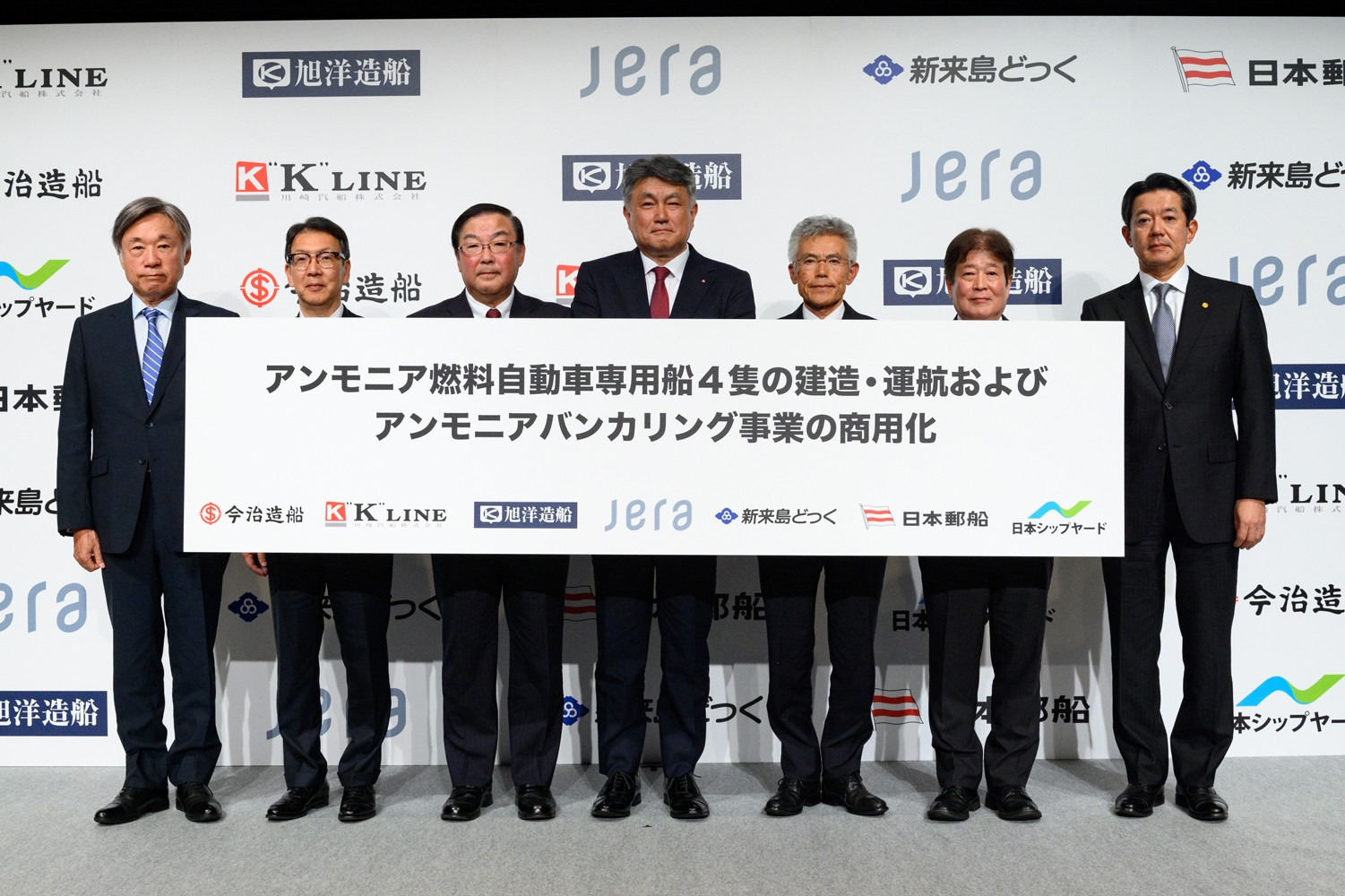
In a significant move to decarbonize the maritime shipping sector, a consortium of seven major Japanese industrial players has announced a comprehensive agreement to establish an integrated ammonia fuel supply chain in Japan’s Chubu region. The initiative marks a strategic shift toward cleaner propulsion for the global automotive logistics industry, with the central objective of deploying four ammonia-fueled car carriers by 2030.
The project represents a cross-sector collaboration involving shipping giants Kawasaki Kisen Kaisha (K Line) and Nippon Yusen Kabushiki Kaisha (NYK), along with leading shipbuilders Imabari Shipbuilding, Kyokuyo Shipyard Corporation, Shin Kurushima Dockyard, and Nihon Shipyard. Energy firm JERA, which oversees fuel procurement and terminal infrastructure, rounds out the partnership.
The scope of the project spans the entire lifecycle of green ammonia, from its initial procurement via renewable energy sources to its eventual combustion in marine engines. JERA has been tasked with sourcing green ammonia, with planned supplies potentially originating from regions such as India. To ensure a reliable delivery mechanism, JERA will also develop specialized ship-loading facilities at the ammonia receiving terminal adjacent to the Hekinan Thermal Power Station. This facility will act as the primary hub for a dedicated ammonia bunkering vessel, which will be constructed by Kyokuyo Shipyard and operated by NYK.
To manage the logistics of ship-to-ship bunkering, K Line and NYK will establish a 50/50 joint venture dedicated to fuel sales and distribution. This infrastructure is vital to support the deployment of four new ammonia-fueled car carriers—two to be introduced by K Line and two by NYK—all scheduled for completion by 2030. These vessels are intended to support the global supply chain, specifically transporting finished vehicles for major automotive manufacturers, including Toyota Motor Corporation.
The engineering requirements for these vessels are substantial. The carriers will be equipped with advanced dual-fuel engines capable of sustained operation on ammonia. To ensure global reach, the vessels will feature high-capacity fuel tanks designed to complete trans-Pacific voyages using only ammonia as a fuel source. Recognizing the toxicity challenges associated with ammonia, the design consortium—led by Shin Kurushima Dockyard, with support from Imabari Shipbuilding and Nihon Shipyard—has integrated a multilayered safety architecture. This includes robust leak prevention and detection systems, as well as onboard neutralizers to mitigate risk in the event of an accidental release.
The push toward ammonia as a marine fuel is gaining momentum as the international shipping industry faces tightening regulations regarding greenhouse gas emissions. Because ammonia does not emit carbon dioxide when burned, it is widely viewed as a viable “zero-emission” alternative to heavy fuel oil. However, the success of such a transition relies heavily on the “green” status of the ammonia; the consortium’s commitment to sourcing fuel produced via renewable energy is essential to ensuring the climate benefits of the project are realized.
By linking port infrastructure with specialized vessel technology and long-haul shipping operations, the Chubu-based initiative serves as a blueprint for the future of maritime logistics. As the 2030 deadline approaches, the project will be closely watched by international maritime regulators and industry stakeholders as a litmus test for the scalability of ammonia-based maritime transport. For Japan, the initiative reinforces its position as a frontrunner in the development of hydrogen and ammonia-based energy economies, setting a precedent for how heavy industries can align to bridge the gap between decarbonization targets and operational reality.
Disclaimer: This content is auto-generated for informational purposes only.
Source: Read Original News