




GRAND HAVEN — City officials have unveiled a long-awaited environmental roadmap for the cleanup of Harbor Island, recommending a $59.2 million strategy to address decades of industrial pollution. The plan, detailed in a 100-plus-page Remedial Alternatives Analysis published Tuesday, focuses on containing toxic coal ash and chemical contaminants on-site rather than pursuing full excavation.
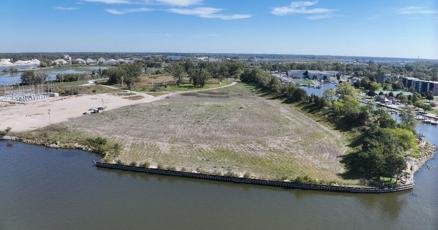
The island, which served for decades as the home of the J.B. Sims Generating Station, has been the subject of extensive study since the coal-fired power plant ceased operations in February 2020. Following the demolition of the facility’s powerhouse and primary smokestack in 2022, the City of Grand Haven has been tasked with mitigating environmental hazards including coal combustion residuals—which can leach heavy metals like lithium into the groundwater—and the presence of per- and polyfluoroalkyl substances (PFAS).
The city’s preferred path, identified as “Alternative 5,” involves excavating coal ash and contaminated soil from the outer regions of the island and consolidating the material into a concentrated, 27-acre central containment zone. This zone would be secured by a subsurface barrier wall and a protective cap, supported by an ongoing system of groundwater extraction and treatment.
At an estimated cost of $59,187,300, Alternative 5 is the most fiscally conservative of the five proposals evaluated by engineering consultants at HDR. By comparison, the most comprehensive option—a full excavation and off-site disposal at a certified landfill—was estimated at $86.2 million.
Derek Gajdos, the City of Grand Haven’s project management director, emphasized that the decision to contain the waste rather than move it was driven by both economic practicality and risk mitigation.
“The liabilities and cost significantly outweigh the benefits,” Gajdos noted in a response to public inquiries. “Safely removing the contamination and transporting it to a certified landfill presents significant risks to the environment, specifically the waterways and our community’s drinking water source.”
Furthermore, Gajdos highlighted the long-term legal and financial exposure the city would face if it were to remain the primary party responsible for waste transferred to third-party landfills.
The study presented to the public provides a stark look at the trade-offs between the five proposed options:
- Alternative 1 (Off-Site Excavation): Full removal at $86.2 million, offering maximum future land-use flexibility but posing the greatest risk during transport and excavation near the Grand River.
- Alternative 2 (In-Situ Stabilization): A $84.4 million plan to treat soil with cement and carbon, though experts caution that the long-term effectiveness against PFAS is uncertain.
- Alternative 3 (Full Containment): A $74.9 million enclosure of the entire contaminated footprint, which would result in significant loss of usable wetland acreage.
- Alternative 4 (Hybrid Containment): A $69.7 million middle-ground approach using targeted removal and a smaller containment footprint.
- Alternative 5 (Reduced-Footprint Hybrid): The recommended $59.2 million plan, which minimizes wetland disturbance and preserves the maximum amount of surrounding acreage for potential public recreational use.
Under the recommended plan, the 27-acre containment mound would be restricted to non-residential use, such as solar panels, turf, or shallow-rooted landscaping. The surrounding areas, however, could be reclaimed for parks, wildlife habitats, or passive recreation, aligning with long-term city goals for the waterfront.
The city has scheduled a public town hall to present the findings at 1 p.m. on Dec. 1 at Central Park Place. Following the public comment period, several municipal bodies—including the Parks and Recreation Commission and the Board of Light and Power—are set to review the proposal throughout December. A final vote by the Grand Haven City Council is anticipated on Jan. 4, 2027.
If the council approves the resolution, formal engineering plans will be submitted to the Michigan Department of Environment, Great Lakes, and Energy and the U.S. Environmental Protection Agency by April 2027. Pending regulatory approval, construction is slated to begin between 2028 and 2030, depending on the availability of funding and the timeline for environmental permitting.
Disclaimer: This content is auto-generated for informational purposes only.
Source: Read Original News