







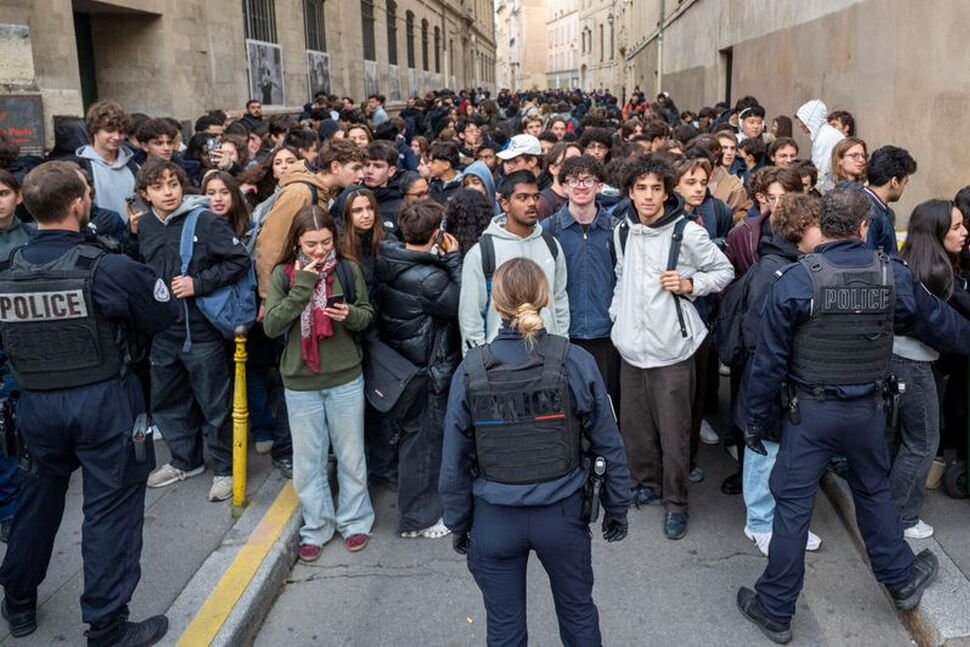
PARIS — French high school student protests resumed on Monday as pupils returned from a two-week autumn break, though the movement appeared significantly diminished compared to the widespread unrest that gripped the nation throughout September.
As of 0830 GMT, the Ministry of Education reported that approximately 41 high schools—roughly 1% of the country’s total—had been subjected to blockades. This marks a sharp decline from the weeks preceding the holiday, when hundreds of the nation’s 3,000 schools were effectively shuttered by student demonstrations.
The protests, which first ignited in the suburbs of Paris in September, quickly expanded beyond education-specific grievances to encompass broader societal concerns, including the soaring cost of living. At their height, the demonstrations drew support from trade unionists and activists, occasionally descending into violent clashes with police, looting, and rioting. These events have presented a significant domestic challenge for the minority government of President Emmanuel Macron.
Education Minister Edouard Geffray dismissed the latest developments as negligible during an interview with France Inter radio on Monday. “In terms of blockades—or rather, attempted blockades—the phenomenon is very marginal,” Geffray stated. “We’re talking about just a handful of units, a few individual schools.” While emphasizing that students have a right to protest, the Minister reiterated that preventing access to educational institutions is illegal. Authorities maintained a visible police presence at affected sites in Paris, Marseille, and Rennes, though officers were seen monitoring the situation without deploying full anti-riot gear.
The students’ core demands remain focused on systemic reform: the renovation of aging school infrastructure, the hiring of additional teachers, an increase in university placements, and the abolition of an admissions system they view as socially inequitable.
In an attempt to quell the unrest, Minister Geffray announced a package of concessions last week, including a cap on class sizes at 28 pupils, a €4 billion investment in school renovations, and the creation of 15,000 new higher education spots. He also proposed a overhaul of the admissions system to be implemented by 2028. However, student representatives have rejected these measures as insufficient, vowing to maintain their pressure on the government.
The unrest in France is part of a broader “Gen Z” wave sweeping across Europe. Similar movements driven by concerns over inflation, corruption, and the declining state of public infrastructure have broken out in Germany, Italy, Belgium, and Albania. As the academic year continues, the French government now faces a delicate balancing act: addressing the structural complaints of a disillusioned generation while containing the potential for further violent escalation.
For now, officials are banking on the movement losing its momentum, even as student leaders maintain that their grievances remain unaddressed and their resolve is unbroken.
Disclaimer: This content is auto-generated for informational purposes only.
Source: Read Original News