









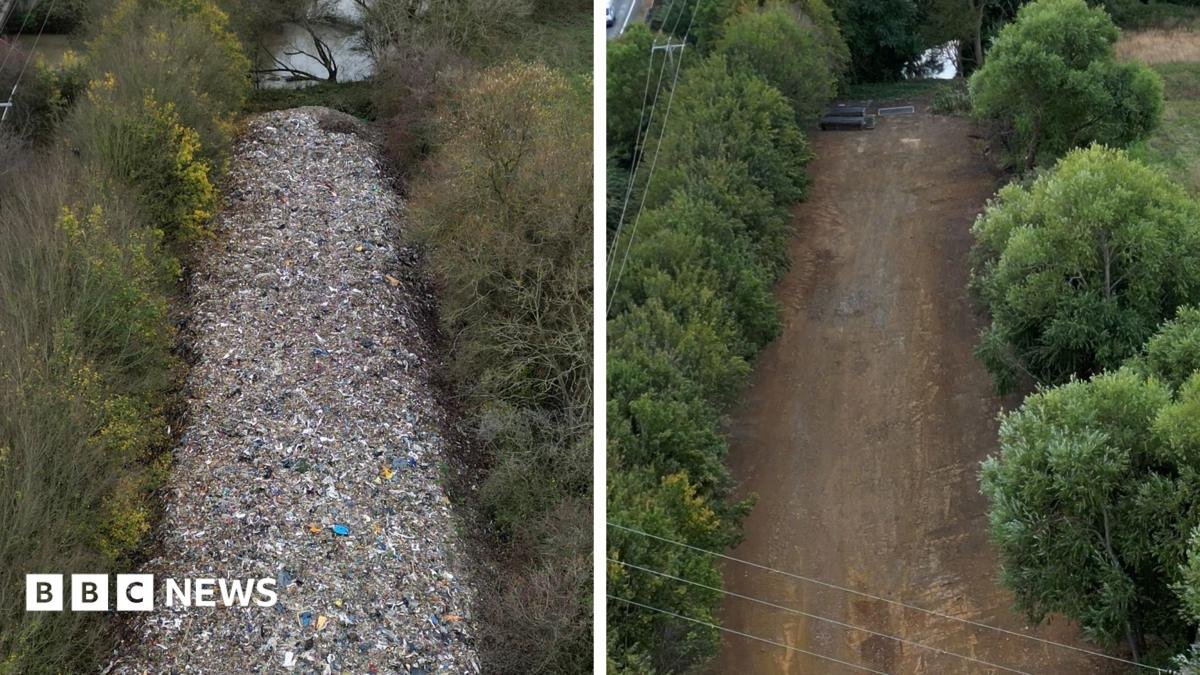
Government Launches Major Crackdown on Illegal Waste Sites Amid Growing Environmental Crisis
The UK government has declared war on the country’s burgeoning waste crime epidemic, launching a new strategic action plan aimed at dismantling the criminal networks responsible for the illegal dumping of refuse. With official estimates suggesting that a staggering 20% of waste in England is currently managed outside the law, the administration of Prime Minister Keir Starmer has signaled a shift toward more aggressive state intervention.
Under the newly unveiled Waste Crime Action Plan, the Environment Agency has been granted the authority to intervene on an “exceptional basis” to clear industrial-scale illegal waste sites. These interventions are reserved for locations where the accumulation of waste poses an “untenable risk” to public safety and the local environment.
A Nationwide Clean-Up Effort
In an escalation of these efforts, Prime Minister Andy Burnham recently announced a nationwide crackdown, specifically targeting some of the most egregious examples of illegal dumping. Six “supersites” have been earmarked for remediation using public funds, pending final environmental assessments. These locations include:
- Power Station Road – Isle of Sheppey, Kent
- Aymer Close – Runnymede, Surrey
- Midland Road – Bradford, West Yorkshire
- Alan Ramsbottom Way – Hyndburn, Lancashire
- Worthing Road – Sheffield, South Yorkshire
- Bolton House Road – Bickershaw, Greater Manchester
Environment Secretary Dame Angela Eagle emphasized that the government is moving away from the complacency of previous years. “After years of waste crime being allowed to fester, we are taking decisive action,” Eagle stated. “By putting more officers on the frontline and using drones to catch offenders in the act, we’re putting the criminal gangs on notice that there is nowhere left to hide.”
The Burden on Landowners
Historically, the financial responsibility for clearing illegal waste has fallen squarely on private landowners, often leaving them bankrupt or facing significant environmental damage through no fault of their own.
Critics argue that the current system lacks a sufficient deterrent. Charlie Coats, chairman of Highnam Parish Council, pointed to an ongoing issue in Over, Gloucestershire, where a major illegal site remains untouched. He noted that the financial penalties currently imposed on offenders are “derisory.”
“It acts as absolutely no deterrent whatsoever because the income that they can derive from this dwarfs anything by way of any fine,” Coats told the BBC.
This sentiment is shared by the Country Land and Business Association (CLA). Gavin Lane, president of the organization, which represents 28,000 rural businesses and farmers, urged the government to adopt a more punitive approach. “The punishment has to be real: seize their vehicles, recover the money they owe and make waste crime a losing business,” Lane demanded.
The Challenge of Recovery
While the Environment Agency maintains that it is actively pursuing assets, the process of recovering funds from convicted criminals remains complex. Agency officials explained that many outstanding confiscation orders are still within the standard six-month payment window. They further noted that the agency continues to investigate, with the potential to seize additional assets should more information about offenders come to light.
Law enforcement efforts are already underway in other areas. In Kidlington, four men have been arrested in connection with a large-scale illegal tip; while all have been released, the investigation remains ongoing.
As the government moves forward with its plan, the challenge will be whether the scale of the state’s intervention can keep pace with the sheer volume of illicit dumping. For now, thousands of smaller sites remain, leaving the question of who will pay for their cleanup—and whether justice will truly be served—unanswered.