







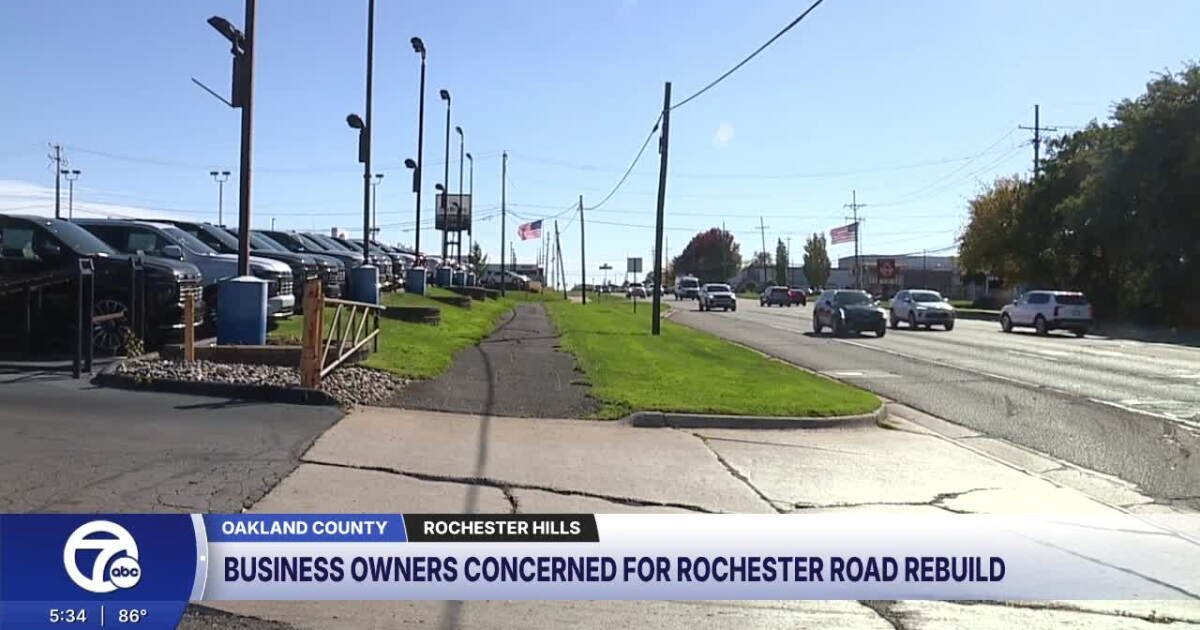
ROCHESTER, Mich. — A looming multi-year infrastructure overhaul on Rochester Road has sparked a wave of anxiety among local business owners, who fear that the construction timeline will create an insurmountable barrier for their customers and daily operations. With the Michigan Department of Transportation (MDOT) set to begin work in 2027, the local business community is bracing for what many describe as a potential financial catastrophe.
The project, which is divided into two phases spanning 2027 and 2028, promises long-term improvements to the corridor’s infrastructure. However, for those operating storefronts along the stretch from M-59 to the Clinton River Bridge, the benefits seem distant compared to the immediate threat to their livelihoods.
## Businesses Face Operational Gridlock
John Fox, president of Fox Automotive, oversees a significant retail presence on Rochester Road, including Chevrolet, Toyota, and Volkswagen dealerships. For Fox, the construction represents more than just a minor inconvenience; it threatens the flow of the 220 repair orders his facilities handle daily.
The logistical nightmare is compounded by the proposed lane closures. According to the current MDOT schedule, work will restrict traffic to a single northbound lane from March through July, switching to a single southbound lane from July through November. Fox expressed extreme frustration with the agency’s communication, noting that MDOT plans to block dealership driveways without providing adequate signage to redirect customers to rear entrances.
“They’re like, ‘We own the land. We’re gonna do whatever we want with it.’ It’s that kind of attitude and that brazenness that’s going to be devastating,” Fox said. To combat the expected dip in traffic, he estimates he will need to hire 40 additional staff members solely for vehicle pickup and delivery services, a massive overhead cost for any business.
## The Struggle for Accessible Commerce
Across the street, Superior Lock and Key faces an even more precarious situation. Unlike the auto dealerships, the business lacks a secondary entrance. Benjamin Lula, who runs the shop with his family, noted that their dependency on the main road makes them uniquely vulnerable to traffic patterns.
Lula voiced concerns that the project would fundamentally change the nature of their service, forcing customers to prioritize “need over want” when considering a visit. Furthermore, the mobility required for their locksmithing services will be hampered by the construction, creating uncertainty regarding how many daily service calls their team can reasonably accommodate.
## Navigating the Intersection of Infrastructure and AI
While this project is focused on physical concrete and asphalt, the tension between infrastructure agencies and local commerce highlights a broader theme of how we manage urban spaces in the modern era. In an age where digital navigation is dominated by Google Maps and Waze, construction projects like this rely heavily on the accuracy of real-time data.
For local businesses, the “tech-enabled” reality of modern driving—where drivers rely on AI-powered routing to avoid traffic—could be both a blessing and a curse. If the construction zones are not properly mapped or if the lack of signage prevents navigation apps from guiding customers to alternative entrances, these small businesses may effectively “disappear” from the digital landscape.
Effective communication between MDOT and digital mapping providers will be crucial. If the state fails to coordinate with tech companies to update traffic parameters in real-time, it could exacerbate the economic fallout. Despite repeated requests for comment, MDOT has remained relatively silent on specific mitigation strategies, leaving business owners like Fox and the Lulas to wonder if their concerns will be integrated into the final execution of this massive public works project. For now, the sentiment remains one of apprehension as 2027 approaches.
Disclaimer: This content is auto-generated for informational purposes only.
Source: Read Original News