








For immediate release
National Retail Inflation Ticks Up to 4.45% in July, Exceeding RBI’s 4% Target for Second Consecutive Month
NEW DELHI – August 15, 2026 – India’s retail inflation, as measured by the Consumer Price Index (CPI), registered a provisional year-on-year rate of 4.45% in July 2026, slightly above the 4.38% recorded in June. This marks the second consecutive month that inflation has surpassed the Reserve Bank of India’s (RBI) target of 4%, although it remains within the central bank’s broader tolerance band of 2-6%.
A closer look at the data, with 2024 as the base year for the All India CPI, reveals a distinct disparity between rural and urban areas. Rural India experienced a higher inflation rate of 4.84% in July, contrasting with a lower 3.96% in urban regions. This divergence underscores the varying economic pressures faced by different demographics.
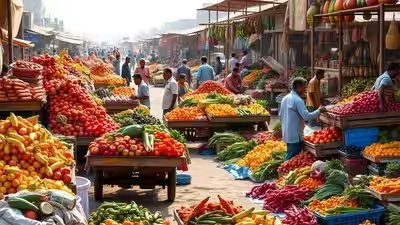
Food inflation, a significant component of the overall CPI, also saw an uptick. The provisional All India Consumer Food Price Index (CFPI) indicated a year-on-year food inflation rate of 5.52% in July 2026. Similar to the general CPI, rural food inflation was more pronounced at 5.79%, while urban areas recorded a slightly lower 5.05%. This suggests that essential food items are experiencing more significant price increases in rural markets.
Housing inflation, another key indicator, stood at 2.22% year-on-year in July 2026. Here again, rural housing inflation outpaced urban areas, registering 2.80% compared to 2.01% in urban centers.
These figures come on the heels of the Reserve Bank of India’s recent monetary policy committee (MPC) meeting earlier this month. While the RBI opted to keep policy rates unchanged, it revised down its full-year inflation forecast while simultaneously raising its GDP growth projections, signaling a complex economic outlook.
RBI Governor Sanjay Malhotra addressed the inflation trajectory in his policy statement, noting, “The MPC noted that headline CPI inflation edged up above the target, as expected. The realised inflation for Q1, however, remained marginally lower than projections reflecting limited pass-through of cost pressures. The higher inflation is mostly on account of fuel and food with little signs of generalisation of price pressures so far. Core inflation excluding precious metals continues to be benign. As projected earlier, headline inflation is expected to rise further in the near term and peak in Q3:2026-27, primarily due to food and fuel, before moderating thereafter.”
Governor Malhotra also highlighted potential risks to the inflation outlook. “Going forward, El Niño’s impact on temporal and spatial rainfall distribution continues to remain a major risk, although proactive supply management and adequate stock of foodgrains should provide comfort. Global oil prices have remained highly volatile with sharp two-way movements triggered by geopolitical developments, blurring the near-term outlook. Although generalised inflation pressures continue to remain modest so far, the risks of second-round impact of higher food, fuel and other input prices translating to broad-based inflation persist,” he stated.
Looking ahead, the RBI projects CPI inflation for 2026-27 to be 5.0%, with specific quarterly projections of 4.7% for Q2, 5.9% for Q3, and 5.5% for Q4. Inflation for Q1:2027-28 is projected at 5.3%, with risks evenly balanced. Core inflation for 2026-27 is projected at 4.3%. The central bank anticipates that core inflation excluding precious metals will initially be lower, but is likely to align with overall core inflation from Q4 onwards.
The consistent rise in retail inflation, particularly in essential categories like food and in rural areas, presents a continued challenge for policymakers as they navigate the delicate balance between supporting economic growth and maintaining price stability.