







The recent “mega-deal” between the United States and Venezuela, designed to bolster oil production, has ignited intense debates regarding economic recovery and political legitimacy. However, beneath the discourse surrounding sanctions and infrastructure lies a quieter, more hazardous reality: the potential for long-term ecological devastation. As global climate targets slip further out of reach, critics warn that expanding oil extraction in the Orinoco Belt may represent a “carbon bomb” that prioritizes short-term fiscal gain over the environmental health of the nation and the planet.
The scale of the expansion is significant. Energy experts, including Paasha Mahdavi of the University of California, Santa Barbara, have cautioned that new developments by companies like Chevron could result in an additional 52 million tons of carbon dioxide equivalent per year. This expansion coincides with the United Nations’ “Limiting Overshoot” report, which concludes that the 1.5°C threshold established by the Paris Climate Accords has already been breached, mandating an immediate shift away from fossil fuels rather than an intensification of production.
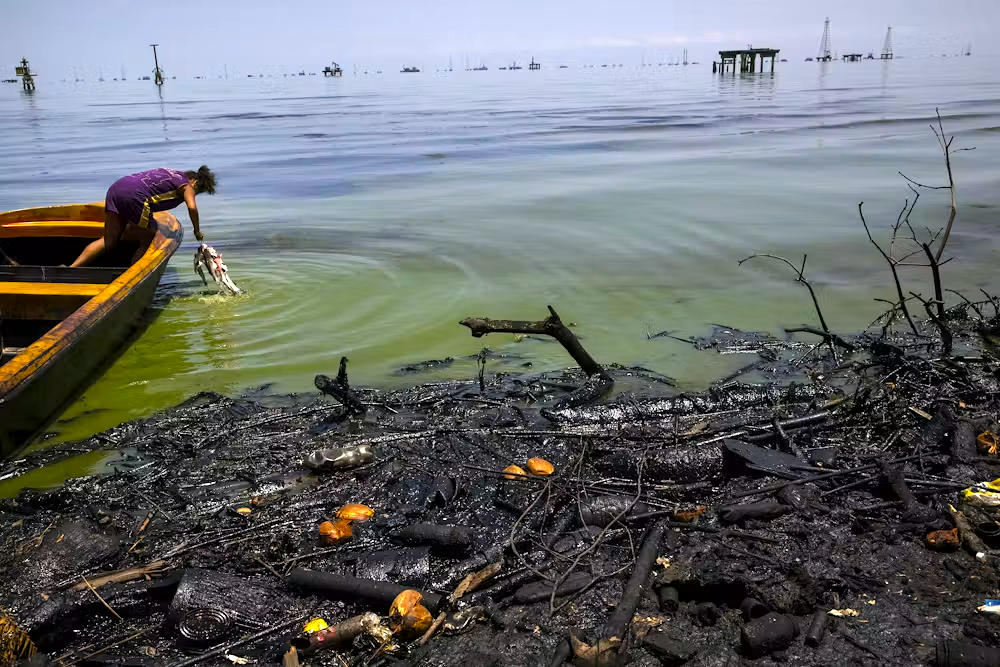
For Venezuelan environmental organizations, the threat is not merely a global climate issue; it is a local crisis. NGOs such as Clima 21 and Provea have issued a joint statement demanding that economic recovery not come at the expense of environmental human rights. They argue that the constitutional right to a safe and sustainable environment must supersede industrial interests. Their concerns are grounded in the documented deterioration of Venezuela’s oil infrastructure. In Lake Maracaibo, for instance, local groups like Azul Ambientalistas have reported a marked increase in oil spills and gas leaks following the reactivation of industrial activity earlier this year.
The lack of transparency remains a major hurdle. Despite the constitutional requirement under Article 129 to perform rigorous environmental and socio-cultural impact studies, there is little evidence that such oversight is being prioritized. Alejandro Alvarez, director of Clima 21, notes that the nation suffers from a systemic, chronic environmental crisis marked by the abandonment of safety protocols. “Our concern is the absence of guarantees in those agreements that these problems will be attended to and solved,” Alvarez stated.
The environmental silence is compounded by a profound institutional failure. Experts point out that Venezuela currently lacks a functional National Policy or Strategy for the adaptation and mitigation of climate change. Unlike many of its neighbors, the country operates without a climate-specific national budget or a transparent inventory of greenhouse gas emissions. Past efforts to diversify into renewables—such as wind farms in Paraguaná and solar projects in the Amazonas state—have largely been abandoned, leaving the nation dangerously reliant on a singular, aging hydroelectric and fossil-fuel-based power grid.
This institutional vacuum leaves the country particularly vulnerable to the accelerating impacts of climate change. The second academic report on climate change (DRACC), presented by the Venezuelan Academy of Physics, Mathematics and Natural Sciences, confirmed that the country’s average temperature rose 0.22°C per decade between 1980 and 2015. These climatic anomalies, exacerbated by global phenomena like El Niño, threaten food security, water supplies, and the integrity of natural ecosystems.
Critics such as sociologist Emiliano Terán-Mantovani argue that the current deal represents a dismantling of environmental sovereignty, suggesting that the drive for oil revenue has rendered the ecosystem invisible in the broader political conflict. As the state continues to focus exclusively on hydrocarbon-led recovery, the opportunity for a transition to sustainable energy models remains largely untapped.
For many observers, the mega-deal represents an unsustainable paradox. While the government and international partners emphasize the immediate need for capital, civil society groups are urging a pivot toward long-term strategic planning. They contend that the path to recovery must include a transition away from fossil-fuel dependence, citing research that indicates potential for growth in non-extractive sectors. Without a commitment to environmental transparency and a genuine strategy for climate adaptation, the cost of this deal may eventually be measured not in barrels of oil, but in the irreversible degradation of the environment upon which all Venezuelans depend.
Disclaimer: This content is auto-generated for informational purposes only.
Source: Read Original News