If there is a musical talent that has truly redefined the Hindi film music scene over the last year or so, it has to be Shashwat Sachdev. Sachdev, 39, has not only scored the globally renowned blockbuster music of the two Dhurandhar films, he has brought in a fresh musical landscape defined not only by his scores for the likes of The Ba**ds of Bollywood, Uri (that won him a National Award), Veere Di Wedding, Phillauri and more, but also through his independent music. Almost everything he touches turns to chartbuster gold, but behind all of it is hard work, perseverance, a new take and a love for music that started at age three.
Among his many laurels, Shashwat has collaborated on a project with Oscar and Grammy winner, the legendary Hans Zimmer, and has won the prestigious ASCAP Award in Los Angeles for Dhurandhar. In a straight-from-the-heart chat, the man being increasingly hailed as a musical genius opened up to t2ONLINE.
I know so much of hard work, time and perseverance has gone into being where you are today, but have the back-to-back successes that have come your way compelled you to step back a little and assess how far you have come?
For a musician chasing a melody, a student chasing knowledge, or a worshipper chasing the divine, the distance between the journey and the destination may be only a single step. I still feel completely inside the journey. I felt that yesterday, I feel it today, and I hope I feel it many years from now. Success is something other people can measure. For me, the work is measured by how honestly I can return to it the next morning. So I do not often step back and assess how far I have come. I step forward and ask what I still do not know. As poetic, or perhaps as absurd as that sounds, I believe it completely.
What was the moment like winning the prestigious ASCAP Screen Awards in Los Angeles for Dhurandhar? Are awards a huge boost to what you do as a creative person?
My maximum gratification comes before the applause, at the precise moment when I know the music is working with the image. A lot of times, it does not. There is not enough time, or the visual is not fully realised, or the music is not fully realised, or their marriage is not complete. If there was a formula, one plus one should become more than two. Too often it remains two, and sometimes it becomes less than two. When it becomes more than two, that is the real award for me. Awards are beautiful, of course, but my parents, friends and family experience them much more purely than I do.
Lokesh bhaiya (Lokesh Dhar, co-producer of the Dhurandhar films) was extremely excited about this one. We were already finishing the second film when the award for the first arrived, which felt like a very accurate picture of my life. There was no full stop because the work had already moved ahead. Still, it was a lovely light in the middle of a very long night.
You went to learn and also made music overseas. What is it about the Indian music scene — both independent and Bollywood — that made you come back here and pursue your passion and profession?
I had been working abroad on production gigs and making fairly generic electronic and pop music. A lot of people wanted me to chase flavours that were already familiar, and I could feel myself moving farther away from what I had actually been educated to hear. By then I had spent 21 years learning Hindustani classical music from my guruji, and I had also trained in Western classical piano. I had grown up listening to the great Indian composers, and my mother filled our home with Lataji (Lata Mangeshkar).
Somewhere, I felt I was abandoning my own inheritance. I did not come back because India looked easier. I came back because the difficulty here was closer to the truth of what I knew. I wanted to discover whether everything I had learnt could become contemporary without becoming generic. So I moved to Mumbai simply to try. I knew nobody.
Then I met (producer) Rhea Kapoor. She heard my music, believed in me and gave me the opportunity to work on Veere Di Wedding (2018). In the meantime, Phillauri (2017) happened and released first. Sometimes, one person’s belief becomes the bridge between years of private preparation and a public life.
Before we get to talking about Dhurandhar, what would you count as the turning point of your career?
I think the turning point was the day the trailer of Phillauri released, and perhaps even before that, the first time I saw Sahiba (from the film) living inside the film in a theatre. For personal reasons, I could not fully enjoy the release of the film, but seeing my music belong to a real film, and then watching people respond to it, changed something in me. I had written Sahiba long before I read the script, and I had met the director (Anshai Lal) only once or twice before the song was complete. What I remember most vividly now is living with those musicians in my studio and making it together. There are moments when a song is still unfinished but the room already knows. I think we knew. Not only that the song or the film was special, but that something in my own life had quietly found its direction.
Which three works of yours do people bring up the most in their conversations with you?
If I set Dhurandhar aside because it is still so fresh, the three that come up most often are Dobara (the lead single from his album Sha), which I released during the lockdown, the songs and score of Uri, and, surprisingly and very satisfyingly, the music I made for my publishing catalogue with Extreme Music. Each one reaches people in a completely different place. Dobara stayed with people through a strange and lonely period. People tell me they train to the music of Uri in their gyms, which makes me very happy. And when somebody writes to me about a piece from the Extreme catalogue, it is particularly satisfying because they have gone looking for the music rather than arriving at it through the machinery of a film.

You achieved a major milestone working on the international project Virdee, with names like Hans Zimmer and James Everingham. What were your biggest takeaways as a musician and a person from this project?
The biggest takeaway was that the higher the level of the work, the quieter the ego becomes. There is much less interest in displaying how much one knows, and far more interest in listening, serving the world of the story, and finding the most truthful sound for it. Working on Virdee with Hans and James reminded me of something I have said before and still believe in — good sound does not need translation; it just needs truth.
As a musician, I learnt that restraint is not the absence of an idea. It is often an idea with confidence. As a person, I learnt to enter every room as a student. When you are around people whose work can make you feel very small, genuine curiosity has the opposite effect — it makes the work feel large and the ego feel unnecessary.
It also reassured me that I do not have to dilute my Indian instincts for them to travel. I have to refine them until they can travel without explanation. Perhaps music is not really made… it is remembered, and different people remember the same emotion in different languages.
Breaking global barriers has always been second nature to you. Based on your experience, what do you think the world music scene expects out of Indian music and Indian musicians?
I do not think the world expects one thing called ‘Indian music’. India itself contains too many civilisations of sound for that phrase to be singular. What the world ultimately expects from an Indian musician is what it expects from any serious artiste — a voice it cannot get elsewhere, and the discipline that makes collaboration possible. We sometimes make one of two mistakes. We either imitate international music so perfectly that we erase ourselves, or we present India as a postcard made of a tabla loop, a sitar phrase and a little decorative spirituality. Neither is the truth. Our rhythm, melody, poetry, classical systems, folk traditions and film music inheritance are not accessories. They are complete philosophies of sound. The world does not need us to become Western. It needs us to become unmistakably ourselves, at a world-class level. The goal is not to sound international. The goal is to be so exact in your own truth that it becomes international.
Going back to the first part of Dhurandhar, what was the brief that you got for the film’s musical journey and what were the biggest challenges and creative highs on working on the two films?
Aditya’s (Dhar, director) brief was radical in its simplicity. He did not want a conventional score sitting underneath the film. He wanted songs to be stitched through it so that the story moved almost like a musical. The music had to carry character, geography, danger, seduction, memory and violence. It had to feel global without feeling borrowed, massive without becoming generic, and rooted without becoming trapped in nostalgia. The greatest challenge was time and scale. The other challenge was to treat the two films as one emotional journey while still allowing each film its own temperature.
The greatest creative high was when qawwali, Punjabi folk, hip-hop, classical ragas, retro memory and modern sound design stopped sounding like separate ingredients and became one world. But my deepest high was still in the theatre, when I could feel the audience breathing with the cut. That is the moment when one plus one becomes more than two.
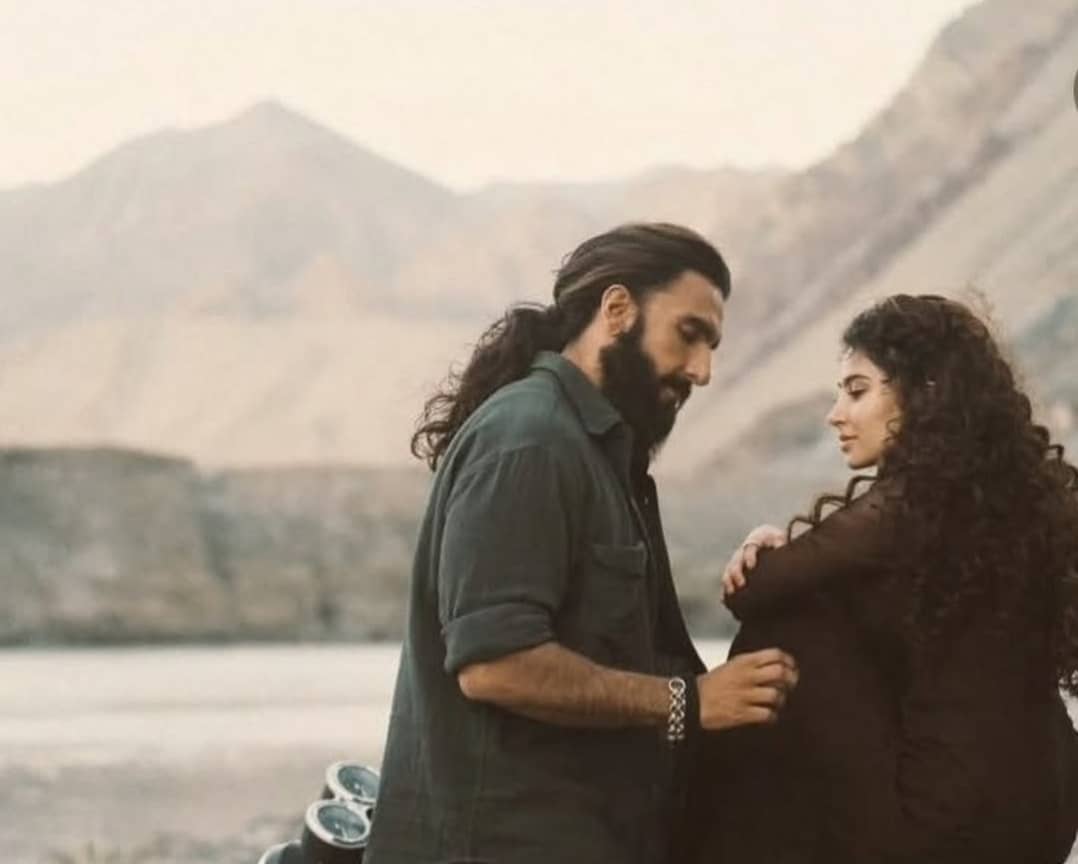 Ranveer Singh and Sara Arjun in Gehra hua from Dhurandhar, scored by Sashwat Sachdev
The use of retro numbers in Dhurandhar has evoked nostalgia and acquainted the new generation with the music of the pre-2000s. Which two retro numbers from the film did you have the most fun working on for the film?
The two I had the most fun with were Ishq jalakar: karvaan and Run Down the City: Monica, but for completely opposite reasons. Ishq jalakar was an act of reverence. The source material already carried such dignity and architecture that the challenge was not to modernise it by making it louder. It was to allow Sahir’s (Ludhianvi) words, the movement between Darbari Kanada and Bhimpalasi, and the contemporary sound to speak to one another without any one of them becoming decoration.
Monica arrived through play. I was creatively blocked, we were sitting in Aditya’s home studio, and a beat began to move. I found myself humming Monica almost unconsciously, and we immediately said: “That is the song.” Four or five hours later, it existed. One song came through reverence and the other through accident, which is probably why I loved making both. Nostalgia only works when memory is not embalmed. It has to be allowed to dance again.
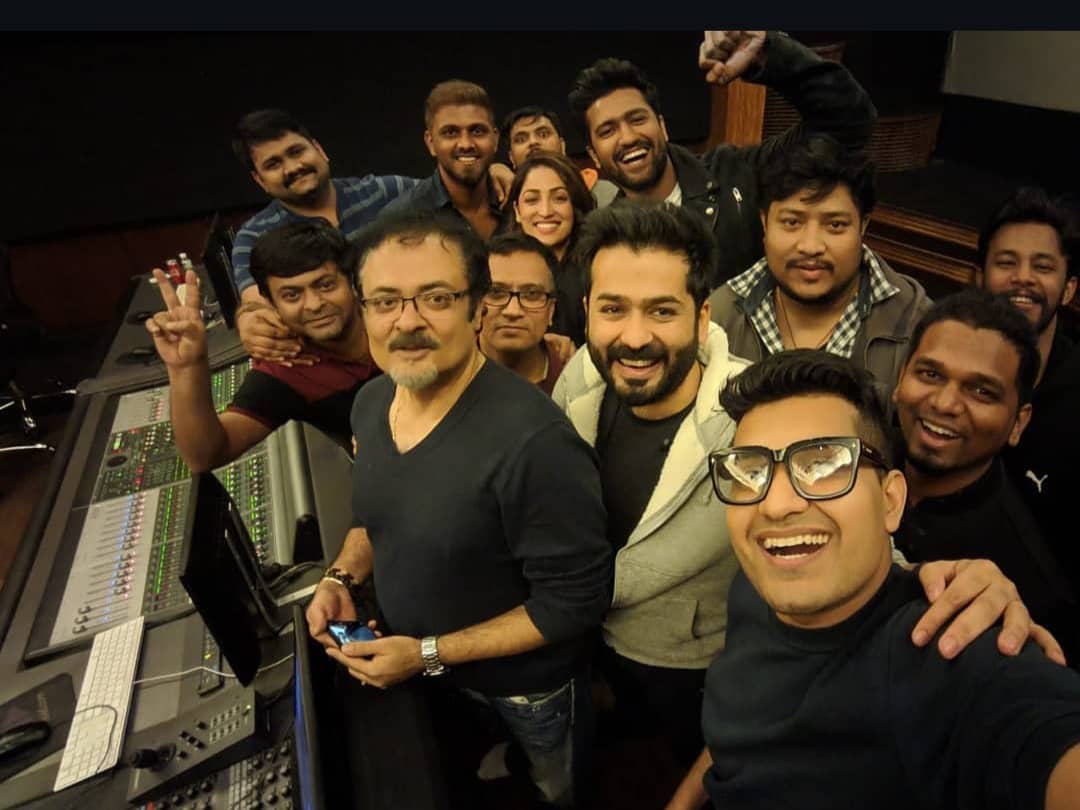 Shashwat with the team of Uri, including actors Vicky Kaushal, Yami Gautam and director Aditya Dhar
Who have your music inspirations been growing up and which global names do you admire now?
I grew up listening almost entirely to Hindustani classical music and older Indian film music. My mother listened to a great deal of Lataji, so melody entered my life before genre did. When I began learning the piano, I entered the Western classical repertoire and its great masters and standards. My ear was formed by long-form music, discipline and melody before I encountered most contemporary music.
I admire musicians who build complete worlds rather than simply decorate a moment. Hans is certainly one of them. I have also long admired Johann Johannsson for the way sound could become psychology in his work. But the honest answer is that my listening habits have not changed as dramatically as my work has. I still return to much of the same music I listened to when I was young. The older I get, the less old it sounds.