





Urgent Calls for Transparency Amid ‘Catastrophic’ Cuttlefish Decline in South Australia
Scientists and divers demand official population estimates as alarming figures emerge following devastating algal bloom.
WHYALLA, SA – An alarming dive survey revealing a mere 44 giant Australian cuttlefish has ignited urgent calls from scientists and divers for the South Australian government to release official population estimates, amid fears of a “catastrophic” decline in the species.
Each year, the waters off the coast of Whyalla, located in the upper Spencer Gulf, become the stage for a globally unique mass breeding event, attracting tens to hundreds of thousands of giant Australian cuttlefish. This particular location is the only place in the world where such a large-scale aggregation occurs.
Historical data from surveys dating back to 1998 illustrate the species’ fluctuating but often robust numbers, ranging from a low of 13,500 individuals in 2013 to an impressive peak of 247,000 in 2020. Even as recently as 2025, more than 63,000 cuttlefish were recorded.
However, expectations for this year’s figures were grim, largely attributed to the devastating impact of a toxic algal bloom that has severely affected the state’s marine environment.
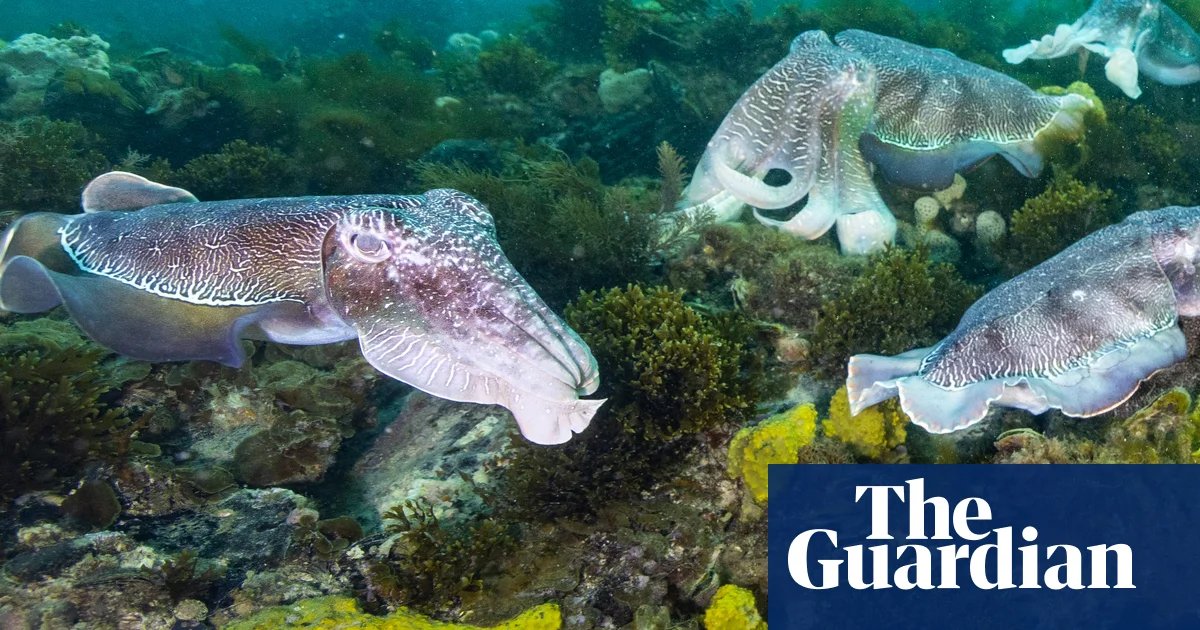
Cuttlefish usually die after breeding, making the population heavily dependent on the success of each breeding season. Photograph: Stefan Andrews
Adding to the alarming count, a team of four divers from the ecological not-for-profit Eyrelab, who conducted their survey in July, reported finding only 440 cuttlefish eggs, a stark contrast to the millions typically observed.
“This is by far the lowest abundance that we’ve had on record,” stated Manny Katz, diver and director of Eyrelab. He further noted that the few dozen cuttlefish encountered were “not out and about – they’re hiding,” indicating a potential behavioral response to stress or danger.
Stefan Andrews, a marine biologist with the Great Southern Reef Foundation, has been vocal in his demand for the state government to release its official figures promptly.
“It’s clear that it’s going to be bad news,” Andrews said. “People need to know just how bad the situation is. Let’s see it, and not sit on it too long because the clock is actually ticking.”
In response to the historically low numbers, tourism and dive operators in Whyalla were forced to cancel their cuttlefish season in June. On July 1, the state government implemented temporary restrictions on recreational activities, including swimming and snorkeling, aiming to minimize disturbance to the breeding cuttlefish and protect their eggs and hatchlings.
During a press conference on June 30, Professor Mike Steer, executive director of the SA Research and Development Institute (SARDI), acknowledged that “less than 50 animals” had been observed earlier in the season. He clarified these were “raw counts,” indicating that further monitoring and analysis were required before a comprehensive population estimate could be provided.
A state government spokesperson confirmed that surveys have now been completed, and the 2026 estimates would be released following a review process.
The spokesperson emphasized that “cuttlefish numbers naturally rise and fall from year to year,” influenced by environmental conditions. They added, “The algal bloom reached the giant Australian cuttlefish breeding site at Point Lowly in upper Spencer Gulf and, while it appears likely the algal bloom has impacted cuttlefish numbers, researchers are working to determine whether this contributed to the reduced population.”
Associate Professor Zoe Doubleday, a leading cuttlefish and octopus expert at Adelaide University, suggested that the Karenia cristata bloom could have directly killed cuttlefish or disrupted their food supply, or even the food supply of their predators.
Cuttlefish live short lives, with adults typically perishing after breeding. This life cycle makes their population highly vulnerable and heavily dependent on the success of each annual breeding season.
The toxic Karenia cristata algal bloom, Australia’s first of its kind, originated in March last year and continues to plague parts of the South Australian coastline. It stands as the largest and most destructive algal bloom in the nation’s recorded history. Recent testing reveals elevated levels of Karenia algae at seven of 32 sites on the Eyre Peninsula and two of 19 sites on the Yorke Peninsula.
Given the “catastrophic decline,” Andrews urged the federal government to consider listing the species as threatened under the Environment Protection and Biodiversity Conservation Act.
While giant cuttlefish are found along the broader Australian coast, Andrews highlighted that the populations in the upper Spencer Gulf are genetically distinct. Beyond their unparalleled aggregation, these cuttlefish exhibit unique behaviors, including female mimicry – where “males pretending to be female, to get up close to the other females so then they can sneak mate with them.” This distinctiveness underscores the critical importance of preserving this particular population.