







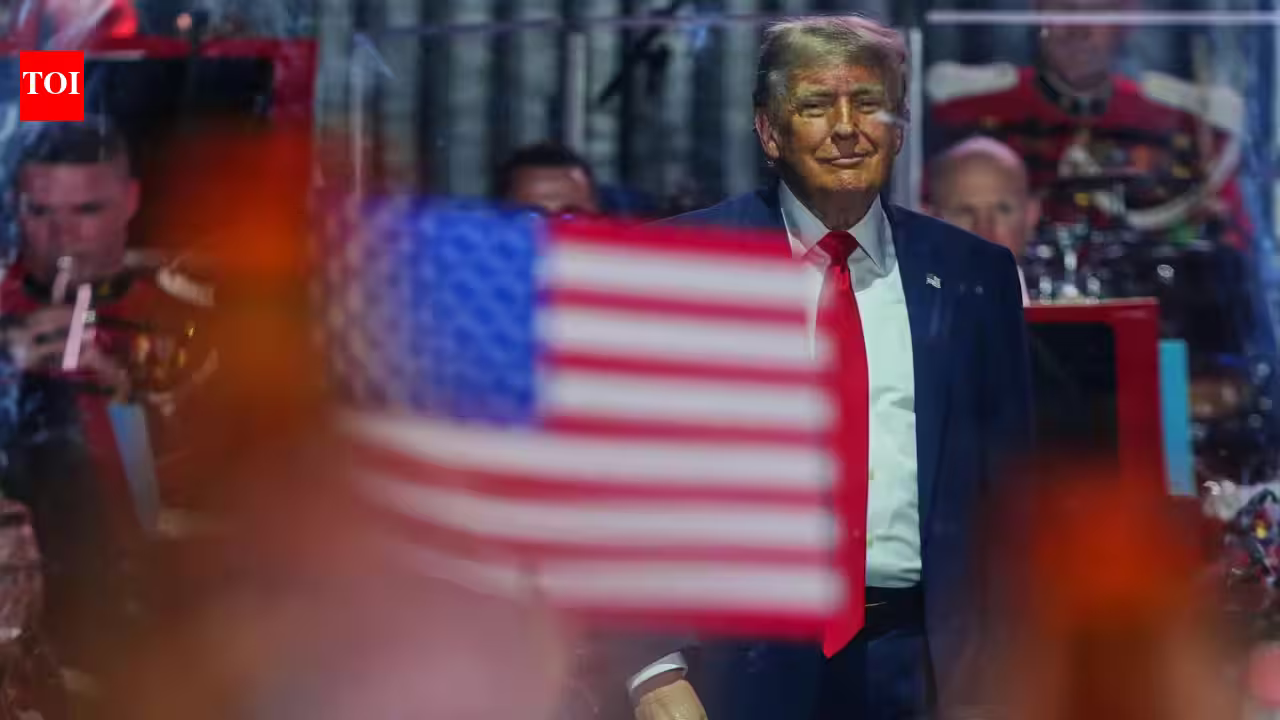
President Donald Trump
TOI Correspondent, Washington:
The United States Senate has overwhelmingly endorsed legislation that would grant President Trump the authority
to levy a 100% tariff on the leading global purchasers of Russian oil and natural gas, including key nations such as
India, China, and Turkey.
This comprehensive bill also targets entities actively assisting Russia in circumventing energy sanctions, along with
Russian financial institutions, government officials, prominent oligarchs, and the country’s “shadow fleet” of oil
tankers.
Approved by a substantial 86-11 vote, the Senate passed the “Lindsey O. Graham Sanctioning Russia and Iran Act of
2026.” This significant legislative measure is named in honor of the late Republican Senator, a renowned hawk and
staunch advocate for Ukraine, who passed away on July 11th. The bill now advances to the House of Representatives
for further consideration; thus, President Trump’s expanded tariff capabilities are not yet fully enacted.
President Trump’s array of tariff mechanisms continues to expand, mirroring a diverse menu from a Washington
restaurant. From reciprocal tariffs and national-security tariffs to sectoral, country-specific, Russia-focused, and
China-targeted tariffs, the latest offering is a “100% punitive tariff, subject to presidential discretion.” This
diversification of tariff policy is a notable development.
However, a crucial distinction emerges. Many of Trump’s previous tariffs were justified as tools to address trade
imbalances, safeguard American industries, or counteract “unfair trade practices.”
In contrast, this new legislation explicitly functions as a secondary sanction. It empowers the U.S. to penalize
nations like India or China not for their exports to America, but for their energy procurement choices, representing
a significantly more assertive and potentially disruptive application of American economic influence.
India, in particular, experiences a peculiar sense of déjà vu, having navigated similar tariff challenges just
months prior. In August 2025, President Trump imposed an additional 25% tariff on Indian goods due to India’s
purchase of Russian oil, elevating combined tariffs on many Indian imports to 50%. This additional 25% tariff was
subsequently rescinded in February 2026 after India agreed to cease Russian oil imports as part of a broader, though
now seemingly dormant, trade agreement. The U.S. then reduced its reciprocal tariff on India to 18%.
The new bill, therefore, prompts an evident question: if India has already been incentivized for shifting away from
Russian oil, why equip the President with another legal instrument to threaten it? The underlying rationale, it
appears, is rooted in a geopolitical landscape characterized by an unpredictable reset button wielded by a volatile
President.
A 100% tariff would not necessarily eradicate all trade. The bill grants President Trump considerable discretion,
including provisions for national-interest waivers and exemptions. Furthermore, allied and partner nations may
qualify for exemptions by demonstrating substantial efforts to reduce their reliance on Russian energy.
India, meanwhile, possesses a uniquely compelling reason to resist such pressures: energy security. Russian oil has
become an indispensable component of its crude supply, with Indian refiners significantly increasing purchases,
especially in the wake of disruptions to Middle Eastern sources. From March to May alone, India settled approximately
$14.6 billion in imports via rupee transactions, a surge largely attributable to Russian oil acquisitions.
The Trump administration’s historical record on tariffs renders this new measure particularly intriguing. Tariffs
have been threatened, announced, postponed, implemented, escalated, de-escalated through negotiation, exempted,
replaced, and, following Supreme Court intervention, even revoked, only for alternative tariffs to re-emerge under
different statutory authorities.
The administration’s initial broad tariffs under the International Emergency Economic Powers Act (IEEPA) were
terminated after the Supreme Court ruled in February that the President lacked the authority to impose them using
that emergency legislation. Yet, tariffs did not cease; they merely underwent a legal transformation.
This distinction is significant. The Graham bill would establish a direct statutory framework from Congress for
imposing punitive tariffs on major consumers of Russian energy. This represents less of an executive improvisation
and more of a congressional authorization for economic coercion.
However, most analysts contend that tariffs ultimately do not constitute a direct payment from Beijing or New Delhi
to the U.S. Treasury. Rather, American importers would bear the initial brunt of the tariffs, with a substantial
portion of these costs likely being passed on to American consumers or partially absorbed by foreign suppliers and
companies.
The Federal Reserve’s analysis indicates that tariffs imposed through November 2025 contributed to a 3.1% rise in
core goods prices by February 2026, accounting for virtually all the excess inflation in that category. The Yale
Budget Lab estimates that current tariffs will eventually elevate the U.S. consumer price level by approximately
0.7%, translating to an average annual cost of roughly $1,100 per household.
Consequently, while President Trump asserts that the U.S. is collecting billions in tariff revenue, American citizens
are simultaneously paying billions more for imported goods and components.
Therefore, the implementation of tariffs is less akin to discovering an oil well beneath the White House lawn and
more analogous to charging oneself admission to one’s own amusement park.
Should such policies compel buyers to seek alternative suppliers, drive up global oil prices, encourage greater trade
outside the dollar-denominated system, or trigger retaliatory measures against American exports, this “tariff
cannon” risks encountering the classic artillery dilemma: the recoil is felt by the very person firing it.