






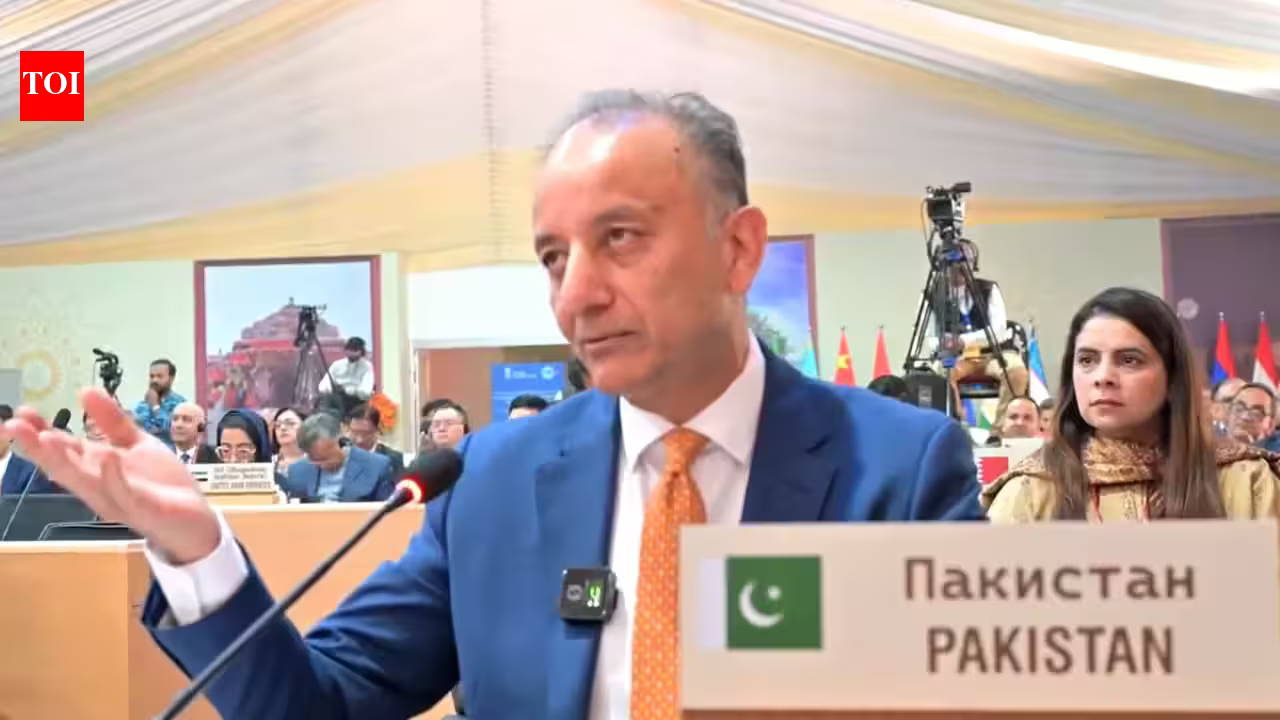
Purana Qila Becomes Backdrop for Diplomatic Nuance as Pakistan Minister Reflects on Shared History
NEW DELHI: The historic Purana Qila, often regarded as a timeless witness to the capital’s evolution, transformed into a significant diplomatic stage this weekend. As the site of the inaugural civilisational dialogue under the Shanghai Cooperation Organisation (SCO) Forum, the fort served as a crucible for reflecting on the subcontinent’s complex and interconnected past.
The gathering, dubbed ‘Tehzeeb Ki Guftagu’ or the “Dialogue of Civilisations,” brought together leaders from across the region. However, the discourse took an intriguing turn when Pakistan’s Minister for Climate Change and Environmental Coordination, Musadik Masood Malik, offered a perspective that contrasted with the narrative prioritized by the host nation.
A Divergent Historical Lens
While India has positioned the Purana Qila—a site deeply linked to the ancient city of Indraprastha and the Mahabharata—as a symbol of 3,000 years of unbroken cultural continuity, Minister Malik utilized his address to highlight the contributions of external influences on the region’s architectural and cultural identity.
Focusing on the fort’s structural evolution, Malik pointed to the dual legacies of Humayun, whose roots were in Central Asia, and Sher Shah Suri, who arrived from Afghanistan. “Within a single wall, one could find the art of two different rulers, two cultural layers, and traces of two traditions,” Malik remarked. By emphasizing these origins, the Pakistani minister sought to frame the subcontinent’s history as one shaped significantly by movements from Central and Western Asia, suggesting that Delhi’s strength lies in its capacity to absorb and integrate these diverse influences.
India’s Narrative of Continuity
The Indian government has utilized the summit to showcase the deep archaeological heritage of the site. Through the ‘Astitva’ exhibition and the display of an 18th-century Mahabharata scroll, New Delhi has consistently reinforced the site’s connection to the epics and its status as a bastion of ancient indigenous civilization. Prime Minister Narendra Modi’s inaugural remarks mirrored this sentiment, grounding the fort’s history firmly in a multi-millennial journey of Indian tradition.
The venue itself reflects this tension of interpretation. Excavations at Purana Qila have revealed multiple layers of occupation, including the structures built by Sher Shah Suri over the ruins of Dinpanah, the city originally commissioned by Humayun in 1533. Where India sees these layers as evidence of an enduring Indian resilience and antiquity, Malik interpreted them as a testament to the enrichment brought by outside arrivals.
A Rare Diplomatic Presence
The visit of the Pakistani delegation carries extra weight given the current state of bilateral relations. The dialogue took place amidst a backdrop of severe regional tensions, exacerbated by the 2025 Pahalgam terror attack. Malik’s presence in India—the first for a Pakistani minister in recent times—provided a rare, if formal, window for engagement on a multilateral stage.
Despite the heavy political undertones, the atmosphere within the fort remained focused on the broader theme of the forum. Acknowledging the archaeological significance of the surrounding excavations, Malik conceded that the venue was “in itself, a story,” and praised the thematic focus on civilisational dialogue. As the SCO member nations concluded their deliberations on the second day, the Purana Qila remained a silent, ancient observer to the delicate dance of modern diplomacy.
Disclaimer: This content is auto-generated for informational purposes only.
Source: Read Original News