







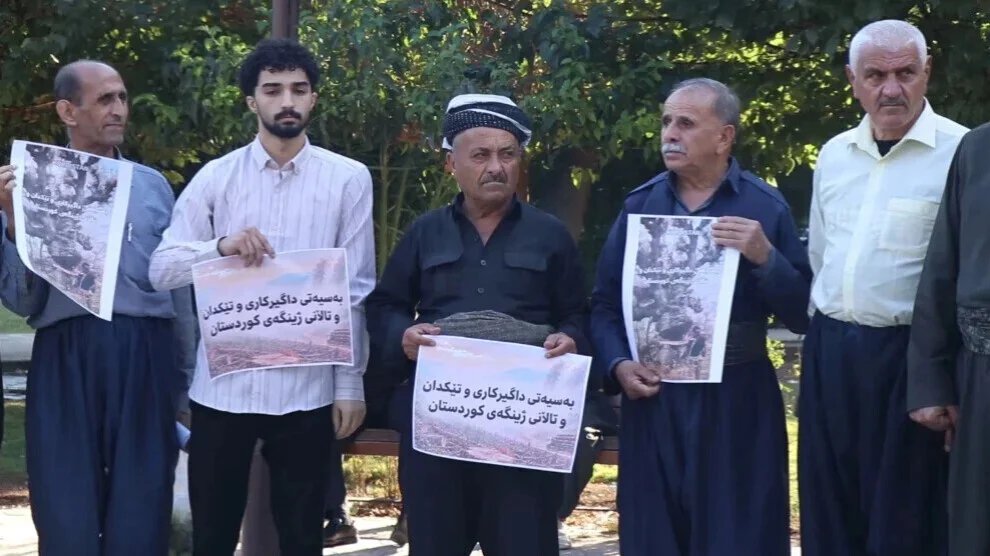
RANYA — A surge of environmental activism has emerged in the city of Ranya, where residents gathered in front of the People’s Garden this week to voice opposition to the ongoing ecological degradation and military presence in the Kurdistan Region of Iraq (KRI). Organized by the Koşan Group, the demonstration carried the defiant slogan, “Êdî bes e dagirkerî û xirabkirina jîngeha Kurdistanê” — “Enough with the occupation and destruction of Kurdistan’s environment.”
The rally highlighted a growing concern among local communities regarding the intersection of regional conflict and the systematic loss of biodiversity. Protesters argued that the protracted military activities, particularly those conducted by the Turkish state in the Behdînan region, have caused irreparable harm to the landscape, including the destruction of vast tracts of forests and vital infrastructure.
Speaking on behalf of the organizers, Şadiye Samed addressed the crowd, emphasizing that the environmental crisis in Southern Kurdistan is a direct byproduct of long-standing geopolitical interventions. For years, she stated, these military operations have been justified through the lens of national security and the conflict with the guerrillas of the Kurdish freedom movement. However, Samed asserted that the cost of these operations has been borne by the local ecosystem and the civilian population, whose livelihoods depend on the health of the land.
The protest gained added urgency following the launch of a regional peace and democratic society process in February 2025. According to the Koşan Group, the emergence of this diplomatic initiative rendered the ongoing military occupation obsolete. The organization maintained that in a climate characterized by a push for peace, the continued presence of foreign military forces and the subsequent environmental degradation are no longer defensible.
“Protecting the borders and forests of Southern Kurdistan is not merely an environmental issue,” the Koşan Group noted in a prepared statement. “It is also part of protecting our land, our culture, and our identity.” For many of those in attendance, the forests are viewed as a foundational element of Kurdish heritage, and their loss is perceived as an existential threat to the region’s cultural identity.
The demonstration also served as a platform for criticism of the Kurdistan Regional Government (KRG). Participants expressed frustration over what they described as an official silence from authorities regarding the environmental devastation. This perceived inaction, protesters argued, has exacerbated the crisis, effectively making the government complicit in the loss of the region’s natural resources.
The Koşan Group concluded the rally by issuing a formal call to action, urging citizens, civil society institutions, and international environmental movements to mobilize against the destruction of Kurdistan’s wilderness. Their demands are two-fold: the immediate withdrawal of Turkish military forces from Southern Kurdistan and a definitive cessation of external interventions that prioritize military objectives over ecological stability.
As climate change continues to impact the Middle East, the link between regional security and environmental preservation is becoming increasingly prominent. The rally in Ranya signals a shift in the local discourse, where environmental advocacy is now deeply intertwined with the broader call for political autonomy and regional stability. By framing the protection of forests as a matter of national defense, the Koşan Group is attempting to elevate environmentalism to the forefront of the KRI’s political agenda, insisting that a sustainable future for the region is impossible without the restoration and protection of its natural environment.
Disclaimer: This content is auto-generated for informational purposes only.
Source: Read Original News