







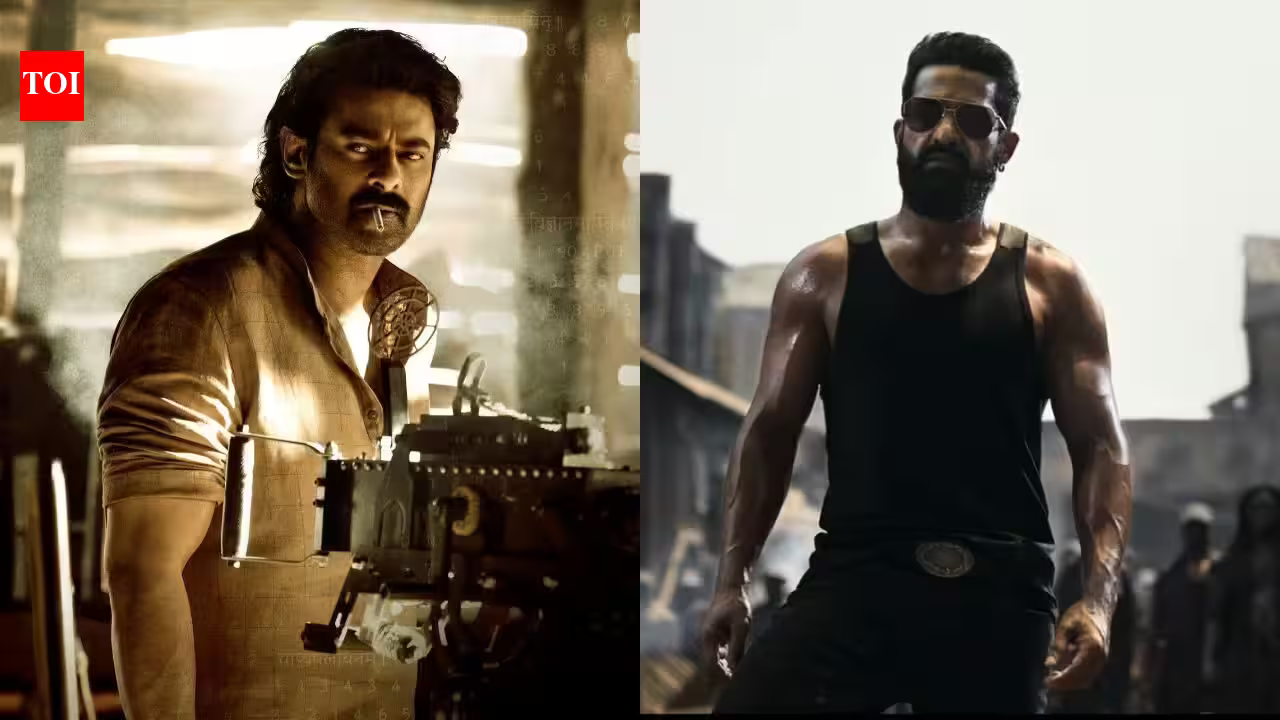
In the high-octane ecosystem of Indian cinema, where the “mass” entertainer is often defined by gravity-defying leaps and slow-motion exits, a paradigm shift is quietly unfolding in the stunt department. At the heart of this evolution is action director Chethan D’Souza, a craftsman who has recently turned heads with his work on the Jailer 2 production. Currently, D’Souza is the man tasked with molding the physical narratives for two of the country’s biggest cinematic juggernauts: Prashanth Neel’s Dragon, featuring Jr NTR, and Hanu Raghavapudi’s Fauzi, headlined by Prabhas.
For an industry long addicted to the “spectacle-first” philosophy, D’Souza’s current manifesto is a breath of fresh air. He is moving away from the purely CGI-reliant, physics-bending choreography of the last decade, favoring a more nuanced, character-driven approach that prioritizes the visceral connection between the hero and the audience.
Redefining the ‘Mass’ Appeal for Jr NTR
When the name Prashanth Neel is attached to a project, audiences naturally anticipate a visual feast akin to the KGF universe—a world of thunderous hammers, dust-choked skies, and men who seem immune to bullet wounds. However, D’Souza is quick to clarify that Dragon is a different beast entirely.
“Prashanth Neel’s films often feature larger-than-life action that perfectly suits the actors’ stature,” D’Souza noted in a recent conversation. “But here, Jr NTR’s physicality is different. He has toned down his physique for the role of an assassin, and consequently, the action must feel believable and relatable.”
For D’Souza, “mass” cinema is being redefined in real-time. He argues that the definition of a crowd-pleaser has become too narrow. “‘Mass’ action doesn’t necessarily mean people flying through the air, slow-motion walks, or impossible jumps,” he asserts. “It comes from a powerful moment created through storytelling. If the audience isn’t invested in the ‘why’ of the fight, the ‘how’ becomes irrelevant.” By rooting Jr NTR’s combat in the cold, calculated movements of an assassin rather than the superhuman strength of a titan, the production is aiming for a level of intensity that feels grounded in reality rather than theater.
Prabhas and the Pivot to Stylized Realism
If Jr NTR is being presented with a leaner, more surgical intensity, Prabhas—the man who essentially defined the modern “pan-India” superhero scale with Baahubali—is headed for a transformation of his own in Fauzi.
Audiences are accustomed to seeing Prabhas as a mythological force, a character whose presence alone can command the screen. In Fauzi, however, the strategy is shifting from scale to style. D’Souza describes the upcoming sequences as “grounded yet highly stylized.” The director’s vision for this collaboration is to ensure that every punch, parry, and movement serves the film’s underlying emotional current.
“We have often seen him in larger-than-life action,” D’Souza explains. “In Fauzi, the action is driven by emotions and marked by suspense and surprise.” This is a critical pivot. By stripping away the bloated, over-the-top choreography, the focus shifts to the internal state of the character. The goal is to turn the action sequence into a dialogue—one that carries the story forward rather than acting as a pause button for the plot.
The Martial Arts Influence on Choreography
D’Souza’s distinct fingerprint is largely thanks to his deep-rooted background in martial arts. With over two decades of training under his belt, he possesses an innate understanding of kinesiology—the way the human body moves under pressure. He believes that the future of Indian action lies in the marriage of technical proficiency and storytelling.
“I have practiced martial arts for around 22 years and have a flair for it,” D’Souza shared. “I like to bring that into my choreography whenever it fits the director’s vision.” In Fauzi, this manifests as a lean toward physical combat. Instead of relying on wires or excessive camera trickery, the choreography emphasizes the grit of hand-to-hand engagements. It is a transition that mirrors global trends, where the messy, kinetic reality of a street fight or a close-quarters skirmish is proving to be more compelling to modern viewers than clean, choreographed perfection.
Why Storytelling Must Lead the Choreography
The central thesis of D’Souza’s approach is the rejection of the “demo reel” mentality. In the digital age, it is easy for action directors to fall into the trap of designing sequences that look incredible in isolation—the kind of snippets that go viral on platforms like YouTube—but fail to provide utility to the film itself.
D’Souza is hyper-aware of this pitfall. “An isolated action sequence might work on YouTube as a demo reel,” he warns, “but within a film, it must tell a story.” Every encounter, whether it involves Jr NTR’s assassin or Prabhas’ protagonist, is being meticulously crafted to ensure the stakes are clear. If an action director can make the audience feel the exhaustion, the pain, or the desperation of the character, they have succeeded.
As we look ahead to the releases of Dragon and Fauzi, it is evident that the “spectacle” era of Indian cinema is undergoing a maturation. It isn’t that the scale is diminishing, but that the focus is shifting. With experts like Chethan D’Souza at the helm, the industry is proving that it can provide the pulse-pounding thrills that fans crave without sacrificing the humanity of the stars on screen. Whether he is working with the raw energy of Jr NTR or the established presence of Prabhas, D’Souza’s commitment to “believability” suggests that the next generation of Indian action will be felt just as much as it is seen.
Disclaimer: This content is auto-generated for informational purposes only.
Source: Read Original News