








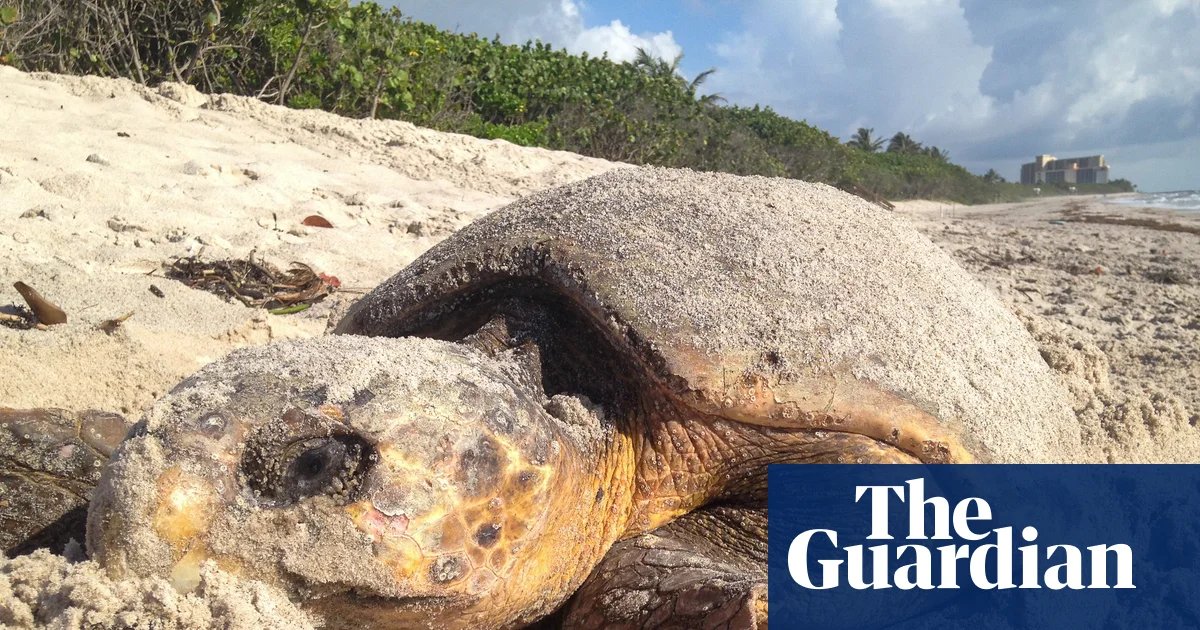
Wildlife conservation groups across Florida are currently celebrating a momentous nesting season for sea turtles, marked by an unprecedented number of nests. This positive trend, however, is overshadowed by serious concerns stemming from recent actions by Donald Trump’s administration, specifically the substantial weakening of the Endangered Species Act (ESA). Experts fear that these regulatory rollbacks could critically undermine decades of dedicated conservation efforts that have successfully brought these magnificent creatures back from the brink of extinction.
Even with over two months remaining in the crucial summer nesting period, loggerhead turtles have already established a remarkable 13,770 nests along an 8.5-mile stretch of coastline monitored by the Loggerhead Marinelife Center in Juno Beach, Florida. This figure significantly surpasses any previously recorded annual total for this particular area on Florida’s Atlantic coast. A similar success story is unfolding on Sanibel Island, located on the Gulf coast, where loggerheads have laid 922 nests to date this year. This number already exceeds the 2023 total of 878 nests, as reported by the Sanibel-Captiva Conservation Foundation, highlighting a widespread resurgence.
These burgeoning nesting numbers are a testament to the ongoing recovery of sea turtle populations, a process that began in earnest in the 1970s. Prior to this period, relentless overhunting, poaching, and widespread habitat destruction had pushed several species perilously close to annihilation. For instance, the Caribbean’s green turtle population suffered a catastrophic decline of approximately 95%.
The ESA, enacted in 1973, provided crucial legal protections that are now yielding substantial dividends. The long gestation period for sea turtles, with hatchlings taking many years, sometimes even decades, to reach reproductive maturity, means that the benefits of these protections are only now becoming fully evident. However, the recent dismantling of certain sections of the ESA by the Trump administration, often described as a “death sentence,” to prioritize interests such as oil drilling, mining, logging, and real estate development, has ignited fears among experts. There is a palpable concern that this recovery might have reached its peak and could now face a significant reversal.
In response to these alarming changes, a coalition of environmental and wildlife organizations has initiated legal proceedings against the Trump administration. A key point of contention in this lawsuit is a new rule that grants disproportionate weight to “economic considerations” when making decisions about protecting endangered species and their critical habitats. David Godfrey, executive director of the Sea Turtle Conservancy, an advocacy group that, while not a plaintiff in the lawsuit, strongly supports its aims, articulated the sentiment shared by many. He stated that the current success is the culmination of several decades of consistent protection under the ESA and various other initiatives aimed at safeguarding their habitats.
Godfrey elaborated on the biological realities that underscore the importance of long-term protection: “It takes just about any species of sea turtle 20, 30 years to reach maturity, to come back and nest, to return to beaches where they were first protected as eggs or as hatchlings and afforded the opportunity to live without ending up in a fisherman’s net and on a table in a nice restaurant.” He emphasized that the ongoing recovery is largely attributable to the ESA, which is precisely why the recent legislative setbacks are a source of profound concern for the conservation community. The ESA is widely recognized for its efficacy, having protected over 1,700 species and their ecosystems, and is credited with preventing the extinction of 99% of those listed. Godfrey countered criticisms of the ESA, stating, “The detractors of the ESA sometimes say, ‘Oh, this thing is a failure. Look at all these animals that are still on the list. We haven’t removed a lot from the list.’ And I come right back and say, yeah, but look at all these animals that are on the list that we haven’t lost.” He further asserted that these species were listed because they were on the precipice of extinction, and sea turtles, in particular, are thriving and increasing in numbers directly because of the Act. While nesting numbers have not yet reached the ideal levels for complete delisting, they are moving in that positive direction, a trajectory that is now under threat.
Justin Perrault, vice-president of research at Loggerhead Marinelife Center, attributes this year’s exceptional nesting figures to the cumulative effect of years of protective measures, combined with favorable environmental conditions, reduced pollution levels, and enhanced public education regarding marine conservation. He expressed enthusiasm, remarking, “It’s incredibly exciting and encouraging because the world needs some good nature stories, and it’s important to celebrate that we are doing some things well.”
Perrault also highlighted the arduous nature of being a female sea turtle: “Being a mother sea turtle is very difficult, they do all the work, they don’t lay just one nest every season, they lay multiple nests, and that is very energetically costly and they usually take about two, three or four years off in between each time they come back to nest.” Despite these challenges, the consistent increases observed over recent years provide a degree of optimism. While caution is exercised in declaring a full recovery, he notes that stability in populations is certainly being achieved.
The Loggerhead Marinelife Center, which operates as a marine life hospital dedicated to treating and rehabilitating sick and injured turtles, actively collaborates with numerous organizations nationwide. This partnership facilitates the sharing of crucial research data and fosters joint educational initiatives. One of their most impactful programs is the Responsible Pier Initiative, which equips anglers with the knowledge and tools necessary to safely rescue stranded or injured turtles, particularly those entangled in fishing lines. This initiative has garnered widespread participation, with 79 piers across various states, including Virginia, Texas, North Carolina, and even Puerto Rico, having joined the program. As a direct result, over 1,200 turtles have been successfully rescued.
Valerie Tovar, the center’s conservation manager, confirmed the program’s success in saving multiple species of sea turtle, including loggerheads, green turtles, olive ridleys, and hawksbills. She recounted instances of even leatherback sea turtles being hooked, though their immense size usually results in the line breaking quickly. Beyond the pier initiative and the establishment of protected zones, Tovar outlined additional ongoing and planned conservation projects aimed at further bolstering the sea turtles’ recovery. “We’ve expanded our horizons,” she noted, indicating a broader focus on water quality, habitat restoration, and extensive outreach and advocacy efforts. The goal is to comprehensively understand and address the intricate connections between water quality, human health, and the health of sea turtle populations.
While the Loggerhead Marinelife Center maintains a neutral stance on political matters, Perrault unequivocally stated their support for the Endangered Species Act. “Every single animal we take into this facility is on the endangered species list so obviously we believe that the animals should be protected and continue to be protected in the ways that they have been since the ESA was enacted,” he affirmed. He also pointed to existing Florida state regulations that continue to provide beneficial protections for these vulnerable species. The increasing frequency of record-breaking nesting years, he concluded, is a profoundly encouraging sign for the future of sea turtles.