




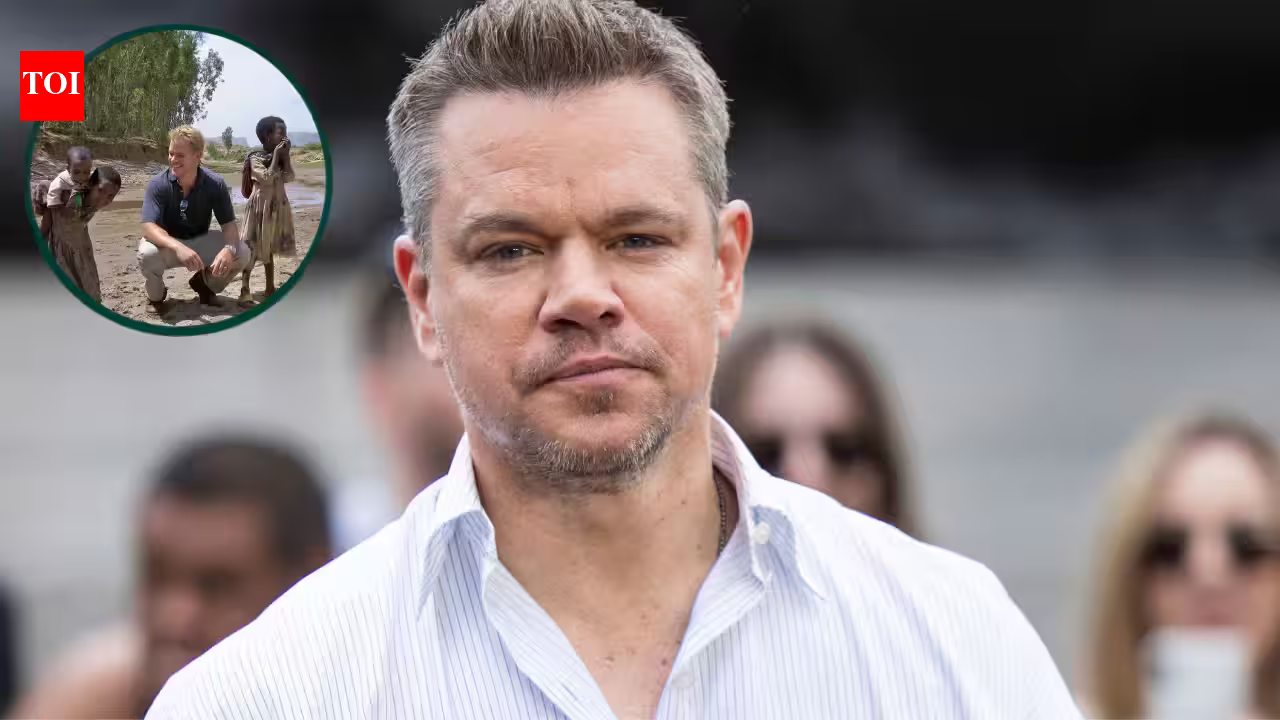


In an industry often defined by fleeting trends and the next big box-office opening, Matt Damon has quietly cultivated a legacy that has nothing to do with scripts or stunt choreography. While the world knows him as the face of the Bourne franchise or the man who survived Mars in The Martian, his most enduring work is taking place in the dusty, underserved corners of the globe. It has been two decades since a life-changing trip to Zambia shifted his perspective, turning the A-list actor into an accidental architect of global change. Today, his nonprofit, Water.org, has reached more than 92 million people—a staggering milestone that proves celebrity activism can be far more than a photo opportunity.
The experience behind Damon’s decision
Damon’s philanthropic roots didn’t sprout from a press release; they grew from his own formative years. Long before he was holding a golden statue, he was a young traveler exploring the world with his mother. Those early journeys exposed him to the stark realities of global poverty, but it wasn’t until he was an established star filming in Africa that the abstraction of “hardship” became a tangible, haunting reality.
During his time in a Zambian village, Damon wasn’t playing a character. He was witnessing a daily, grueling marathon that millions of women and children run every single day: the quest for clean water. He saw firsthand that the absence of a tap or a toilet wasn’t just an inconvenience; it was a societal shackle. It was a cycle of disease, lost education, and the crushing exhaustion of walking miles just to secure enough liquid for basic survival. That experience didn’t just tug at his heartstrings—it anchored his purpose. In 2006, he launched the H2O Africa Foundation, moving beyond the standard Hollywood “donor” model to try and grasp the systemic nature of the crisis.
Meeting Gary White changed the scale of the mission
If passion fueled the engine of Damon’s mission, meeting Gary White provided the map. In 2008, at the Clinton Global Initiative, their paths crossed, and it was a meeting of minds that arguably saved the organization from being just another well-intentioned, small-scale charity. White, an engineer and seasoned water-sanitation expert, possessed the technical prowess and the “boots-on-the-ground” experience that Damon realized he needed to scale up.
Their partnership in 2009 was transformative. Damon provided the megaphone, the platform, and the unwavering commitment to keep the issue in the public consciousness; White provided the rigorous, evidence-based strategy. Together, they didn’t just want to “give” water—they wanted to change how the world financed it. By moving toward a model that empowered local communities and partnered with financial institutions to provide affordable credit for water and sanitation projects, they stopped treating water access as charity and started treating it as an investment in human dignity.
Why access to water can change everyday life
The true metric of success for Water.org isn’t found in a spreadsheet of millions, but in the small, profound shifts in an individual’s life. Damon frequently recounts a story from Haiti that sticks with him: he asked a young girl what she would do with her life now that she no longer had to spend hours each day hauling water. She didn’t talk about grand geopolitical shifts or economic output; she simply said she wanted to play.
That single response encapsulates the essence of the work. When water access is solved, you aren’t just improving health markers—you are reclaiming time. Time is the currency of the impoverished. By eliminating the necessity of the “water walk,” Damon and White’s efforts have effectively returned millions of hours to people who can now invest that time in classrooms, small businesses, and family life. It is the most direct way to break the poverty cycle, turning a basic human necessity into a springboard for human potential.
From one experience to a global impact
The evolution from the H2O Africa Foundation to the powerhouse that is Water.org has been marked by a relentless drive for efficiency. In 2012, when they hit their first million-person milestone, the mood was celebratory. Today, that million-person mark is crossed in a matter of months. This exponential growth is testament to the fact that they moved beyond “giving” to “facilitating.” Through the sister organization, WaterEquity, they have brought the power of capital markets into the equation, proving that social impact can be both massive and sustainable.
Damon’s role has never been merely ceremonial. He remains deeply embedded in the strategic discussions, often leveraging his platform to keep stakeholders honest and focused. He has successfully navigated the delicate balance of being a recognizable face without letting his celebrity overshadow the work itself. He treats the foundation with the same obsessive detail he applies to his film roles, proving that his long-term commitment was never a vanity project.
Two decades later, the mission continues
As we look at the 92-million-person figure, it is easy to view it as a statistic—a cold, hard number on a website. But for Damon, that number represents a sprawling, diverse network of individual lives that have been fundamentally altered by the decision he made in that Zambian village twenty years ago. The mission has changed, ballooning from a localized concern in one region to a global financial initiative spanning several continents. Yet, the core goal remains as humble and urgent as it was in 2006.
The legacy of a Hollywood actor is typically measured in box office receipts, Oscar wins, and iconic lines of dialogue. But for Matt Damon, his most significant project is one that will continue long after the cameras stop rolling. He has demonstrated that the most effective way to change the world is to stop looking for a cinematic resolution and instead commit to the messy, slow, and incredibly rewarding work of helping your neighbor gain access to the most basic requirement of life. In doing so, he has created a narrative that actually matters.
Disclaimer: This content is auto-generated for informational purposes only.
Source: Read Original News