






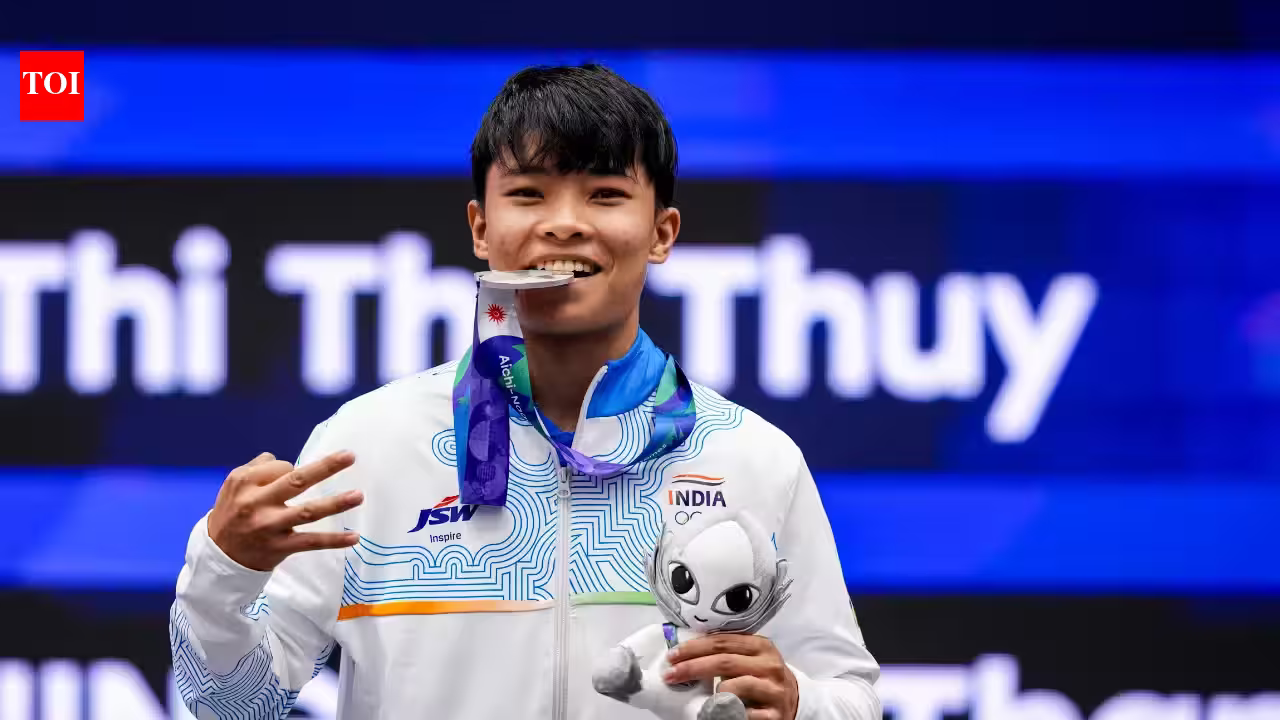
NAOREM ROSHIBINA DEVI has carved her name into the annals of Indian sporting history. In a display of profound resilience, the 25-year-old Manipuri sensation secured the silver medal in the women’s 60kg Sanda category at the 20th Asian Games in Aichi, Japan. By stepping onto the podium at the Aichi Prefectural Martial Arts Hall this Thursday, she became the first Indian woman to capture three successive Asian Games medals in Wushu, cementing her status as a titan of the sport.
The accomplishment is made all the more staggering when considering the turbulent path that led her to the final. Roshibina’s journey to Japan was marred by administrative hurdles, selection controversies, and a sudden, high-pressure eleventh-hour recall. Yet, she emerged from the chaos with the poise of a seasoned veteran, adding to a trophy cabinet that already boasts a bronze from Jakarta 2018 and a silver from Hangzhou 2023.
From Controversy to the Podium
The road to this historic silver was anything but conventional. In a high-stakes selection trial held this past June, Roshibina had initially fallen short against Divyanshi Choudhary, seemingly ending her hopes of competing at the games. However, the tides shifted when the Wushu Association of India (WAI) withdrew Choudhary from the squad, citing a partial high-grade ACL tear revealed during medical imaging.
The ensuing weeks saw the athlete embroiled in a public dispute, as allegations of mental and physical harassment were leveled by Choudhary, with accusations aimed at Roshibina’s involvement. The WAI stood firm, categorically rejecting these claims and maintaining that the squad change was strictly a medically-mandated necessity. With the full approval of the Sports Ministry, Roshibina was reinstated to the team, receiving the life-changing news around September 10.
When asked about the turmoil that had threatened to derail her career, Roshibina displayed a cool, professional detachment. “What happened was not because of me. It was the federation’s decision,” she stated. “I will ignore it. I just want to focus on my goal.”
Little Time to Prepare
The impact of the administrative uncertainty was felt directly on the mat. Removed from the national training camp for nearly six weeks, Roshibina was forced to scramble to regain her competitive edge after being recalled in mid-September. She travelled directly from her home in Manipur to the Games, having had minimal time to acclimatize or refine her strategy.
“There was a lot of disturbance when I came here,” Roshibina admitted following her final bout. “I did not get much time to prepare. If I had more time, I would have done better.” Her coach, Amit Pal, echoed this sentiment, highlighting that her training block was severely compressed.
Despite the lack of preparation time, Roshibina’s class shone through in the early rounds. She dispatched Bangladesh’s Shika Khatun in the pre-quarterfinals before delivering a dominant 5-0 victory over Chu Man Sin of Macao, China, in the quarterfinals. Her clinical performance in these rounds proved that her natural talent and experience were enough to overcome the lack of a standardized preparation cycle.
The Gold Medal Bout
In the final, she faced a formidable opponent in China’s Zhang Xiaoyu. The Chinese fighter brought a level of technical precision and aggression that proved difficult for Roshibina to neutralize. Zhang secured the gold by winning both rounds unanimously, with all five judges scoring every segment of the bout 5-0 in her favor.
Zhang’s tactical use of side-kicks disrupted Roshibina’s defensive rhythm, preventing the Indian star from effectively executing her signature throwing techniques. “She is a new player; I have not fought against her,” Roshibina noted. “She was good in her side-kicks. I tried to defend, and I tried to throw her, but she did better.”
While the silver medal is a historic achievement, Roshibina was visibly disappointed, clearly frustrated by her inability to clear the final hurdle. “I have won silver earlier and this time also, I could win only silver,” she lamented. “I could not give the gold medal to the Indian people. I could not give what everyone wanted.”
A Legacy of Sacrifice and Inspiration
Behind the high-intensity action of the Sanda ring lies a story of immense personal sacrifice. Hailing from Kwasiphai Mayai Leikai in the Bishnupur district of Manipur, Roshibina’s rise was powered by the unwavering support of her family. In her formative years, her father, Naorem Damu Singh, a farmer, sold a precious piece of family land to fund her training and travel expenses, believing in her potential when no one else would.
Today, that gamble has paid off in the form of a historic career that continues to evolve. With three Asian Games medals now in her possession, Roshibina has already shifted her focus toward the future. Her sights are set on continuing to evolve as an athlete and serving as a beacon for the next generation of Indian martial artists.
“I want to inspire all the players,” she said, reflecting on her legacy. “I want to be a role model for them. I will do my best in the upcoming Games.” As the sun sets on the Aichi Games, Roshibina Devi stands not just as a silver medalist, but as an enduring symbol of perseverance in the face of uncertainty.
Disclaimer: This content is auto-generated for informational purposes only.
Source: Read Original News