







The Strategic Shift toward Ambient AI
Meta Connect 2026 served as a theater for the company’s aggressive expansion into hardware, marking a departure from traditional smartphone-centric computing. While the event featured high-profile updates to VR headsets and smart glasses, the most unexpected introduction was the Muse Charm. This device represents a critical evolution in how Meta intends to distribute its Muse large language model to the public. By moving away from the screen-heavy requirements of standard handsets, the company is attempting to place its generative AI directly into the fabric of daily physical interaction.
The Muse Charm functions as an ambient computing node. Unlike a smartphone, which acts as a multifunctional portal, this hardware is purpose-built for conversational engagement with Meta’s proprietary AI. This move suggests that the company is betting on a future where users prefer hardware that is lightweight and task-specific over devices that demand constant visual attention. By branding the device as a “charm,” Meta is repositioning the complexity of advanced machine learning as a casual, everyday accessory.
Hardware Architecture and User Interaction
Despite the compact footprint of the Muse Charm, the technical specifications suggest a highly capable local processing unit. The device features an integrated microphone array designed for far-field voice capture, enabling users to interact with the Muse model without needing to manually trigger the device. This focus on natural language interaction is a hallmark of current AI-first product design, emphasizing a hands-free experience.
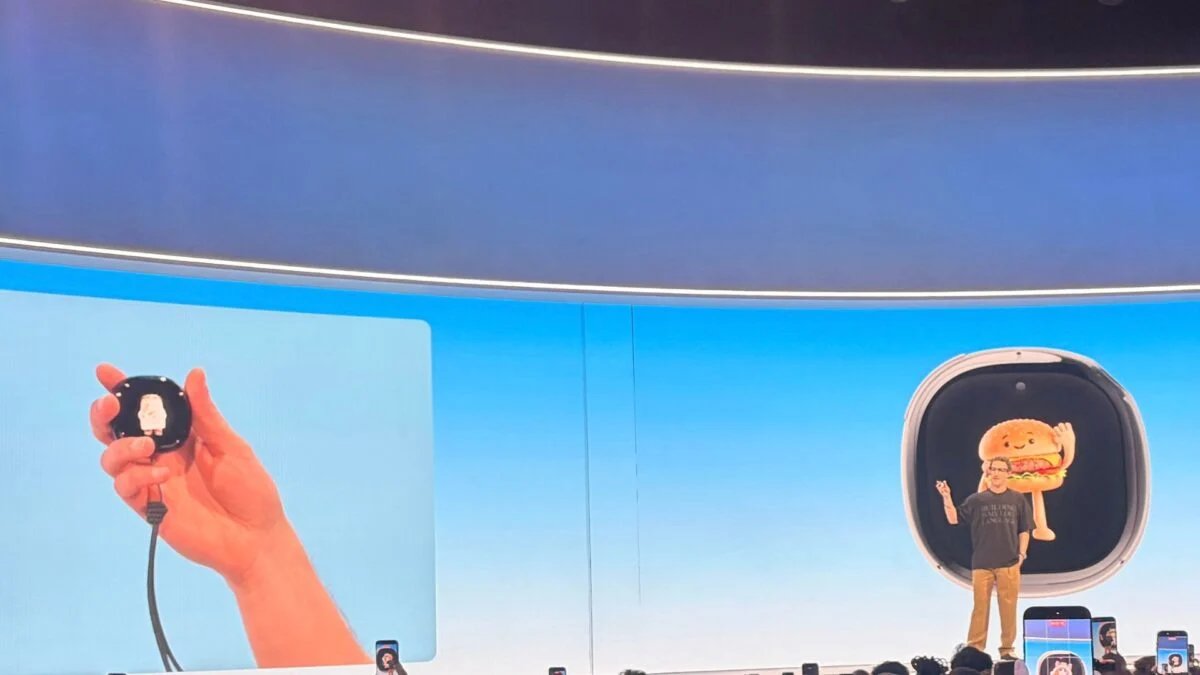
A notable hardware feature is the high-resolution compact display embedded into the casing. This screen serves as the visual feedback loop for the Muse model. Meta has opted for an interactive character interface, where a stylized digital avatar responds to inputs. This visual manifestation provides a layer of feedback that traditional voice assistants lack. By seeing the AI “respond” or react, users receive confirmation that the processing is active, which reduces the friction typically associated with blind voice-activated systems. The device also includes a versatile lanyard attachment, allowing it to be worn as a pendant or attached to bags, effectively classifying it as a persistent wearable.
The Muse Model Integration
The core of the Charm’s utility is the Muse AI model, which serves as the brain of the device. This iteration of Meta’s model is optimized for low-latency responsiveness, a requirement for any device meant to function in real-time scenarios. Meta has configured the device to handle a wide range of requests, mirroring the capabilities found in their cloud-based AI interfaces. Whether it is managing schedules, retrieving information from the internet, or providing companionship, the Muse model acts as a personal assistant that remains tethered to the user via the charm.
From a technical standpoint, the device likely utilizes a hybrid processing model. While much of the heavier inference occurs on Meta’s high-performance server clusters, the device must maintain a local buffer to detect “wake words” and perform preliminary data filtering. This architecture is vital for maintaining battery efficiency while ensuring that the AI can act with the immediacy required for a mobile, keychain-sized form factor.
Use Cases in a Connected Ecosystem
The potential use cases for the Muse Charm extend beyond basic scheduling. Because the device is designed to be carried continuously, it positions itself as a contextual bridge. For instance, a user could pose queries related to their immediate environment, with the AI utilizing its internal model to process real-world questions in seconds. The integration with the broader Meta ecosystem is also expected to be seamless; messages, calls, and information synced across other Meta services will likely flow through the charm.
Furthermore, the form factor is intentionally designed to bridge the gap between heavy, cumbersome wearables like headsets and the distraction of smartphones. In a professional or social setting, interacting with a charm is less intrusive than staring at a phone screen. By stripping away unnecessary applications and focusing entirely on the AI agent, Meta is encouraging a lifestyle where the user remains present in the physical world while having an AI assistant available at a moment’s notice.
Market Impact and Future Trajectory
The introduction of the Muse Charm poses an interesting question regarding the market’s appetite for dedicated AI hardware. Several smaller technology firms have attempted to create AI-focused “pin” or “charm” style devices, with mixed results regarding public adoption. Meta’s entry into this category changes the landscape by leveraging its massive infrastructure and user base. If the Muse Charm finds success, it could signal a shift where companies stop trying to pack every feature into a single smartphone and instead distribute functionality across a suite of smaller, specialized gadgets.
Meta’s approach appears to be one of trial and experimentation. By targeting a holiday release window, the company is positioning the Charm as an entry-level consumer tech product. This is not necessarily intended to be a replacement for high-end computing devices, but rather an exploratory attempt to normalize the presence of generative AI in physical, wearable shapes. The success of the device will depend largely on whether the Muse model can deliver enough value to justify carrying a dedicated piece of hardware. If the user interaction remains limited to gimmicky responses, it may struggle; however, if the device provides utility that simplifies daily chores and communication, it could establish a new category of wearable technology that persists long after the current hype cycle concludes.
Disclaimer: This content is auto-generated for informational purposes only.
Source: Read Original News