









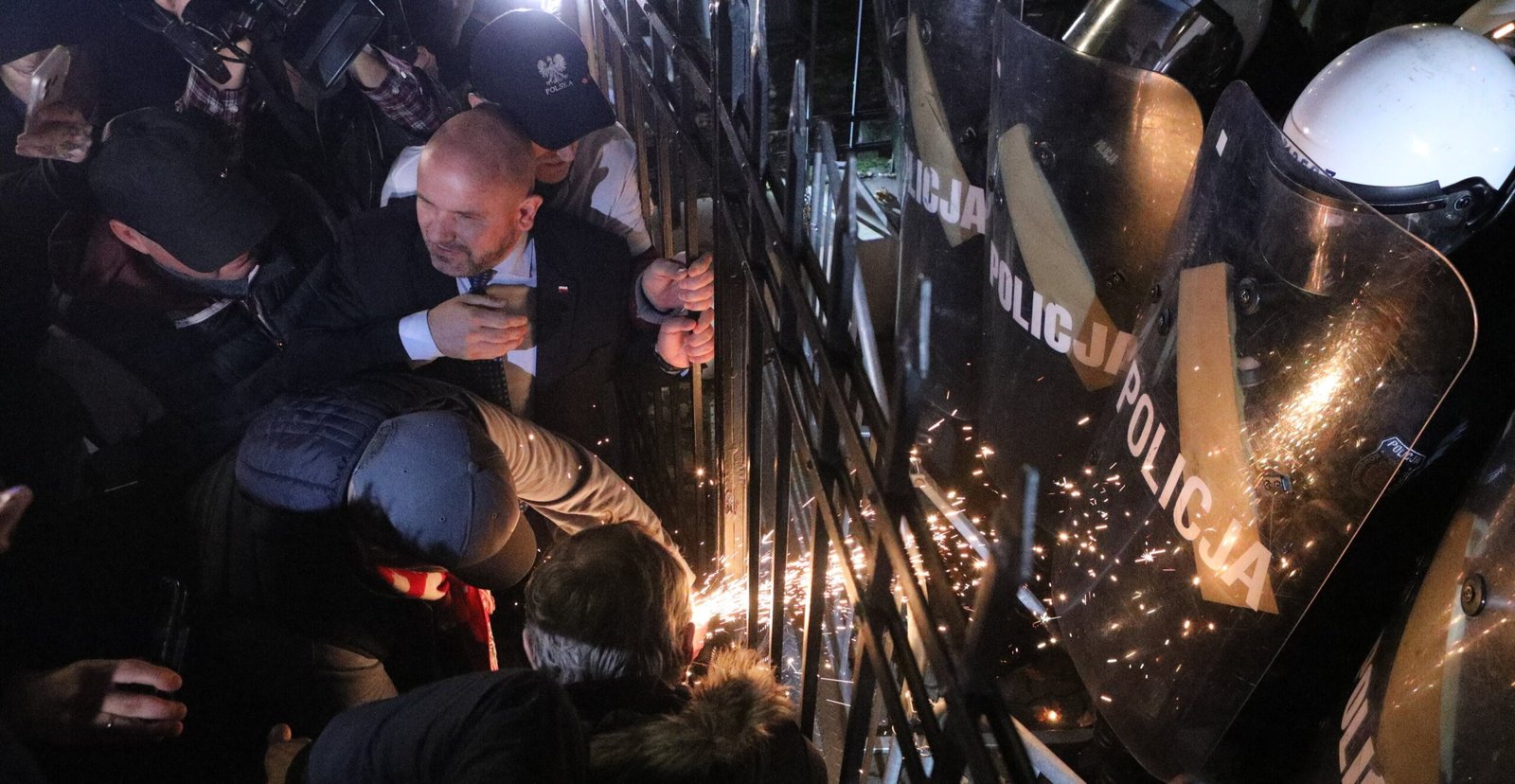
Poland’s Constitutional Tribunal (TK) was plunged into chaos on Friday evening as a faction of judges, backed by the government, moved to seize control of the court from its sitting chief justice, Bogdan Święczkowski. The move marks a dramatic escalation in the country’s years-long rule-of-law crisis, with opposition leaders and the chief justice branding the operation an “illegal coup d’état.”
Tensions at the court reached a boiling point when supporters of Święczkowski, who is aligned with the conservative opposition and President Karol Nawrocki, attempted to breach the court grounds. As protesters cut through fences with power tools, riot police were deployed to surround the facility, effectively locking out the embattled chief justice.
Inside the building, the situation shifted rapidly. A group of government-appointed judges, who had previously been refused entry by Święczkowski, successfully accessed the premises through a rear entrance linked to the Prime Minister’s chancellery. Under the protection of the State Protection Service (SOP), they declared that Święczkowski and his deputy had been suspended from their duties.
The suspension was spearheaded by Judge Anna Korwin-Piotrowska, who claimed authority as the court’s longest-serving member. She accused the leadership of blocking legally appointed judges and mishandling case assignments. The court’s official website, now apparently under the control of the incoming group, posted a notice of the suspension, citing provisions typically reserved for common court disciplinary actions.
However, the official TK social media account—still operated by the outgoing leadership—hit back, dismissing the takeover as a “criminal act” and insisting that Święczkowski remains the rightful head of the institution.
The crisis follows months of legal paralysis. Since Prime Minister Donald Tusk’s coalition government took office in 2023, it has viewed the TK as an illegitimate relic of the former Law and Justice (PiS) administration. While the government recently secured a nominal majority on the court by appointing new judges, President Nawrocki has refused to swear them in, leading to a constitutional standoff. Even when the European Court of Human Rights ordered the court to seat the new judges, Święczkowski refused, arguing the ECHR lacked the authority to intervene.
The political fallout was immediate. PiS leader Jarosław Kaczyński declared that Poland had descended into a “police state.” In response to the unrest, President Nawrocki, who had been en route to Senegal for a state visit, ordered his plane to turn back toward Warsaw.
Prime Minister Tusk defended the actions in a statement released shortly after the takeover. “Restoring the rule of law is our duty,” Tusk wrote. “After years of PiS-led lawlessness, this is a difficult process… There is no other way.”
Legal experts remain divided on the legitimacy of the maneuver. While many critics of the previous government have long sought to reform the TK, observers warn that the use of force to install judges sets a dangerous precedent for the separation of powers in Poland.
Disclaimer: This content is auto-generated for informational purposes only.
Source: Read Original News