







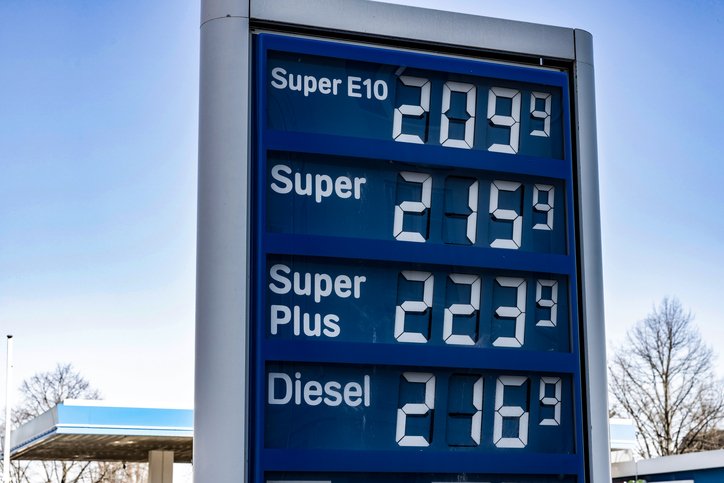
Price controls introduced at German petrol stations to shield motorists from spiking oil prices amid the war in the Middle East have had the opposite effect, driving up the average cost of fuel, economists said Monday.
Economy and Energy Minister Katherina Reiche said in March that petrol stations would have to limit any price rises to once per day at noon to limit the effect of soaring energy prices after Iran effectively cut off about a fifth of the world’s oil and gas supplies in response to US-Israeli attacks.
However, the law in fact boosted retailers’ petrol margins by five to six cents a litre, according to economists at the ZEW institute and the Düsseldorf Institute for Competition Economics, who compared wholesale prices with pump prices at 15,000 petrol stations.
News of the law’s apparent failure comes as Germany’s government under Chancellor Friedrich Merz, nearing a year in office, is struggling to revitalise a sluggish economy, and a reform drive has sparked discord between Merz’s conservative CDU and his centre-left coalition partners, the SPD.
Looking at price data before and after the measure’s introduction, the economists found that prices now spiked at noon before falling only gradually over the course of the day and bottoming out the next morning.
This leaves fewer windows during the day for drivers to snap up relatively cheap petrol compared to before the reform.
“The reform was succesful in increasing price transparency but failed to reduce price levels”, the economists said. “If anything, it had the opposite effect”.
“Low-price windows become more salient and easier to anticipate. However, this simplification comes at a cost: prices are systematically elevated during the midday period,” they added.
Retailers were making an additional five to six cents per litre on petrol, they calculated, with smaller petrol stations and independent businesses making the most.
The authors found no robust effect for diesel prices, however.
The speculated this may have been because of reduced demand from diesel owners who tend to drive further, faster price rises at the start of the crisis or because the price had approached the psychologically important threshold of 2.50 euros ($2.94) a litre.
(cm)