






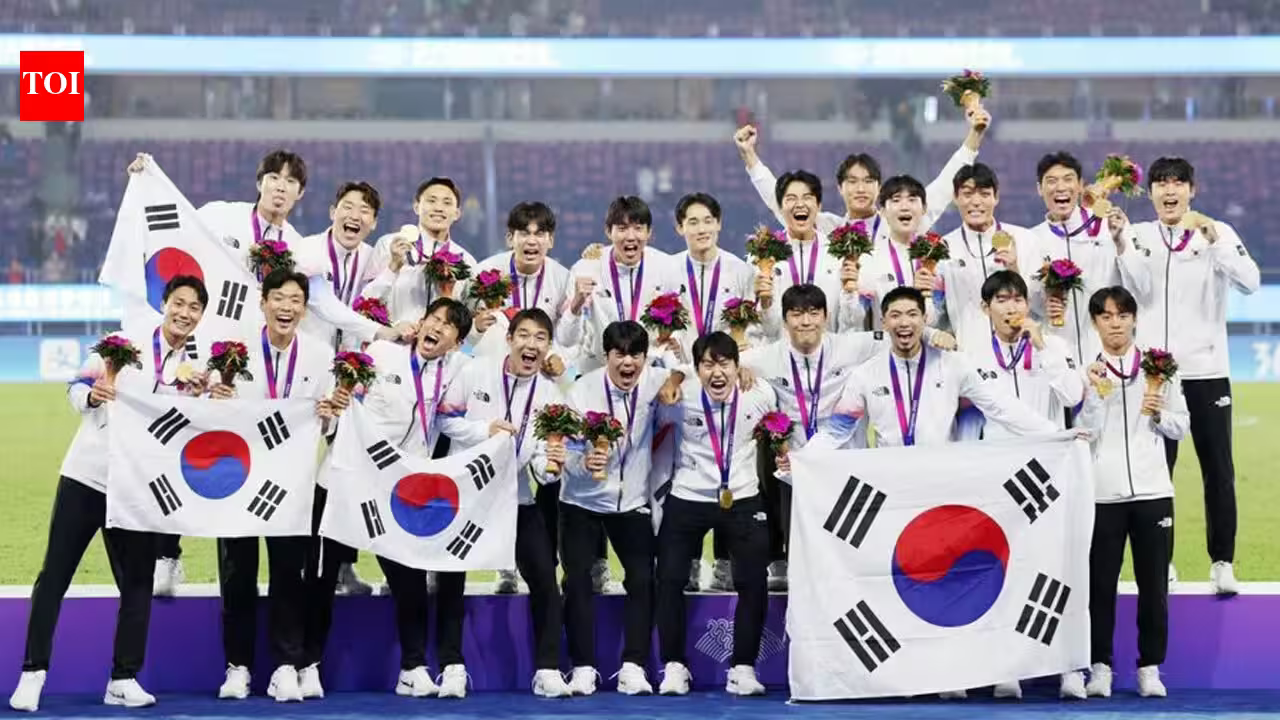
SOUTH KOREA stands at a crossroads regarding one of its most unique sporting traditions. A storm of public indignation has erupted following the nation’s men’s football gold medal victory at the Aichi-Nagoya Asian Games, forcing the government to reconsider a decades-old policy that allows elite athletes to bypass mandatory military service.
The controversy was ignited not by the victory itself, but by the candid—and ultimately inflammatory—remarks made by the team’s stars. Following a 1-0 win over Japan, captain Lee Gi-hyuk, winger Yang Min-hyuk, and forward Park Seung-soo triggered a fierce national debate with comments that many citizens perceived as entitled and dismissive of the country’s civic duties.
Lee, brandishing his gold medal, declared, “I’m not going to the military,” while Yang admitted the service exemption was his primary motivation throughout the tournament. The backlash was instantaneous, further fueled by a social media post from Park showing him wearing a cap associated with military veterans. While all three players have since issued public apologies, the damage to the optics of the program is done. The incident has turned a spotlight on the inherent inequality of the “military exemption” system at a time when South Korean society is increasingly sensitive to fairness and national duty.
What is South Korea’s military exemption for athletes?
In South Korea, all able-bodied men are mandated to complete between 18 and 21 months of military service. It is a cornerstone of national life, designed to maintain readiness in the face of persistent regional tensions. However, for elite athletes, a specialized loophole exists. Athletes who secure Olympic medals or Asian Games gold medals are granted an “alternative-service” status.
This label is often misunderstood by outsiders. These athletes are not exempt from their obligation; rather, they are permitted to perform “supplementary service.” This involves three weeks of basic training followed by 544 hours of community service over a 34-month period. Crucially, they are allowed to continue their professional training and club careers during this time. For a footballer or golfer in their physical prime, the difference between losing nearly two years to the barracks and maintaining a competitive career is immeasurable. It is a career-defining benefit that has long been the primary incentive for South Korea’s brightest stars.
Why is South Korea considering cuts now?
The outcry over the footballers’ comments is merely the spark that lit a much larger fire. Government officials are now acknowledging that the current system is under intense scrutiny due to shifting demographics and changing social expectations.
South Korea is currently grappling with a severe decline in its birth rate, resulting in a shrinking pool of young men available for mandatory enlistment. This demographic reality has made every able-bodied citizen a critical asset for national security, making the existence of special “carve-outs” for athletes increasingly difficult to justify.
Furthermore, the “fairness” argument has taken center stage. The public has increasingly compared the athlete exemption to the experience of ordinary citizens and even global superstars. Most notably, members of the K-pop phenomenon BTS famously underwent their mandatory military service, a move that set a powerful cultural precedent. When the world’s most famous South Korean cultural exports prioritize their duty to the state, the argument that a footballer’s gold medal warrants a shortcut to service rings hollow to much of the public.
History of the athlete exemption
The arrangement dates back to 1973, an era when the state prioritized elite sports as a tool for international prestige and soft power. For over 50 years, the policy has served as a bedrock for national sports development. However, the system has stumbled before. Following the 2002 World Cup, the government faced similar heat when it granted special exemptions to the national squad—a move so controversial that the World Cup was subsequently stripped from the list of qualifying events for such benefits.
The “Gold Medal” divide
The debate has produced a stark contrast in perspectives. Golfer Tom Kim, who secured an Asian Games gold after his stint at the Presidents Cup, struck a markedly different chord than his football counterparts. “I’m more proud that I’m able to bring a medal for my country,” Kim stated, highlighting the patriotic spirit the government originally intended the policy to foster.
This duality—the athlete who views the service benefit as a reward for service versus the athlete who views it as a commodity—is precisely what the Defence Ministry is now evaluating. Defence Minister Kang Shin-chul has been explicit about the ministry’s long-term goal: to gradually scale back these supplementary service programs with the ultimate objective of total abolition.
Will South Korea abolish military exemptions for athletes?
While there is no immediate “on-off” switch for the policy, the gears of bureaucracy are turning. The Culture, Sports and Tourism Ministry, in conjunction with the Defence Ministry, has launched a comprehensive review to consult with the sports and arts communities.
As the government weighs its next move, the athletes of the Aichi-Nagoya Games may have inadvertently become the final beneficiaries of a dying tradition. The debate is no longer about the prestige of a gold medal; it is about whether, in the modern era, any professional achievement can outweigh the shared, fundamental responsibility of service to the nation. For now, the future of the exemption system remains in limbo, but the writing on the wall is clear: the days of automatic military alternatives for elite performers are likely numbered.
Disclaimer: This content is auto-generated for informational purposes only.
Source: Read Original News