








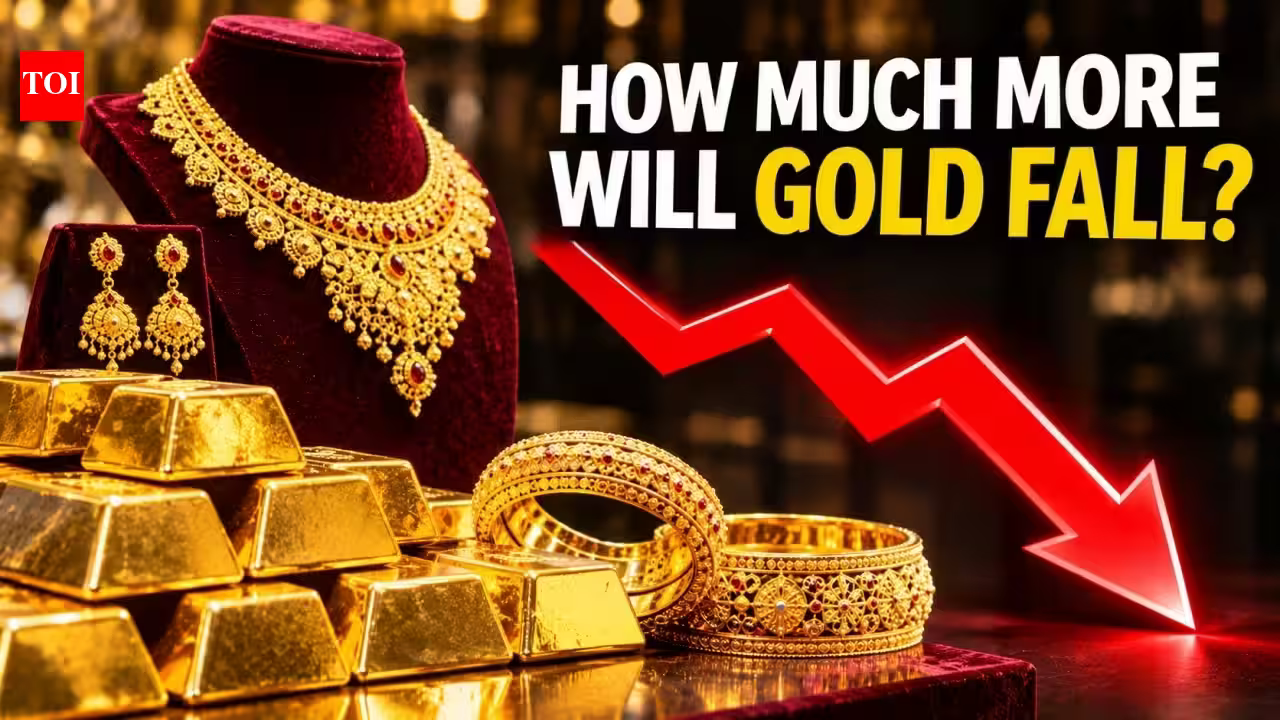
The recent downturn in gold prices has sent ripples across financial markets, marking a significant departure from the euphoric highs observed earlier in the year. After peaking at a record Rs 1.8 lakh per 10 grams in 2026, the yellow metal has experienced a correction of roughly 33%, with prices recently sliding below the Rs 1.25 lakh threshold. This decline has prompted investors and analysts alike to re-evaluate the role of gold as a hedge, particularly within the unique context of the Indian economy, where gold remains both a cultural staple and a primary investment asset.
The Anatomy of the Gold Market Correction
The sharp decline in gold prices is not an isolated event but rather the result of a confluence of global and domestic factors. Internationally, gold has dropped by approximately 37% to hover near $3,527 per ounce. In India, while the fall has been severe, the impact was slightly moderated by government-led hikes in customs duties, which acted as a fiscal buffer against the full force of the global slump.
The primary triggers for this reversal include a massive wave of profit-booking and the liquidation of leveraged positions. As tech stocks and equities faced volatility, investors pivoted to liquifying their gold holdings to address margin calls and raise cash. This shift is exacerbated by a stronger US dollar and elevated bond yields, which increase the opportunity cost of holding non-yielding assets like gold. Furthermore, geopolitical tensions, such as the US-Iran conflict, initially introduced extreme volatility, eventually forcing a market correction as investors sought safer, more liquid instruments.
Analyzing the Probability of Further Declines
The breach of the psychological Rs 1.25 lakh support level has naturally led market participants to question whether a drop to Rs 1 lakh per 10 grams is on the horizon. While industry experts do not rule out this possibility, they emphasize that such a movement would require a specific set of circumstances—most notably a significant appreciation of the Indian Rupee against the dollar and a sustained fall in international gold prices toward the $3,000 per ounce mark.
However, the consensus among analysts is that a sustained fall to such low levels is unlikely. The structural demand for gold, driven by consistent central bank acquisitions, provides a robust floor for prices. Even if short-term speculative forces push the price lower, the long-term fundamentals suggest that the market is currently undergoing an adjustment phase rather than a permanent collapse. Analysts note that technical indicators, such as the 200-day Simple Moving Average, reflect a bearish short-term phase, but these metrics often lag behind the physical demand dynamics that historically stabilize the market.
Evaluating Gold as a Safe Haven Asset
A central theme in financial discourse is whether the recent volatility indicates a loss of gold’s status as a traditional safe haven. The short answer from market experts is that the status remains intact. To understand this, one must view gold through a multi-year lens rather than a snapshot of a single volatile quarter. Over the past two years, gold has delivered substantial returns, with prices climbing from approximately Rs 75,000 in early 2025 to current levels, reflecting a significant net appreciation.
The perceived lack of stability in recent months is, in reality, a classic cycle of market correction. Gold remains a hedge against long-term sovereign debt concerns and currency debasement. While retail investors may be unnerved by the rapid price fluctuations, institutional demand, particularly from central banks and through gold-backed ETFs, continues to underpin the asset. World Gold Council data confirms that central bank purchasing remains at historically high levels, reinforcing the theory that gold is being accumulated by major monetary authorities, even as private speculators exit the market.
Strategic Investment Approaches for the Current Climate
For the individual investor, the current market environment demands a shift in strategy. Rather than attempting to time the absolute bottom of the market—a feat that remains statistically improbable—experts advocate for a staggered, systematic approach to accumulation. Those who find their portfolios under-allocated in precious metals, specifically those with less than 15% exposure, may find the current correction an opportune time to increase their holdings gradually.
This “dollar-cost averaging” method minimizes the risks associated with price volatility. By accumulating in tranches, investors can mitigate the impact of further short-term downside while positioning themselves to capture potential gains when the market regains momentum. The focus for long-term investors should remain on portfolio diversification rather than the pursuit of quick profits.
The Outlook for 2027 and Beyond
Looking ahead, the market trajectory for 2027 remains cautiously optimistic. Many analysts project a potential recovery of 20% to 25% by the second half of 2027, as central bank purchases and institutional inflows continue to provide a floor for global prices. Domestically, the recovery in Indian markets could see prices moving back toward the Rs 1.45 lakh to Rs 1.65 lakh range, depending heavily on the trajectory of the Rupee and the global Comex gold rates.
While the domestic price of gold may underperform compared to international rates if the Rupee continues to strengthen, the overall outlook remains anchored by persistent global geopolitical uncertainty. Investors are advised to view the current volatility not as a failure of the asset class, but as an opportunity for portfolio balancing. As the market eventually moves toward a new equilibrium, the inherent qualities of gold as a store of value—honed over thousands of years—will likely reassert themselves, rewarding those who maintained a disciplined and long-term perspective.
Disclaimer: This content is auto-generated for informational purposes only.
Source: Read Original News