







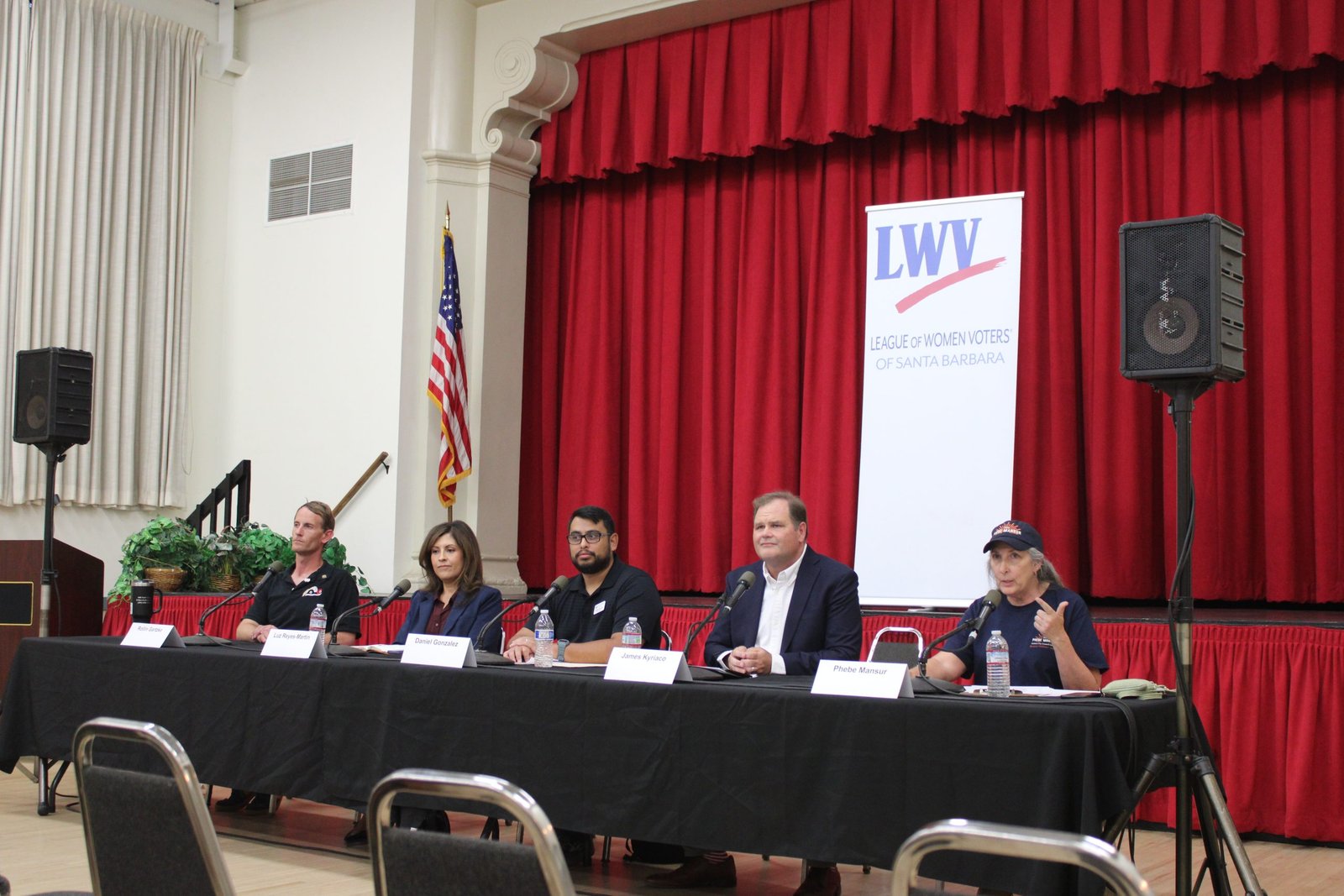
Goleta City Council candidates clashed over the role of emerging technology, the future of urban infrastructure, and regional autonomy during a candidate forum hosted by the League of Women Voters at the Goleta Community Center. With Election Day approaching on November 3, the race for District 1 and 2 seats has highlighted a significant divide regarding how local government should leverage modern tools and manage public resources.
### The AI Divide in Municipal Governance
A notable point of contention surfaced regarding the integration of artificial intelligence within city hall. The candidates offered starkly different visions for how technology should shape municipal operations.
Incumbents Luz Reyes-Martín and James Kyriaco expressed deep skepticism. Kyriaco voiced strong apprehension, stating that AI “scares him to death,” particularly regarding cybersecurity risks and the potential for unintended consequences in sensitive areas like municipal permitting. Reyes-Martín echoed these concerns, emphasizing that the city must carefully consider the privacy and environmental impacts of adopting such advanced systems.
Conversely, challengers Rollin Gartzke and Phebe Mansur championed the efficiency of AI. Mansur, a local business owner, cited her own successful implementation of AI at her printing shop as proof of concept. She argued that the city’s slow permitting process could be modernized and expedited through automated digital tools. Gartzke agreed, suggesting that AI could be utilized to draft designs and streamline urban planning, potentially reducing the city’s reliance on expensive external consulting firms.
### Infrastructure and Urban Development
The forum also centered on the city’s physical landscape, particularly the ongoing debate over the configuration of Hollister Avenue. Business owners Mansur and Gartzke criticized current projects, with Mansur pushing for a return to four-lane traffic to alleviate the reported 75% drop in visitor traffic she claims some businesses have faced.
Kyriaco and Reyes-Martín defended the city’s current approach to “Project Connect,” noting that urban development involves complex trade-offs. They argued that the current infrastructure prioritize pedestrian safety and neighborhood livability, not just vehicle throughput. While they signaled an openness to minor adjustments, they pushed back against the idea that major civic projects—such as the Goleta Train Depot—should be labeled as unnecessary “boutique” investments.
### Fiscal Policy and Regional Strategy
The discussion extended to the city’s long-standing revenue neutrality agreement with Santa Barbara County. While all candidates acknowledged the financial burden this agreement places on the city’s tax base, they remained largely aligned on the need for continued, pragmatic negotiations.
The question of Isla Vista’s potential incorporation as a city also prompted a variety of responses. While incumbents expressed support for Isla Vista’s right to pursue self-governance, they emphasized that any such move must not negatively impact Goleta’s own fiscal health or public safety services. Gartzke, however, took a harder stance against the prospect of annexation, suggesting that the college town’s unique economic and social challenges might be better addressed by the county or potentially through integration with Santa Barbara rather than Goleta.
As the race enters its final stretch, the contrast between the candidates’ views on technological adoption and urban management remains a key focal point for voters. Whether the city chooses to double down on traditional municipal management or pivot toward AI-integrated solutions, the outcome of the November 3 election will set a new trajectory for Goleta’s administrative and infrastructural priorities.
Disclaimer: This content is auto-generated for informational purposes only.
Source: Read Original News