







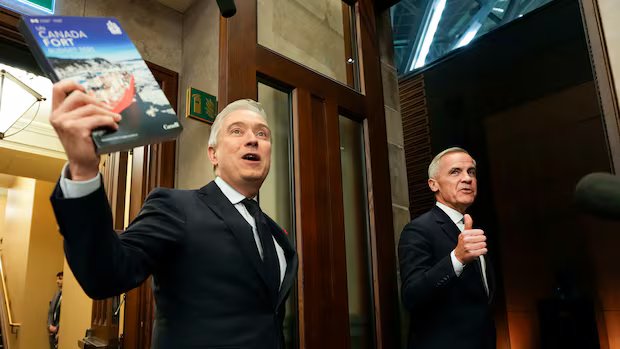
Finance Minister François-Philippe Champagne announced Tuesday that the federal government will table its latest budget on November 5. The move marks the second consecutive year the government has moved away from the traditional spring delivery schedule in favor of a fall tabling, a shift initiated by Prime Minister Mark Carney last year.
The announcement comes at a challenging economic juncture, as the Parliamentary Budget Office (PBO) released a revised fiscal and economic outlook on the same day, signaling a cooling economy and mounting budgetary pressure. The PBO has trimmed its expectations for real gross domestic product (GDP) growth, lowering the projection to 0.9 per cent for this year and 1.5 per cent for 2027. These figures represent a decline from the watchdog’s June forecast of 1.1 per cent and 1.6 per cent, respectively.
Parliamentary Budget Officer Annette Ryan attributed the gloomier outlook to “additional trade measures and ongoing uncertainty.” The Canadian economy has been buffeted by the recent collapse of trade talks with the United States and a subsequent tit-for-tat tariff war between the two nations.
Fiscal projections from the PBO also suggest that deficits will remain substantial. The watchdog now anticipates a deficit of $63.3 billion for the 2026-27 fiscal year, a figure expected to climb to $70.2 billion by 2027-28. According to the PBO, these deficits are roughly $3 billion higher per year than previously estimated, driven by new spending measures that are outpacing revenue gains.
These figures present a hurdle for Prime Minister Carney’s fiscal targets. While the government has pledged to balance its “operating budget”—the portion dedicated to day-to-day government services—by 2027, the PBO’s latest analysis suggests that milestone may not be reached until the 2029-30 fiscal year. The PBO has further criticized the government for inconsistencies in how it categorizes operational versus investment spending.
The timing of the upcoming budget is complicated by a tick upward in inflation. Statistics Canada reported Monday that the annual inflation rate reached 3.1 per cent in September, slightly higher than the previous month, with rising fuel costs cited as a primary driver. The PBO projects that energy prices will keep inflation elevated at an average of 2.8 per cent in 2026, forcing the Bank of Canada to potentially raise its policy rate to 2.75 per cent by mid-2027 to stabilize expectations.
As Minister Champagne prepares to unveil the fiscal plan in November, he faces a delicate balancing act: managing higher-than-expected deficits and sluggish growth, all while navigating trade tensions and the persistent upward pressure of inflation on the cost of living.
Disclaimer: This content is auto-generated for informational purposes only.
Source: Read Original News