








Unearthing Proto-Indo-European: The Mysterious Ancestor of Modern Languages
ATHENS, GR – Imagine a lost language, spoken 8,000 years ago in the vast expanse of Eurasia, a tongue so ancient its words were never committed to writing. Yet, its echoes resonate in languages as diverse as Sanskrit, Greek, Latin, and English today. This is the fascinating story of Proto-Indo-European (PIE), a hidden ancestor that continues to captivate linguists and historians alike, as explored in a recent article by Mark W. Post, Senior Lecturer in Linguistics at the University of Sydney, republished from The Conversation.
For anyone who has delved into European languages, the striking similarities between words often spark curiosity. The French “mort” (dead) and English “murder,” German “Hund” (dog) and English “hound,” or Czech “sestra” and English “sister” are not mere coincidences. These words, and countless others, are “cognate,” meaning they share a common origin from a single ancestral language. While borrowings between languages (like English “igloo” from Inuktikut) and sheer chance (Thai “fai” and English “fire”) exist, the systematic nature of these resemblances points to a deeper connection.
This now-extinct language, PIE, predates written records, leaving no direct evidence of its existence. However, through rigorous linguistic reconstruction methods, scholars have pieced together aspects of its structure, revealing the roots of a vast linguistic family tree.
The Dawn of Discovery: Recognizing Shared Ancestry
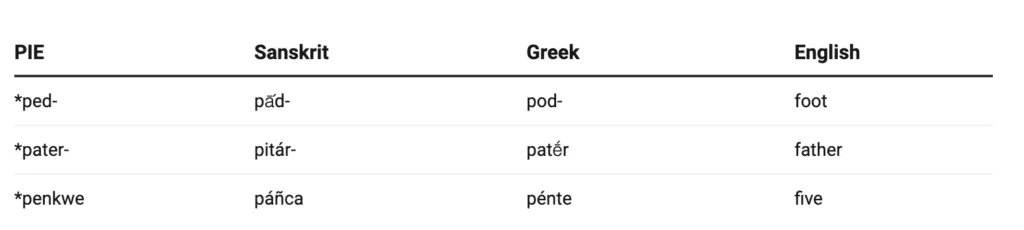
The understanding of Indo-European languages’ shared ancestry began to emerge during the Renaissance and early colonial periods. European scholars based in India, such as Gaston Coeurdoux and William Jones, were struck by the undeniable parallels between Sanskrit words and their European counterparts. Sanskrit’s “mā́tṛ” (mother), “bhrā́tṛ” (brother), and “dúhitṛ” (daughter) resonated powerfully with Latin, Greek, and German equivalents.
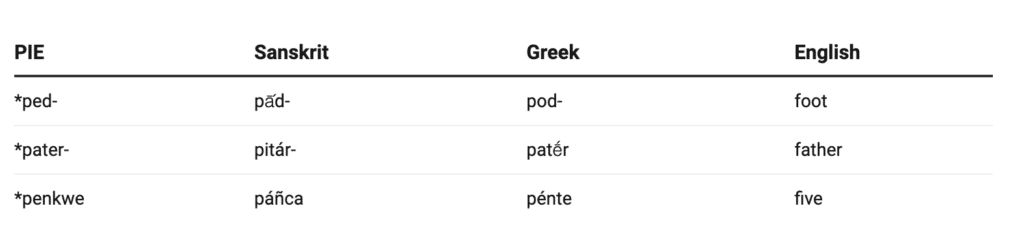
Crucially, these similarities couldn’t be explained by historical contact, nor by mere chance. What truly cemented the theory was the systematic nature of these correspondences. For instance, Sanskrit’s “bh-” consistently matched Germanic “b-,” not only in “bhrā́tṛ” (brother) but also in “bhar” (bear). Similarly, Sanskrit “p-” aligned with Latin and Greek “p-,” but with Germanic “f-.”
Such regular sound shifts, or “correspondences,” provided irrefutable evidence that these languages diverged from a common ancestor. Nineteenth-century philologists like Rasmus Rask, Franz Bopp, and August Schleicher formalized these observations. By comparing and reverse-engineering the phonetic changes words underwent in descendant languages, they demonstrated that the vocabulary of the lost ancestral language could be reconstructed. This pioneering work not only established historical linguistics as a discipline but also influenced Charles Darwin’s groundbreaking concept of biological evolution.
The Proto-Indo-European Family Tree: A Vast Linguistic Network
The Indo-European language family is extensive and diverse, akin to a biological genus. PIE stands as the root, with descendant languages branching out to form various sub-families. These include:
- Indo-Aryan languages: Sanskrit and Hindi
- Iranian languages: Persian and Kurdish
- Hellenic languages: Greek and Ancient Macedonian
- Italic languages: Latin, Spanish, and Italian
- Germanic languages: English, Dutch, and German
- Balto-Slavic languages: Russian and Lithuanian
- Celtic languages: Welsh and Breton
- Armenian and Albanian
Additionally, extinct branches like Anatolian (Hittite) and Tocharian are known through ancient written records. Other languages such as Phrygian, Dardanian, and Thracian are believed to be Indo-European, although historical documentation is less complete.
It’s important to note that not all languages spoken in India or Europe belong to the Indo-European family. For instance, Dravidian languages like Tamil and Telugu in India, and Basque, Georgian, Maltese, and Finnish in Europe, represent distinct linguistic lineages. The Finnish words “jalka” (foot), “isä” (father), and “viisi” (five) offer a stark contrast to their Indo-European counterparts, highlighting this diversity.
Glimpses into the Lives of PIE Speakers
Beyond mapping linguistic relationships, reconstructed PIE vocabulary provides invaluable insights into the lives, culture, and geographical origins of its speakers. Terms like “*rēg-” (tribal king) and “*pelə-” (fortified high place) suggest a hierarchical, perhaps martial, society. The presence of words for grain agriculture (*agro, field; *grə-no, grain), animal domestication (*ghaido, goat; *gwou, cattle), vehicular transport (*wogh-no, wagon; *aks-lo, axle), and metalworking (*arg-, shine or silver; *ajes, copper or bronze) paints a picture of a developed, resourceful community.
Evidence of trade (*wes-no, buy; *k(a)mb-yo, exchange) and religious practices (*deiw-os, god; *meldh, pray) further enriches our understanding. Such linguistic clues have led scholars like V. Gordon Childe to link Proto-Indo-European speakers with the Late Neolithic/Early Bronze Age Kurgan culture, situated in the Pontic-Caspian steppe (modern-day Ukraine and southern Russia).

More contemporary research, leveraging phylogenetic methods from evolutionary biology, has also explored a controversial theory suggesting an Anatolian (modern-day Turkey) origin for PIE. This hypothesis posits that the spread of agriculture played a pivotal role in the expansion and diversification of Indo-European languages.
While the actual sounds and direct knowledge of Proto-Indo-European speakers have been lost to the mists of time, the enduring patterns preserved in their descendant languages offer a profound, if shadowy, glimpse into their ancient world. The methodologies developed through this ongoing linguistic detective work continue to be vital tools for reconstructing human ethnolinguistic prehistories across the globe.
This article, authored by Mark W. Post, Senior Lecturer in Linguistics at the University of Sydney, was originally published at The Conversation and is republished under a Creative Commons License.