








DURBAN — History was written at Kingsmead on Friday, though perhaps not in the way the Australian selectors intended. As the first ball of the opening Test against South Africa was delivered, the Australian XI stepping onto the field didn’t just carry the weight of a World Test Championship series; they carried the weight of 149 years of tradition, setting an unprecedented record as the oldest playing XI in the nation’s men’s Test history.
In a remarkable statistical anomaly, not a single player in the Australian lineup was in their 20s. Every member of the squad, from the opening batter to the final slip fielder, had entered their fourth decade of life. It was a selection strategy that leaned heavily on experience, grit, and, evidently, a deep-seated trust in the veterans of the game.
A Historic Age Milestone
The numbers paint a fascinating picture of a team defined by maturity. Captain Pat Cummins, leading a group with an average age of 34.59, steered a side that cricket statistician Ric Finlay identified as the seventh-oldest Test XI in the history of the game—and the oldest in approximately a century.
At 38 years of age, spin stalwart Nathan Lyon anchored the seniority of the team, while at the other end of the spectrum, Matt Renshaw served as the “youth” of the side at 30. The roster is dominated by seasoned campaigners: Steve Smith (37), Mitchell Starc (36), Alex Carey (35), and Josh Hazlewood (35) all crossed the 35-year threshold, highlighting a reliance on the core group that has served Australia for over a decade.
The catalyst for this age-related milestone was the surprise recall of 34-year-old Nic Maddinson. Maddinson, returning to the Test fold for the first time since December 2016, effectively closed the door on the “youth movement” that had seen at least one player under 30 included in the playing XI for months. With Maddinson’s inclusion, the rotation of younger talent—such as 27-year-old Cameron Green, who has struggled for form—was set aside in favor of a “win-now” veteran approach.
The Test of Fire at Kingsmead
If the selection was intended to provide stability, the South African bowling attack certainly put that theory to the test. Despite the absence of their pace spearhead Kagiso Rabada, the Proteas utilized the favorable, grass-tinged conditions at Kingsmead to keep the Australian veterans on their toes.
South African quicks Anrich Nortje, Wiaan Mulder, and Marco Jansen exploited the early bounce and seam movement with surgical precision. Australia, having won the toss and elected to bat, found themselves in early trouble. Mulder provided the initial breakthrough by dismissing Travis Head for just nine runs. Shortly after, the returning Maddinson endured a grueling 33-ball stay at the crease without scoring a single run, eventually falling to Jansen. By the time the scorecard read 24/2, the questions regarding the wisdom of selecting an aging lineup began to surface in the commentary box.
Smith Reaches Personal Milestone Amidst Struggle
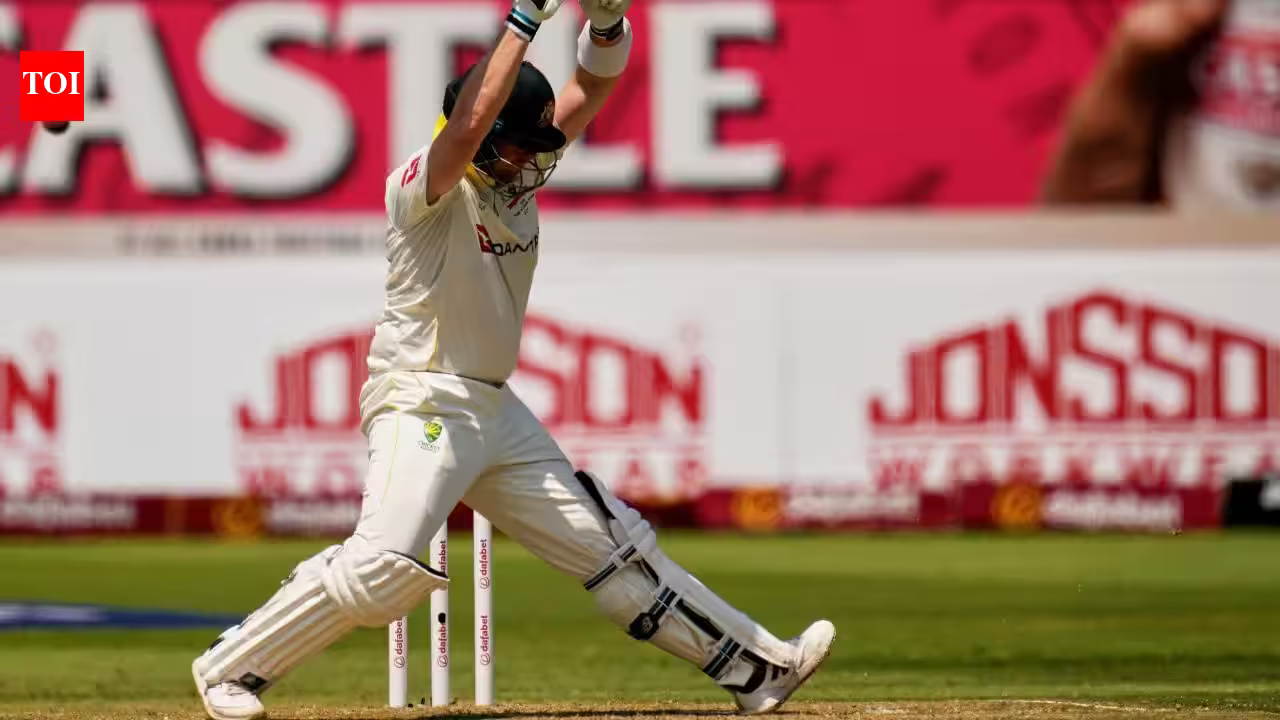
While the scoreboard showed pressure, the middle order attempted a recovery. Marnus Labuschagne (37) and Steve Smith (25) combined for a vital 60-run partnership that occupied 94 balls, providing the stability the team desperately needed.
For Smith, the innings was significant for more than just the runs provided. By taking to the crease, he officially moved past the legendary Steve Waugh to become Australia’s third-highest run-scorer in men’s Test cricket. Even at 37, Smith showed flashes of his trademark flair, dispatching spinner Keshav Maharaj for two emphatic sixes before his tenure was brought to a close by Jansen shortly after the lunch break.
Weather Intervenes
By the time rain and deteriorating light halted play, Australia sat at 187/6. It was an underwhelming start to a series that carries massive implications for the World Test Championship standings.
For the Australian management, the gamble on seniority is clear. With an 18-member squad averaging 32.6 years and only three players under 30—Cooper Connolly (23), Cameron Green (27), and Sam Harper (29)—the team has signaled that they prioritize temperament and battle-hardened consistency over the exuberance of youth.
Whether this aging guard can withstand the intensity of a high-stakes series in South Africa remains to be seen. As the players return to the pavilion at the end of Day One, they do so knowing that they have etched their names into the history books—not just for the cricket they are playing, but for the rarity of the demographic they represent. They are a team of veterans, playing a young man’s game, with the pressure to prove that age is merely a number in the pursuit of Test supremacy.
Disclaimer: This content is auto-generated for informational purposes only.
Source: Read Original News