








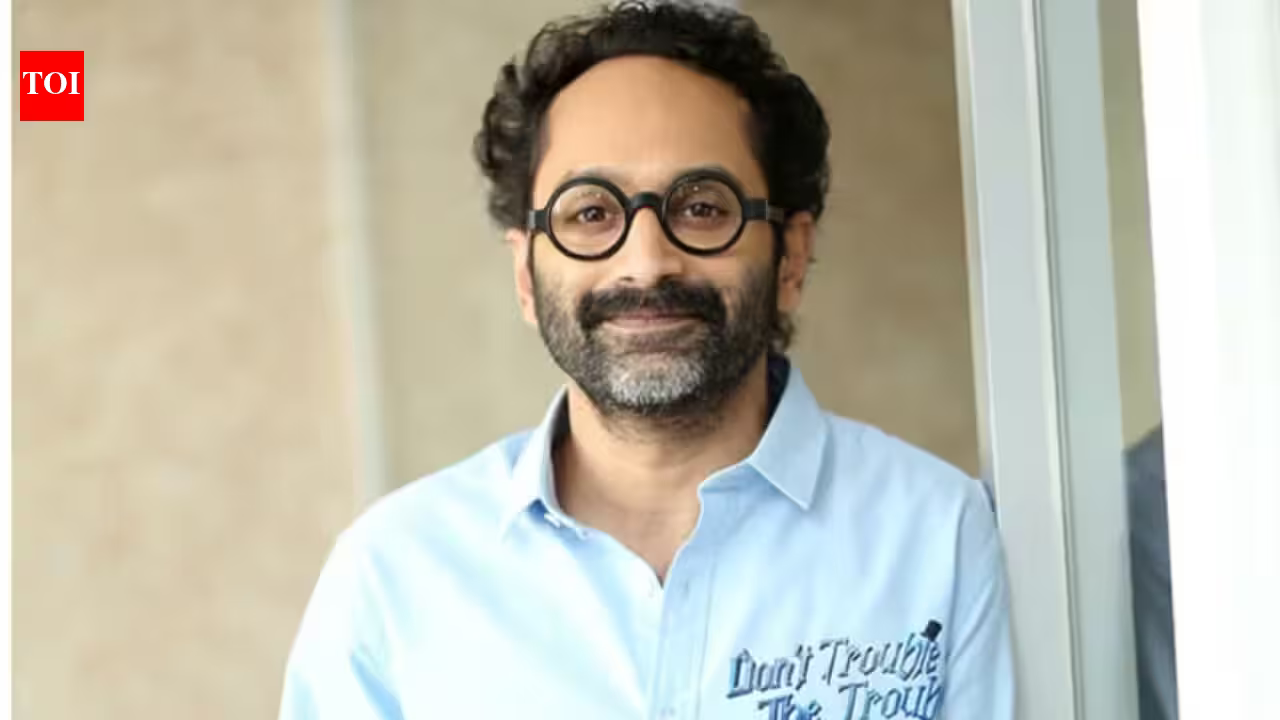
It is impossible to look at Fahadh Faasil today and see anything other than a titan of modern Indian cinema. With his piercing, restless gaze and an uncanny ability to inhabit the skin of the most morally ambiguous characters, he has redefined what it means to be a “star.” Yet, the trajectory of his life—and the quiet intensity he brings to the screen—was forged not in the glamorous studios of Kochi, but in the halls of American academia and the shadow of one of the 21st century’s most defining tragedies.
Long before he was commanding the screen in Aavesham or holding his own against giants in Pushpa, Fahadh was simply a young man looking for a way out. His story is one of serendipitous detours, where the grand machinery of history collided with a teenager’s ambition, forcing him onto a path that would eventually make him the most enigmatic actor in the country.
The Butterfly Effect of September 11
In the autumn of 2001, Fahadh Faasil had the world at his feet—or so he thought. Having just completed his Class XII, the young aspiring student had his sights set firmly on the United States. He had secured scholarships and was prepared to trade the humid landscapes of Kerala for an American campus. Then, the world stood still.
The 9/11 terror attacks sent shockwaves across the globe, bringing international travel and student visa processes to a grinding, uncertain halt. For Fahadh, the impact was visceral and immediate. His plans were frozen, his departure date vanished into the ether, and he found himself grounded in India for months.
It is easy to view this as a footnote in a successful man’s biography, but for the teenage Fahadh, it was a period of intense limbo. As he spent four to five months waiting for the dust to settle, the anxiety in his household began to mount. His mother, concerned by his sudden stagnation, pushed him to find a temporary footing. He enrolled at SD College in Alappuzha, a detour that kept him occupied for a year. It was a time of internal restless energy—a prelude to the transformative odyssey that awaited him across the Atlantic.
Finding Philosophy Amidst the Engineering Dreams
When Fahadh finally landed in the U.S., the reality of the American dream did not match the brochures. Initially arriving on a scholarship to pursue engineering, he quickly realized that the technical rigidity of the degree was at odds with the creative, observational mind he was cultivating.
In a candid admission, Fahadh noted that he eventually dropped the engineering track after two years. It was a bold, potentially life-altering risk, but one that led him to the study of Philosophy. This academic pivot was perhaps the most critical moment of his pre-stardom life. Philosophy forced him to interrogate the human condition, to analyze motivation, and to understand the subtext of existence—all skills that would eventually become the hallmark of his acting style.
He now describes his life in two distinct halves: the version of him that existed before the U.S. and the version that returned. The six years he spent in America were his crucible. Away from the pressures of being the son of a legendary filmmaker, he became an ordinary student, exposed to a global landscape of literature, philosophy, and—most importantly—world cinema. He wasn’t just consuming movies; he was deconstructing them.
The Departure and the Quiet Return
The irony of Fahadh’s journey is that he had technically already entered the industry before his U.S. hiatus. His debut film, Kaiyethum Doorath, arrived with expectations that were as high as the disappointment that followed. The film tanked at the box office, and for a young, bruised ego, the retreat to the U.S. felt like a permanent exit. He left India just two days after the film’s release, harborous thoughts that he might never look back at the industry again.
For a long time, the U.S. was his home, and India was merely a place for a holiday. But the very thing he sought to escape—cinema—began to pull him back. The six years of intellectual maturation in America acted as a strange kind of gestation period. He wasn’t the same boy who had fled the shame of a box-office failure. He returned with a matured craft, a deeper reservoir of life experience, and a laser-focused intention. He famously said, “Those six years made me want to come back and do a movie.”
What was initially intended to be a single, redemption-seeking project blossomed into a career trajectory that has been nothing short of phenomenal. He didn’t just return to acting; he returned as a reinvented force of nature.
A New Frontier: The Pan-Indian Evolution
Today, Fahadh Faasil’s work is synonymous with an uncompromising dedication to character-driven storytelling. Whether it is his chilling portrayal of a ruthless antagonist or his nuanced, vulnerable performances in smaller independent features, he has cultivated a brand that transcends the boundaries of the Malayalam industry.
His upcoming project, Don’t Trouble The Trouble, directed by Shashank Yeleti and co-starring Saurabh Sachdeva, marks another step in his widening horizon. It signals a move into broader, pan-Indian territories where his unique brand of understated intensity is now being recognized as a gold standard for performance.
Looking back at the trajectory—from a college student stranded by a global tragedy to a philosopher-actor who captivates audiences in every language he touches—it is clear that the 9/11 delay was not a roadblock. It was a recalibration. Fahadh Faasil’s life reminds us that sometimes, being forced to wait is exactly what you need to become the person you were meant to be. The delay didn’t stop him; it gave him the six years of perspective he needed to eventually dominate the screen.
Disclaimer: This content is auto-generated for informational purposes only.
Source: Read Original News