







If you were designing a setting to encourage people to take their health seriously, you could do worse than St Barts, the tiny island in the Caribbean. You reach it via Antigua, in what feels like the world’s smallest plane, landing on, allegedly, one of the world’s shortest runways (646m long — eek!), the descent skimming water so vividly blue it looks almost artificial.
I arrived with my husband, Bruce, carrying more than I had quite acknowledged. The past two years had been dominated by my mother’s decline and death from Alzheimer’s. I arrived not in acute grief, but something more enduring that settles into the body, and shows up in sleep, or the lack of it.
Alongside the fatigue, I carried something else: that creeping midlife vigilance about memory — not dramatic lapses, but small, everyday glitches most of us experience. When you have watched someone you love disappear incrementally, neurone by neurone, they land differently. The line between normal ageing and something more ominous no longer feels abstract.
So when I was invited to Saint-Barth Longevity — a high-end medical and wellness retreat promising deep biological insight, personalised health optimisation and, implicitly, a degree of control over how we age — it felt both appealing and faintly provocative. Appealing, because I wanted to sleep again. Provocative, because it sits within a growing area of medicine that asks not just how we treat illness, but how far we can go in trying to pre-empt it.


There is a particular kind of stillness in Saint Barthélemy that feels improbable: not silence, but something softer, held within heat, light and sea. The water is impossibly clear, the air warm, salt-edged, the days long, unhurried.
At the St Barthélemy Hotel and Spa we were looked after by the wonderful Maksym Vasylyev and his team. The space itself feels deliberately softened: calm, light-filled, with natural tones, clean lines and an ease that feels refined without effort. There is an understated elegance that settles the nervous system almost immediately.
The visionary owner, Denise Dupré, brings a human-centred approach to hospitality, defined by her idea that “everything begins with people”. This is further shaped by a “long-term vision” to create something “enduring” and “deeply personal”. Her ethos carries through to the exceptional food — elegant and balanced — and staff who can talk you through every dish, accommodating any preference effortlessly.
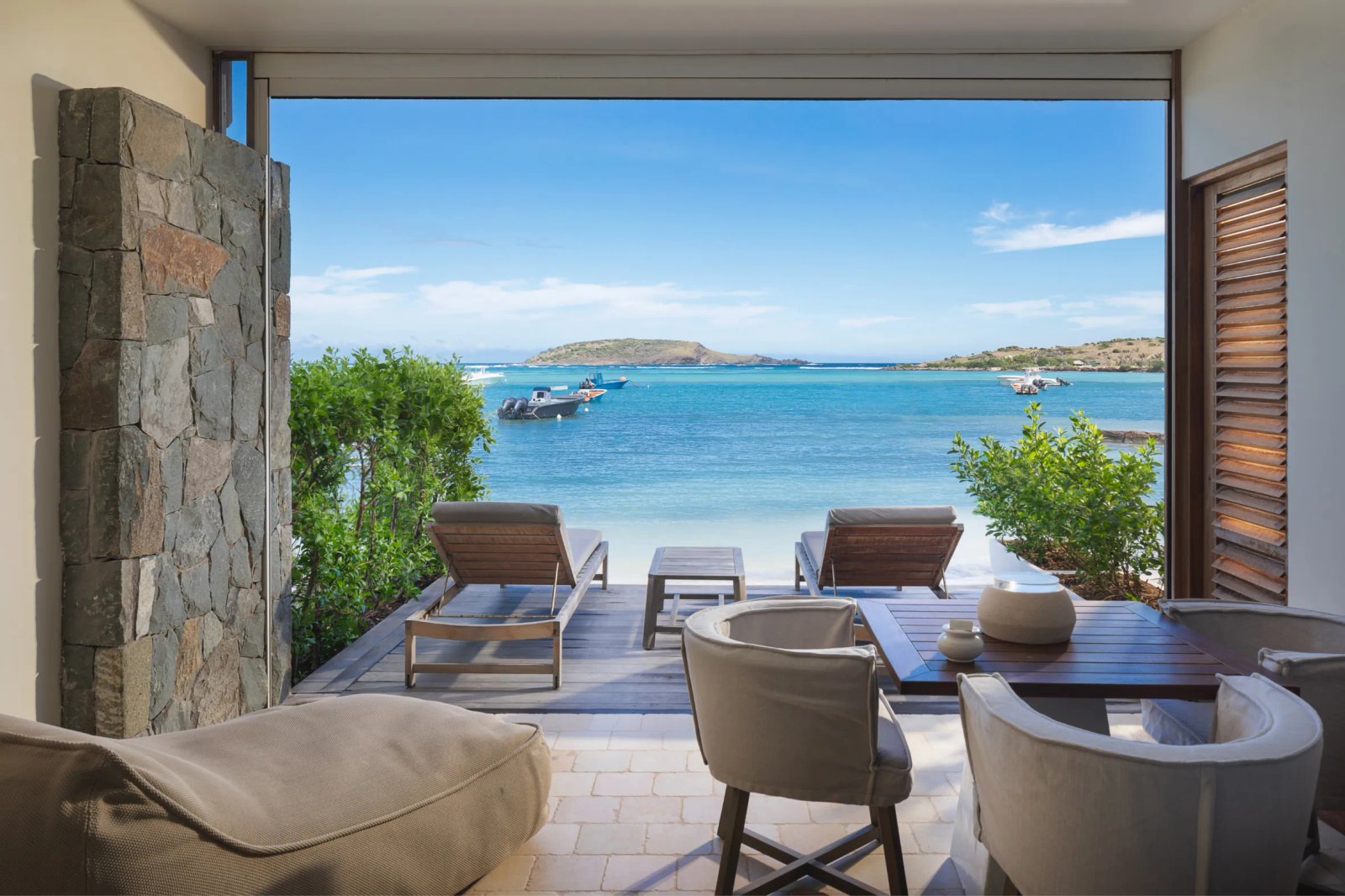
From the infinity pool to the well-equipped gym and luxurious spa, everything feels expertly curated and quietly refined, creating a sense that nothing is hurried, and everything is considered. Our La Suite Plage, unfolding across two levels, opens directly onto a peaceful private beach. From day one we were greeted by name, our preferences quietly anticipated, the concierge on WhatsApp. It is easy to see why Dr Franck Baudino chose to embed his programme here.


Baudino is a French physician whose career has moved from frontline medicine into longevity science. He is unmistakably suave but grounded — welcoming without performance. His path feels less like a lifestyle pivot and more like a natural evolution: from repair to prevention.
On my first day (the one-year anniversary of my mother’s death), I met him for an initial consultation in a space that was neither clinic nor spa, but something in between. He frames his model as four pillars of preventive medicine and longevity, which are interconnected rather than standalone: sleep and recovery, metabolic health and nutrition, movement and physical vitality, and mental-emotional regulation. The aim is not optimisation in isolation, but balance across the system.
Our conversation moved quickly between mind and body: sleep, stress, cognition, loss. He quickly identified the familiar midlife anxiety — which is less the fear of death, than the fear of decline and of losing cognitive sharpness. In my case, there is the fear of subtle changes that might signal something more serious. He is pragmatic. Some changes are normal. But sleep, stress and metabolic health shape how the brain ages. The aim is not to eliminate risk but to reduce what is modifiable.


The programme begins, as all good medicine should, with a conversation: a detailed exploration of history, lifestyle and symptoms. Grief, Baudino notes, is not just felt but carried: in disrupted sleep, elevated stress, and a nervous system that never quite switches off.
Following the conversation, the process deepens to blood tests, cardiovascular screening and metabolic profiling. Each offers a different perspective on body functioning beneath the surface. It’s not symptoms that are analysed but a whole system.
My schedule was full: diagnostics, consultations and treatments alongside yoga, Pilates, hiking, massage, sound baths and cold-water immersion. It is intense. The programme runs over five or seven days. I would recommend seven.
The approach shifts the question from “What’s the matter?” to “How are you functioning?” Baudino’s team reflects this: they are multidisciplinary, thoughtful, and notably free of the evangelical tone that often creeps into this space.

There is, on St Barts, a particular kind of morning that feels designed for reinvention. It was into this quiet that I met Diana Bourel, who has the calm of someone entirely at home in her own body. Her yoga is slow, deliberate, almost forensic in its attention. She notices everything: the guarded shoulders, the shallow breath, and gently invites you back into yourself. There is something disarming about being seen in that way.
As we hiked, occasionally spotting whales in an ocean that recalibrates your sense of scale, conversation drifted easily. We both have daughters of the same age, who got married recently around the same time. We both lost our mothers to Alzheimer’s. We share the same birthday. Her care came via a quiet insistence: to feel your body working, your lungs expanding, your physical self not as something to be fixed, but inhabited.
I also had a consultation with a performance specialist who works with elite athletes — although you wouldn’t know it from the way he meets you, without hierarchy or judgment. “There is no competition nor failure here,” he says. The assessment feels more like conversation than test.
From there, the lens widens into nutrition. This is approached not through calories, but through patterns and rhythms, the way you eat within the context of how you live. It is less prescriptive than interpretive.


Sleep, here, is central. Not secondary but foundational, particularly for cognitive health. There is growing evidence that sleep supports the brain’s clearance of metabolic waste, including proteins associated with Alzheimer’s disease. I needed both help and reassurance, since my sleep had been fractured by the long goodbye of my mother’s illness.
Baudino is clear — sleep is not simply rest, it is maintenance. After an overnight study, he reframed my sleep not as broken, but as responding to stress and a system that had been held on alert for too long.
The focus is not on quick fixes, but on recalibration: light exposure, timing, nervous-system regulation. This is a return to fundamentals, delivered with a precision that is rarely available in everyday care.
My final consultation was with the precision medicine and longevity doctor Dr Adrien Paix, who presented my full report, compiled by all the practitioners. There is rigour here, but also coherence. Results are not presented as numbers, but as a narrative: patterns are identified and connections made. I have follow-up tests (hormones), cardiac screening (my father died suddenly and unexpectedly of a heart attack aged 67) and programmes to reduce cholesterol and increase muscle strength and movement, as well as regular support for the next month and then sustained follow-ups. This I now recognise is preventive medicine at its best: early, personalised and integrative.
Spending time at Saint-Barth Longevity, I became aware of a subtle shift. Traditional medicine draws a line: you are either well or you are not. Here, that line softens. The focus is on optimisation, making the body and brain function as well as possible.

I arrived with my usual twin lenses: questioning journalist and evidence-based clinician. I expected something polished but commercial and perhaps a bit woo-woo. What I encountered instead was more authentically persuasive. This is a model that does not abandon science but expands it.
I did not leave younger. But I did leave different. A sense that the body is not entirely opaque. That there are ways of understanding it, supporting it, nudging it in a better direction.
And already, although still grieving, I am sleeping again.
Dr Tanya Byron was a guest of Le Barthélemy Hotel and Spa. Three, five and seven-day Saint Barth Longevity cost from £3,995 to £42,561, depending on the length and scope of treatment plan. Following a retreat, guests can receive up to six months of continued expert support, including virtual consultations, personalised supplements and access to a private monitoring platform. Doubles at La Suite Plage cost from £2,031, B&B, and the private Villa Oui — exclusive to Le Barth Villas — from £30,200 a week, B&B, with use of all hotel and spa facilities