







Three Days of Tennis: The Inside Story of Wimbledon’s Never-Ending Marathon
It sounds like the premise of a surrealist sports comedy—a tennis match so long that the stadium’s electronic scoreboard literally gives up and stops functioning. Yet, in the summer of 2010, this absurdity became reality at the All England Club when American John Isner and France’s Nicolas Mahut engaged in a battle of attrition that defied the limits of human endurance.
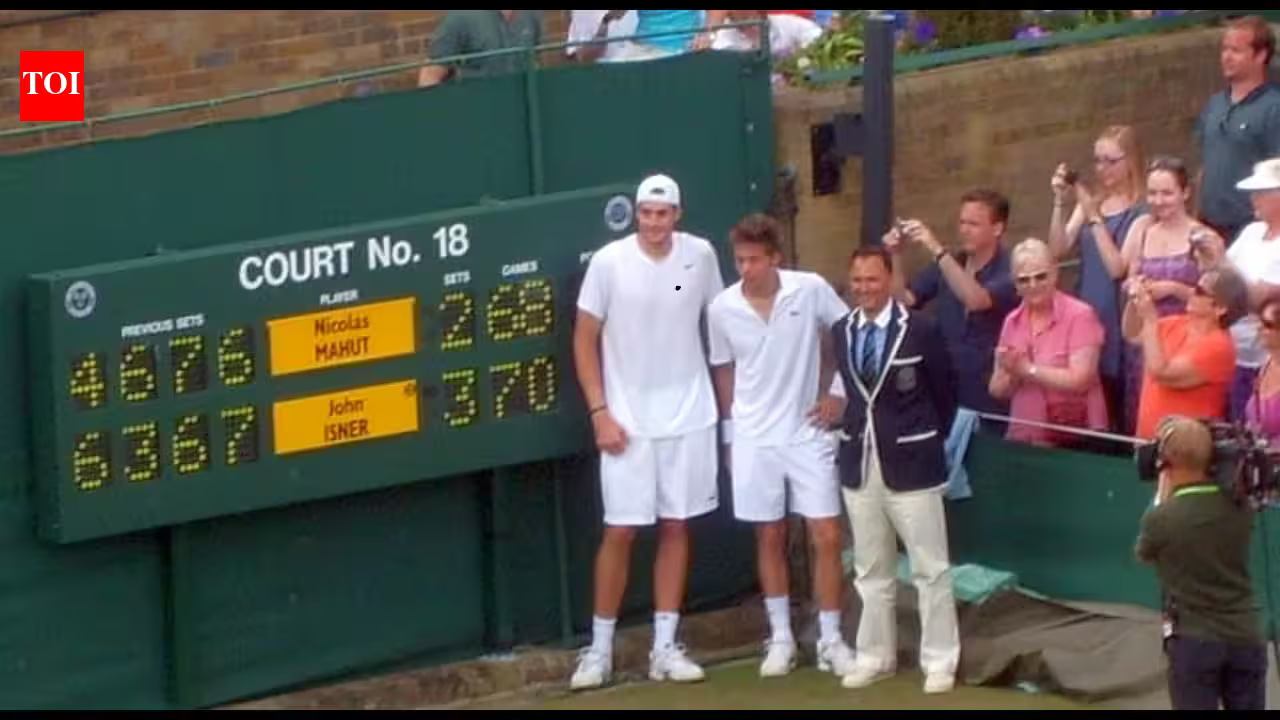
The opening round of the 2010 Wimbledon Championships began on Court 18 on June 22. What followed was an 11-hour, five-minute epic spread across three days, resulting in a scoreline that remains the most famous in the sport’s history: 6-4, 3-6, 6-7, 7-6, 70-68.
The Fifth Set That Refused to End
While the first four sets were competitive, the deciding set transformed into a grueling test of willpower. Because Wimbledon rules at the time required a two-game advantage in the final set, neither player could secure the win. They held serve with mechanical consistency, moving through the 20s, 30s, and 40s.
By the time they reached 47-47, the stadium’s electronic scoreboard, which had not been programmed to track such astronomical numbers, suffered a technical malfunction. The crowd watched on as the two players, visibly depleted and physically shattered, continued to trade aces. In total, the pair blasted 215 aces over the course of the match—112 for Isner and 103 for Mahut.
Only three service breaks occurred throughout the entire 183-game marathon. Finally, after eight hours and 11 minutes of play in the fifth set alone, Isner managed the decisive break to claim the victory.
A Legacy of Change
The physical toll of the match was immediate. Isner, struggling with the lingering exhaustion of his three-day battle, was eliminated in the very next round. However, both men earned their place in sporting history, eventually being honored with a dedicated plaque outside Court 18.
The match’s impact on the sport was profound. The sheer length of the contest and a similar marathon involving Isner in 2018 served as catalysts for the Grand Slams to overhaul their rulebooks. Today, the major tournaments have largely abandoned the “unlimited” final set in favor of tie-breaks, ensuring that such an exhaustive display of endurance may never be repeated.
From Court 18 to Hollywood
The sheer unlikelihood of the encounter captured the global imagination, eventually serving as the inspiration for the 2015 HBO mockumentary 7 Days in Hell. Starring Andy Samberg and Kit Harington, the film turned the 2010 spectacle into a comedic premise, proving that the real-life encounter was, in many ways, stranger than fiction.
More than a decade later, the match stands as a testament to the iron will of two athletes who redefined the boundaries of professional tennis. It remains, by every metric, the longest tennis match in history, a record that currently sits untouched in the annals of the sport.