






India and Japan Strengthen Security Ties, Focus on Indo-Pacific and Domestic Defense Production
NEW DELHI – India and Japan have agreed to significantly bolster their security cooperation, particularly in maritime affairs, following a high-level meeting between their defense ministers in New Delhi on Thursday. The move signals a deepening alliance between the two nations, both key members of the Quad security framework, as they seek to counter regional challenges and foster a "free and open Indo-Pacific."
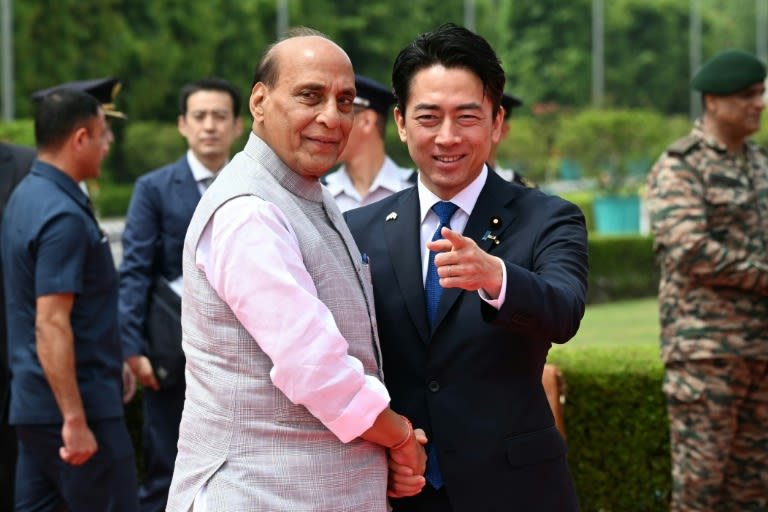
India’s Defence Minister Rajnath Singh and his Japanese counterpart Shinjiro Koizumi engaged in extensive discussions, culminating in the signing of a crucial memorandum of understanding on maritime security cooperation. A joint statement released after the meeting emphasized the importance of this enhanced partnership, stating, "The two ministers affirmed their commitment… to further deepen defence cooperation to realise a free and open Indo-Pacific." The statement further highlighted that "Such cooperation is vital not only to Japan and India, but also to the region and the international community."
Both India and Japan are integral components of the Quad security alliance, alongside the United States and Australia. This grouping is widely perceived as a strategic counterbalance to China’s growing military and economic influence across the Indian Ocean and the broader Asia-Pacific region.
A significant aspect of the discussions focused on India’s ambitious "Make in India" initiative, which aims to establish a robust domestic military hardware industry. New Delhi has expressed a strong desire for Tokyo’s increased involvement, leveraging Japanese capital and advanced technological expertise to accelerate this goal. The defense ministers explored avenues for joint development in naval shipbuilding and design, envisioning a synergistic collaboration that combines Japan’s cutting-edge technology with India’s burgeoning production capabilities. This strategic alignment could prove instrumental in enhancing the defense capabilities of both nations while fostering economic growth and technological transfer.
Minister Koizumi’s visit closely follows a productive meeting in July between Indian Prime Minister Narendra Modi and Japanese counterpart Sanae Takaichi. During that earlier summit, leaders agreed to intensify collaboration on critical minerals – a sector currently dominated by China. Following that meeting, Takaichi issued a cautionary note, highlighting that both Japan and India were contending with significant challenges, including the "weaponisation of the economy and non-market policies and practices."
These statements have not gone unnoticed by Beijing. In response to the Modi-Takaichi meeting, China’s foreign ministry had previously commented that international cooperation "should not target or harm the interests of third parties, let alone serve as a pretext for forming exclusive cliques or stoking confrontation." This underscores the broader geopolitical context in which India and Japan are strengthening their alliances.
The renewed commitment to security and defense cooperation between India and Japan signifies a shared vision for regional stability and prosperity. By leveraging their respective strengths in technology, production, and strategic positioning, the two nations aim to enhance their collective security, promote a rules-based international order, and contribute to a truly free and open Indo-Pacific.