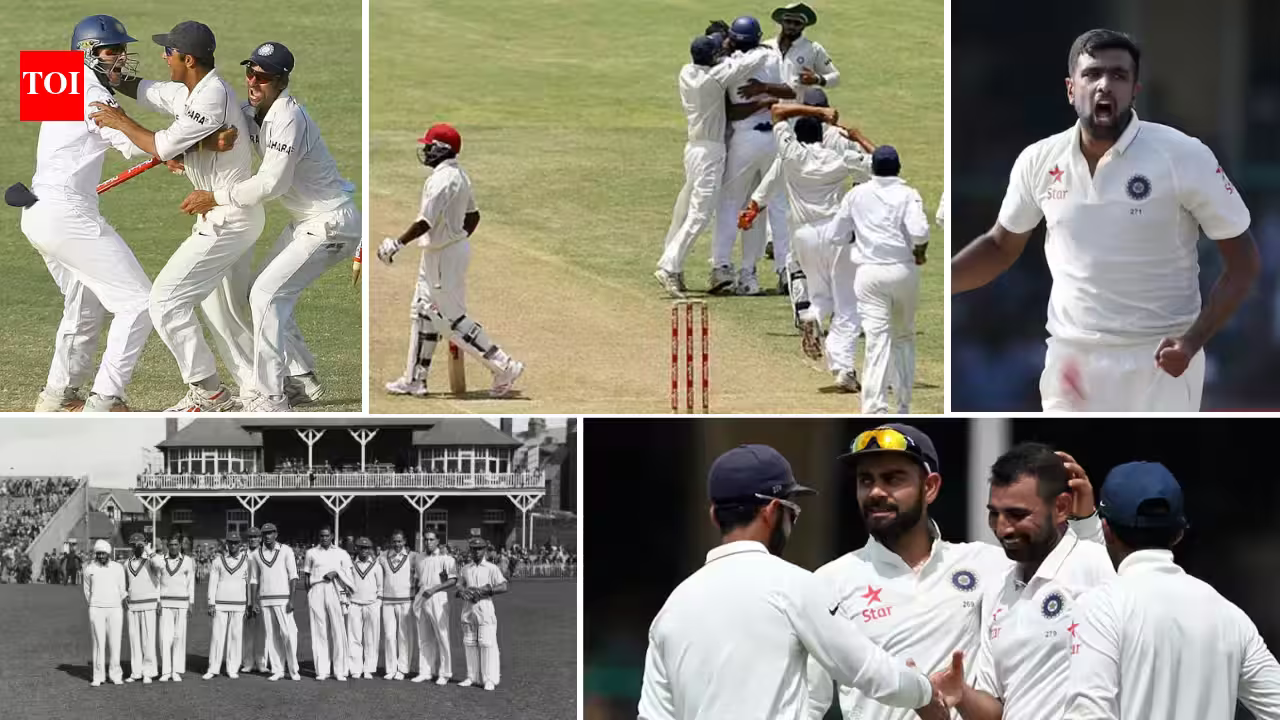






This Saturday marks a significant moment in the annals of Indian cricket history, as the nation prepares to contest its 600th Test match at the Galle International Stadium in Sri Lanka. This monumental achievement comes an astounding ninety-four years after India’s inaugural appearance in the format, led by the legendary Colonel Cottari Kanakaiya Nayudu (CK Nayadu) at Lord’s Cricket Ground on June 25, 1932. The Indian team, under the captaincy of Shubman Gill, will join the esteemed company of England and Australia as only the third nation to reach this incredible milestone. Adding a layer of poetic significance, this landmark event coincides with India’s 80th Independence Day, a powerful reminder of the nation’s journey from colonial rule to a global cricketing powerhouse.
Over these nearly ten decades, 319 talented individuals have proudly worn the Indian Test cap, with Manav Suthar being the most recent addition to this exclusive club. The record for the most Test appearances belongs to the iconic Sachin Tendulkar, who incredibly featured in 200 matches. The leadership baton has been passed through 38 captains, guiding the team through countless highs and lows, all in pursuit of cricketing excellence. Virat Kohli stands out as the most decorated Test captain, having led India in 68 matches between 2014 and 2022, securing an impressive 40 victories. As the Men in Blue prepare for their 600th encounter in Galle, it’s worth reflecting on some of the pivotal moments in their Test match journey.
India’s first ever Test, played against England at Lord’s from June 25 to 28, 1932, was not without its pre-match drama. While the Maharajah of Porbandar was initially slated to captain the touring side, wisdom prevailed, and CK Nayudu was ultimately chosen to lead the nascent Indian team. Despite Mohammad Nissar’s brilliant opening spell, which saw him clean bowl Percy Holmes and Herbert Sutcliffe for 6 and 3 respectively, England’s captain Douglas Jardine steadied the ship with a crucial 79, supported by Les Ames’ 65, taking their first innings total to 259. Nissar’s 5 for 93 marked India’s first five-wicket haul in Tests. India struggled in their reply, bowled out for 189 by the efforts of Bill Bowes (4 for 49) and Bill Voce (3 for 23), granting England a 70-run lead. England capitalized, declaring their second innings at 275 for 8, setting India a daunting target of 346. Despite a valiant 51 from Amar Singh, India succumbed to a 158-run defeat.
The 100th Test for India took place at Birmingham against England, from July 13 to 15, 1967. Led by the charismatic Mansur Ali Khan Pataudi, India embarked on a three-match Test series in England. Having already lost the first two encounters, India entered the third match hoping to avoid a whitewash. England batted first, scoring 298, with India’s quartet of spinners – Srinivas Venkataraghavan, Bhagwath Chandrasekhar, Bishan Bedi, and Erapalli Prasanna – claiming all ten wickets. Despite a batting line-up featuring Farokh Engineer, Ajit Wadekar, Chandu Borde, and Pataudi himself, India crumbled against the English attack, managing only 92 runs in their first innings. Engineer was the highest scorer with 23. While Chandrasekhar, Bedi, and Prasanna again combined to take nine of England’s ten second-innings wickets, England had already amassed a lead exceeding 400, setting India a target of 410. Wadekar’s fighting 70 wasn’t enough, as India were dismissed for 277, resulting in a 132-run victory for England and a 3-0 series sweep.
India’s 200th Test, held in Lahore against Pakistan from December 10 to 15, 1982, was an unusual affair. Due to a controversial decision by the then Board of Control for Cricket in Pakistan (BCCP) to sell the entire series to a private party for approximately £800,000, high ticket prices kept spectators away from the historic Gaddafi Stadium. Although prices were halved after the second day, the crowds largely remained absent. Despite the sparse attendance, the match, the first of a six-Test series, witnessed exceptional batting performances. Zaheer Abbas’s monumental 215, his 100th first-class century, propelled Pakistan to a formidable 485 after Indian captain Sunil Gavaskar chose to field. Mohinder Amarnath, returning after nearly two years, anchored India’s reply with an unbeaten 109. Gavaskar also contributed 81, surpassing the 7,000 Test run mark, while Sandeep Patil played a blistering knock of 68 off 56 balls. India posted 379 in their first innings, and with Pakistan scoring 135 for 1 in their second, the match ultimately ended in a draw.
The 300th Test for India took place in Ahmedabad against South Africa, from November 20 to 23, 1996. This match also marked the Test debut of VVS Laxman. Indian captain Sachin Tendulkar made a strategic decision to bat first on a dry, dusty pitch, putting India in a potentially advantageous position. Tendulkar’s 42, Manjrekar’s 34, and Azharuddin’s 35 helped India reach 223 in their first innings, with Allan Donald claiming 4 wickets for 37 runs. India’s spin trio of Anil Kumble, Sunil Joshi, and Narendra Hirwani then wreaked havoc, taking 8 South African wickets and restricting them to a mere 21-run lead. India struggled again with the bat in their second innings, finding themselves at 123 for 6, before Laxman’s crucial 51 helped them reach a total of 190. Chasing 170 for victory, South Africa lost two wickets without a run on the board. Javagal Srinath then delivered a masterful performance, taking six wickets to bowl out South Africa for just 105, securing a memorable victory for India.
India’s 400th Test was contested against West Indies at Sabina Park, Jamaica, from June 30 to July 2, 2006. With the preceding three Tests in the series ending in draws, both teams arrived in Jamaica for the decisive final encounter. West Indies, led by Brian Charles Lara, were sensationally bundled out for a mere 103 runs, with Harbhajan Singh emerging as the wrecker-in-chief, claiming 5 wickets for just 13 runs. Indian captain Rahul Dravid won the toss and elected to bat. India also found batting challenging but managed to reach 200, largely thanks to Dravid’s stoic 81. This gave India a 97-run first-innings lead. However, they couldn’t build a substantial advantage in their second innings. Dravid once again led from the front, scoring 68, but India were dismissed for 171, setting West Indies a target of 269. Anil Kumble then produced a brilliant six-wicket haul, bowling out the West Indies for 219, securing a 49-run victory for India in their 400th Test.
The 500th Test for India took place at the iconic Green Park in Kanpur against New Zealand, marking the beginning of a three-match series. Under the captaincy of Virat Kohli, this match occurred during a period of India’s dominant home performance, particularly driven by the formidable spin duo of Ravichandran Ashwin and Ravindra Jadeja. Murali Vijay (65) and Cheteshwar Pujara (62) scored half-centuries, guiding India to 318 in their first innings on a decent pitch. While New Zealand’s Tom Latham (58), captain Kane Williamson (75), and Luke Ronchi (38) offered resistance, Jadejda (5 for 73) and Ashwin (4 for 93) ensured India secured a 56-run first-innings lead. In their second innings, four Indian batsmen – Vijay, Pujara, Rohit Sharma, and Jadeja – scored fifties, allowing India to declare at 377 for 5 on day four, setting an imposing target of 434 for New Zealand. Unsurprisingly, Ravichandran Ashwin once again proved instrumental in the fourth innings, taking a six-wicket haul to secure a commanding 197-run victory for India. India went on to win the series 3-0, further solidifying their dominance in cricket.