









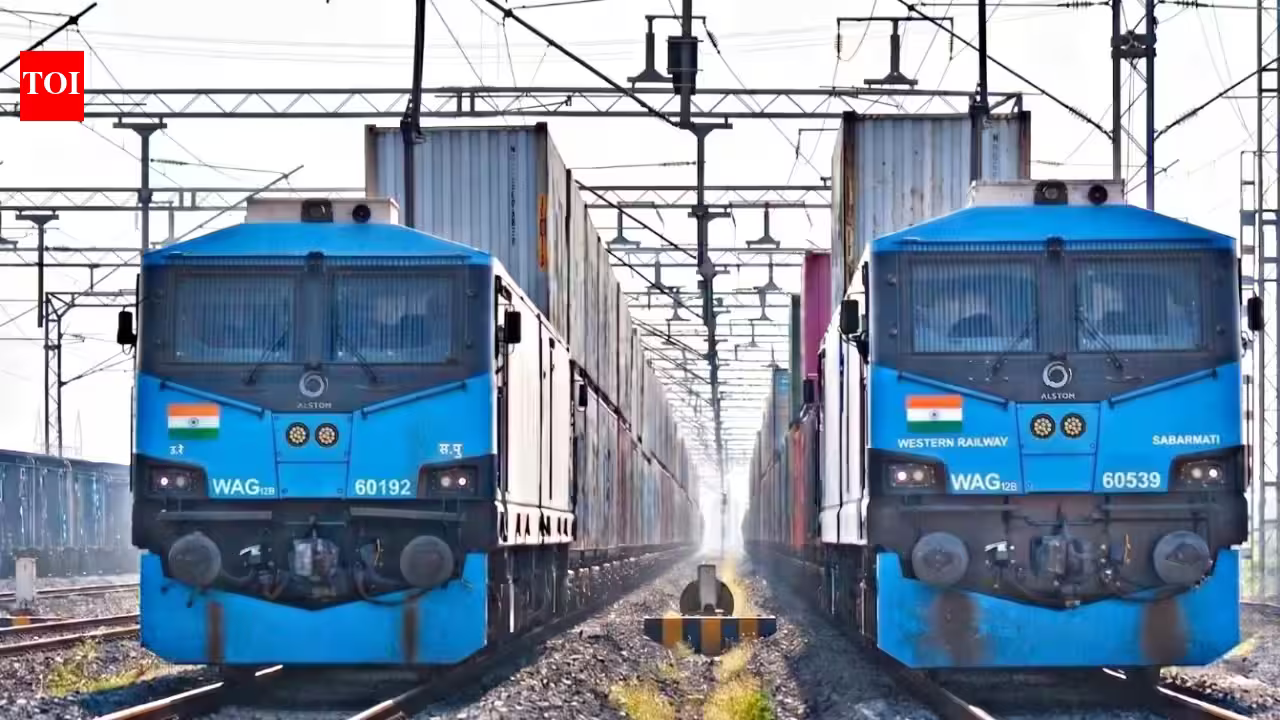
The successful completion of India’s 2,843-km Dedicated Freight Corridor (DFC) network marks a structural pivot in the nation’s logistics landscape. By segregating freight movement from passenger traffic, Indian Railways has addressed a chronic bottleneck that previously saw key trunk routes operating at 115% to 150% of their intended capacity. This infrastructure upgrade is not merely a technical feat of engineering; it serves as a foundational shift toward lowering logistics costs and improving the global competitiveness of Indian manufacturing.
Unlocking Capacity Through Structural Separation
Historically, Indian Railways functioned as a unified network where high-speed passenger trains and heavy freight loads shared the same tracks. This convergence forced freight trains to wait at loops or side tracks to allow passenger express trains to pass, leading to sluggish average speeds and unpredictable transit times. The Western DFC, stretching 1,506 km between Dadri and the Jawaharlal Nehru Port Trust (JNPT), and the 1,337-km Eastern DFC, connecting New Sahnewal in Punjab to New Sonnagar in Bihar, have effectively decoupled these two traffic streams.
The primary operational benefit is the drastic increase in transit velocity. Freight trains on these corridors now maintain average speeds exceeding 50 kmph, nearly double the performance on non-dedicated legacy tracks. This velocity is augmented by the capacity to run double-stack container trains, which maximizes the throughput per rake. By moving heavy, bulk, and containerized commodities onto these specialized arteries, the legacy network is relieved of its congestion, effectively creating dormant capacity that can now be utilized for new passenger routes and higher-frequency transit services.
Economic Efficiency and Modal Shift
For a nation aiming to reduce its logistics costs from the current high levels—often cited as a significant drag on export competitiveness—the DFCs act as a primary cost-optimization tool. Currently, rail freight in India is significantly more economical than road transport, with costs averaging approximately Rs 1.96 per tonne-km compared to roughly Rs 4 per tonne-km for road. Despite this price advantage, rail’s share of total freight movement has hovered around 20%, largely due to the unreliability of transit times and the lack of integrated last-mile connectivity.
The operational predictability offered by the DFCs provides a powerful incentive for industries to pivot back to rail. Reliability is often as valuable as price in modern supply chain management. When logistics managers can guarantee arrival windows, inventory holding costs decrease. Furthermore, as the network matures, the integration of Multi-Modal Logistics Parks (MMLPs) and Gati Shakti terminals along the corridor will allow for seamless transitions between rail and road, ensuring that the “first mile” and “last mile” do not negate the efficiency gains achieved on the main line.
Strategic Requirements for Future Growth
While the infrastructure is in place, the transformation of Indian logistics depends on how these assets are managed and integrated. Industry analysts and transport experts emphasize that the DFCs alone cannot solve the entirety of India’s logistics challenges. To fully capitalize on this investment, a four-pronged approach is necessary: standardizing peripheral feeder connectivity, implementing dynamic pricing models, offering assured transit slots, and expanding the footprint of dedicated logistics hubs.
Standardization is vital because the DFCs represent a high-tech layer in a broader, heterogeneous system. If the local rail lines connecting to factories or mines do not possess the capacity or loading standards to match the DFC, the efficiency gain is bottled up at the periphery. Competitive pricing models, such as those based on Gross Tonne-Kilometers (GTKm), will encourage higher utilization of the corridors, ensuring that the heavy capital expenditure is offset by high-volume throughput. Moreover, as the private sector begins to play a larger role in wagon ownership and terminal management, the efficiency of the DFCs will likely accelerate, turning the corridors into a commercial engine rather than just a public utility.
Expanding the Network and Future Connectivity
The vision for the DFC does not end with the current 2,843-km network. Recognizing the economic impact of the initial phases, the government has already signaled plans for expansion. The proposed Dankuni-Surat corridor, which would traverse the mineral and industrial heartlands of Odisha, Chhattisgarh, Madhya Pradesh, and Maharashtra, indicates a strategic shift toward covering the interior of the country. This would integrate the eastern mineral belts with the western ports, creating a holistic East-West spine that complements the existing North-South structure.
Beyond this, DPRs (Detailed Project Reports) for corridors connecting Kharagpur to Vijayawada and various other sub-corridors demonstrate a long-term commitment to a hub-and-spoke rail freight model. These future projects are designed to ensure that no major industrial cluster remains disconnected from the dedicated freight grid. By continuously expanding this network, India is effectively creating a modern, high-capacity backbone that mirrors the logistics efficiency found in the world’s most advanced rail-based economies.
The Bottom Line: A New Logistics Paradigm
The completion of the Western and Eastern DFCs is a milestone that marks the end of a long-standing constraint in India’s industrial development. The challenge now transitions from construction to optimization. The focus for the next decade will be on “maximizing the yield” of these corridors—specifically, increasing the rail-to-road modal share and lowering the overall logistics cost as a percentage of the country’s GDP.
As India positions itself as a global manufacturing alternative and a crucial link in international supply chains, the efficiency of its internal transport infrastructure becomes a matter of national economic strategy. The DFC network serves as the hardware that supports this ambition. By providing a scalable, reliable, and cost-effective alternative to road freight, it not only promises to decongest India’s roads but also lays the groundwork for a more robust, integrated industrial economy. The ultimate success of these corridors will be measured by their ability to foster consistent, year-on-year growth in freight throughput and their success in making the “Made in India” tag more competitive in international markets through lower landed costs.
Disclaimer: This content is auto-generated for informational purposes only.
Source: Read Original News