

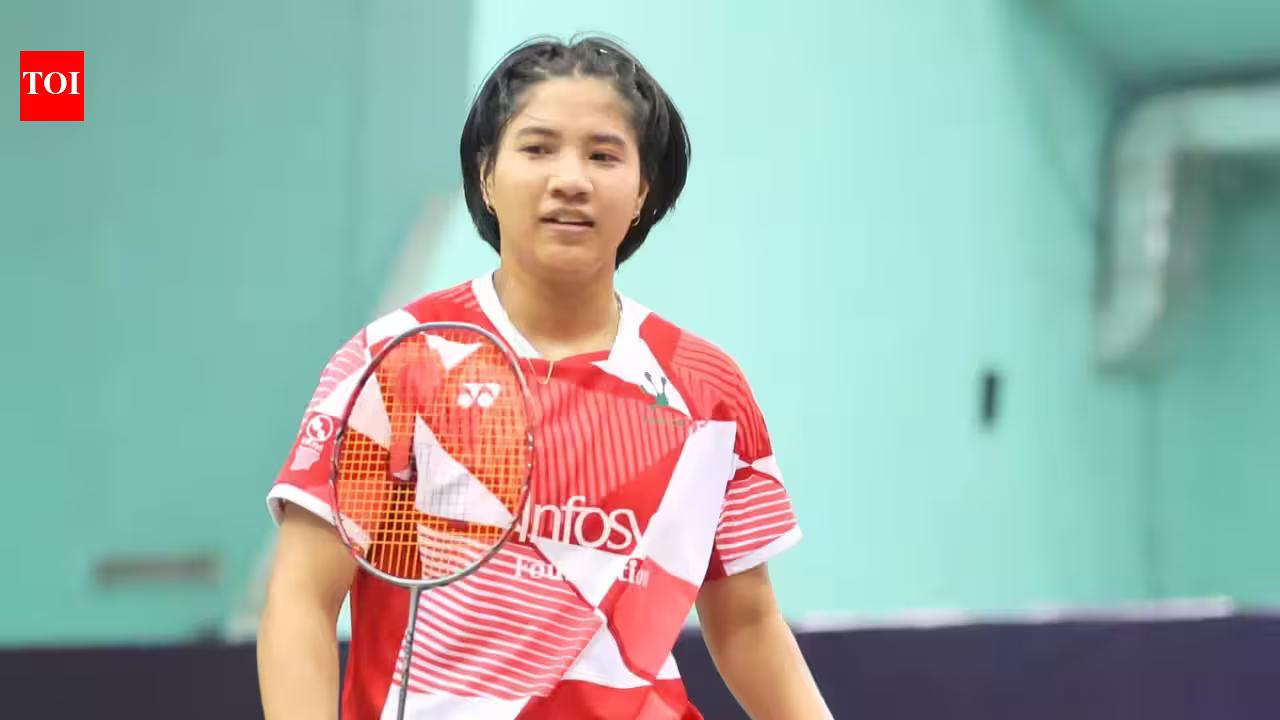






NEW DELHI — The landscape of Indian badminton is shifting, and at the heart of this evolution is a 22-year-old dynamo from Assam who refuses to be intimidated by the sport’s traditional Goliaths. As Isharani Baruah prepares for her maiden Asian Games appearance in Aichi-Nagoya, she carries with her not just the hopes of a nation, but the quiet, unshakable confidence of a new generation that views the continental giants as peers rather than untouchable legends.
Isharani, whose rapid ascent through the world rankings has been one of the most compelling narratives in Indian badminton this year, joins a squad that perfectly balances seasoned wisdom and youthful exuberance. While the team features the towering presence of two-time Olympic medallist PV Sindhu—a beacon of inspiration for any aspiring shuttler—Isharani is part of a wave of emerging talent that includes Tanvi Sharma, Unnati Hooda, and the formidable doubles pair of Treesa Jolly and Gayatri Gopichand. Together, they represent a collective shift in mindset: the days of entering Asian tournaments just to gain experience are firmly in the rearview mirror.
From Dibrugarh to the Continental Stage
The story of Isharani’s rise is as unconventional as it is inspiring. Growing up in Dibrugarh, her trajectory was never plotted on a conventional graph of elite training academies or sporting dynasties. There was no badminton pedigree in her household; instead, her entry into the sport was almost serendipitous. A natural athlete who frequently dominated the neighborhood boys in various games, her raw energy caught the eye of a neighbor who suggested to her mother that she channel that competitive fire into badminton.
What began as an accidental hobby soon morphed into a disciplined pursuit of excellence. Without an elaborate master plan, she simply took to the court with a racquet in hand and an innate ability to outwork her opponents. That same spirit has propelled her from the courts of Assam to the international circuit, where she has consistently proven that her game belongs on the world stage.
Bridging the Gap with Asia’s Powerhouses
India’s ambitions in Aichi-Nagoya are backed by tangible evidence. Over the past few seasons, the Indian contingent has increasingly become a staple in the latter stages of major tournaments. Where once Indian players were happy to claim a second-round upset, they are now routinely finding themselves in quarterfinals and semifinals.
Isharani, who recently demonstrated her potential with a deep run at the Syed Modi International, believes the psychological barrier that once separated Indian shuttlers from the titans of China and Japan is finally dissolving.
“If you see the Super 100 and Super 300 tournaments, there are always three or four Indians reaching the quarterfinals or semifinals,” Isharani noted during a recent training session. “Even in the 500-level events, we’re competing well. Badminton has definitely grown in India, and we’re going to reach the level of countries like China and Japan quite soon. We’re ready to challenge these powerhouses at the Asian Games.”
For the young shuttler, the pathway to the top is methodical. Her climb up the BWF rankings has been predicated on the understanding that one must earn their stripes in the lower-tier circuits to survive the intensity of the Super 750 and 1000 events. By consistently testing herself against the relentless depth of the Japanese and Chinese ranks in earlier rounds, she has built a reservoir of confidence that she plans to unleash in Aichi-Nagoya.
The Science of Composure
Perhaps the most significant evolution in Isharani’s game has been the mental fortitude she has cultivated. Historically, young talents often struggle with the “tightening” effect—that crushing pressure that manifests when errors mount and the stakes rise. Isharani, however, has treated her mental state as a technical skill, as vital to her game as her drop shots or cross-court smashes.
She has adopted a philosophy of composure that is rarely seen in players of her age. The signature smile she wears on court, often mistaken by casual observers as mere enjoyment, is actually a tactical reset button. By choosing to smile rather than succumb to frustration after an unforced error, she successfully maintains her focus on the next point, preventing a singular mistake from snowballing into a collapse.
“For me, the most important thing is to enjoy playing,” she explained. “Even if I’m making mistakes, I don’t want to become tense, because then I lose focus on the next point. I keep smiling, I talk to my coaches more, and I trust the process.”
A Bright Future in Aichi-Nagoya
As she stands on the precipice of her first Asian Games, Isharani Baruah is not just a debutant looking to soak in the atmosphere. She is a representative of a new, fearless Indian badminton culture. With her technical skills reaching maturity and her mental game fortified by the challenges of the last year, she is prepared to trade blows with the best in the world.
The road to the podium in Aichi-Nagoya is fraught with high-caliber competition, but for Isharani, the magnitude of the moment is secondary to the challenge itself. Whether she walks away with a medal or simply gains more ground on the world’s elite, one thing is certain: the girl from Dibrugarh is ready to play.
Disclaimer: This content is auto-generated for informational purposes only.
Source: Read Original News