








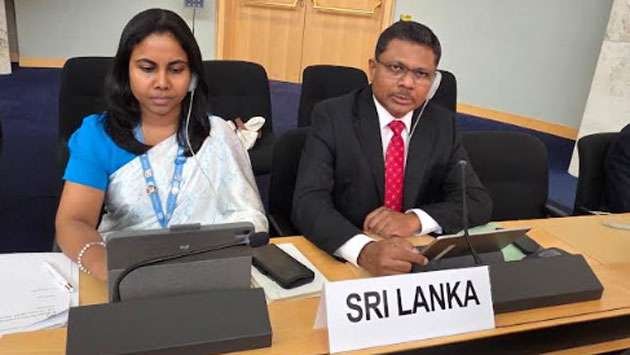
GENEVA — Sri Lanka has formally challenged the longevity of country-specific mandates within the United Nations Human Rights Council (UNHRC), arguing that such measures should not be treated as permanent fixtures of the international body.
Speaking at the 63rd Session of the UNHRC in Geneva on September 8, Sri Lanka’s Permanent Representative to the United Nations, Ambassador Sumith Dassanayake, delivered a pointed address during the General Debate under Agenda Item 2. He asserted that the Council must move away from open-ended oversight and instead adopt a framework centered on periodic reviews, defined objectives, and measurable outcomes.
The address followed the presentation of a written update regarding the human rights situation in Sri Lanka, an event attended by UN High Commissioner for Human Rights Volker Türk.
Ambassador Dassanayake emphasized that at a juncture when the international community is grappling with severe global crises—including escalating armed conflicts, mass displacement, and humanitarian emergencies—the Council’s finite resources must be directed toward the most urgent matters. He proposed that all country-specific mandates should incorporate “sunset clauses” and phase-out provisions, ensuring that oversight is tied to progress rather than indefinite duration.
“No Council mandate should be regarded as permanent,” Dassanayake stated, urging the body to establish a more transparent and goal-oriented approach. He argued that when a nation demonstrates tangible progress through established national processes, active dialogue, and cooperation with international technical assistance, the UNHRC has a responsibility to provide a “credible pathway” toward the eventual conclusion of that mandate.
This push for a transition from surveillance to cooperation received backing from several like-minded nations during the session. These delegations voiced their support for the Sri Lankan government, commending the strides the country has made in protecting and promoting human rights across all segments of its society.
The debate highlighted a growing tension within the Council between member states that favor sustained international scrutiny and those, like Sri Lanka, who advocate for a shift toward sovereign domestic processes once certain benchmarks are met.
As the 63rd Session continues, the discourse surrounding the efficiency of the UNHRC’s monitoring mechanisms remains a focal point. For Colombo, the message remains clear: the council’s engagement should be viewed as a temporary partnership aimed at capacity building and reform, rather than a permanent state of international monitoring. The Sri Lankan delegation’s call for sunset provisions seeks to formalize this transition, effectively proposing a structural reform in how the UNHRC engages with member states moving forward.
Disclaimer: This content is auto-generated for informational purposes only.
Source: Read Original News