









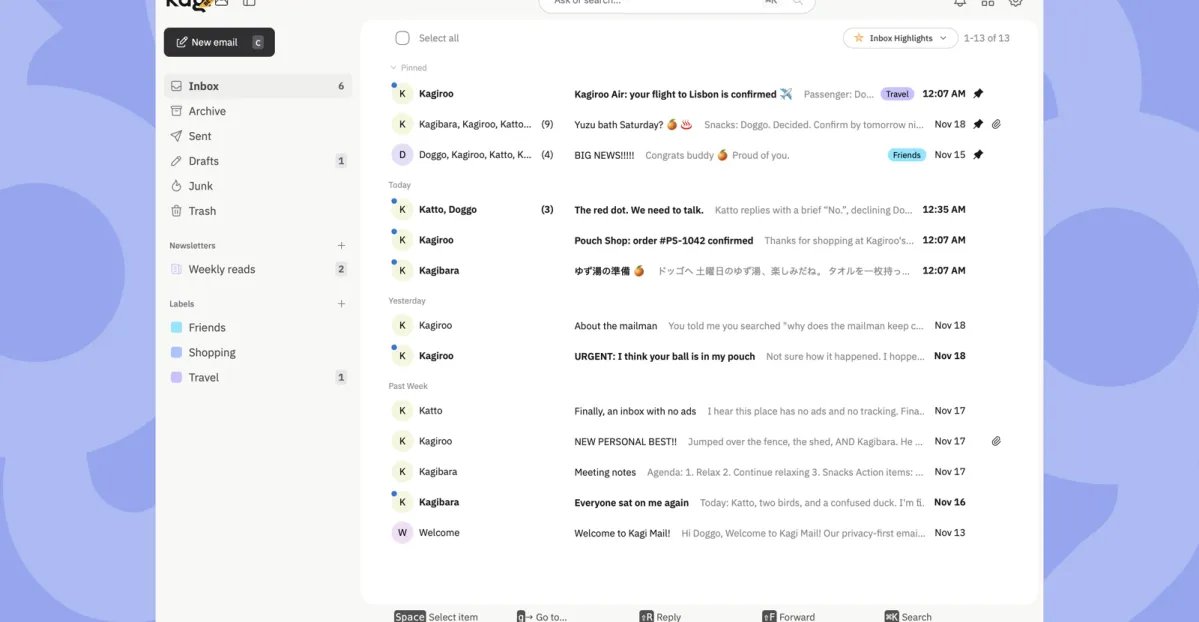
A New Standard for Privacy-Focused Communication
The landscape of modern digital communication has long been dominated by advertising-supported platforms that derive their business value from the aggregation of user data. Kagi, the organization known for its subscription-based search engine and the Orion web browser, has officially challenged this model by launching the public beta of Kagi Mail. By positioning itself as a direct alternative to legacy providers like Gmail, Kagi is aiming to provide an environment defined by the absence of surveillance and the total removal of tracking-based advertising.
The core philosophy driving this release is the belief that professional and personal tools should operate without interfering with the user. Kagi contends that the current email ecosystem has become bloated with analytics trackers, pixel-based monitoring, and data mining, all of which compromise user privacy. Kagi Mail aims to strip these layers away, focusing instead on efficiency and the preservation of open standards. This launch is a significant step in the company’s broader mission to create a suite of software that respects the autonomy of its users while maintaining high performance.
Technical Infrastructure and User Features
At the functional level, Kagi Mail is built to prioritize utility over data harvesting. Users receive an @kagimail.com address upon sign-up, but the service provides robust support for custom domains, allowing individuals to maintain their own digital identity without being tethered to a specific platform. Perhaps most notably, the service includes support for unlimited aliases. This feature is a critical component for security, as it enables users to generate unique email addresses for every service or newsletter they interact with, effectively mitigating the risk of spam and making it easier to identify and block potential data leaks.
The platform includes a baseline of 50GB of storage, which is intended to accommodate long-term archival of correspondence without the need for frequent pruning. Furthermore, the service integrates a built-in calendar system directly into the email interface. This keeps scheduling and communication within a unified, secure ecosystem, reducing the need to rely on external tools that might otherwise ingest metadata from email threads to populate calendar entries. By keeping these functions internal, Kagi maintains a cleaner security perimeter around the user’s personal data.
Strategic Roadmap and Long-Term Development
While the public beta provides a stable core for desktop usage, the service is currently in a transitional development phase. Kagi has been transparent about its roadmap, highlighting where the product currently sits and where it plans to expand over the coming years. One of the most significant upcoming additions is the inclusion of a comprehensive contacts and address book system, which is currently scheduled for the first quarter of 2027. This component is vital for creating a truly seamless workflow, as it allows users to manage their network securely without relying on third-party cloud contact syncing that often bypasses privacy protections.
Furthermore, the company has projected that native mobile applications for iOS and Android will arrive in the third quarter of 2027. While the service is currently accessible via mobile web browsers, the development of native applications will be essential for integration with local device notifications and streamlined mobile authentication. By setting these specific timelines, Kagi is emphasizing a methodical approach to development, focusing on backend stability and data integrity before scaling out to mobile environments. This deliberate pace is intended to ensure that when mobile apps arrive, they meet the same high privacy standards established by the desktop version.
Addressing the Market Need for Independence
When considering why a company would enter the crowded email market, one must consider the issue of vendor lock-in. Kagi emphasizes that its service is designed with open standards at the forefront, ensuring that data is portable and that users are not held captive by proprietary file formats or restricted export protocols. This represents a stark departure from the typical “walled garden” approach favored by many technology giants.
The competition in this space includes established privacy-centric players such as Fastmail and Tuta, both of which have paved the way for subscription-based email. Kagi acknowledges these predecessors but posits that there is still a space for a service designed under the “get out of your way” mantra. For power users who already utilize Kagi’s search engine and browser, the addition of email creates a vertical integration of their digital life. This ecosystem approach aims to reduce the friction of switching between disparate tools that might otherwise rely on different security frameworks, thereby creating a more cohesive and verifiable security posture.
Subscription Model and Access Requirements
Kagi Mail follows the organization’s established subscription-based business model, reinforcing the principle that if a product is free, the user is likely the product. To access Kagi Mail, users can utilize a 60-day free trial period to evaluate the functionality and performance of the platform. Following the trial, the service is priced at $99 per year. Additionally, it is included as part of the broader Kagi Ultimate subscription, which is priced at $25 per month.
This pricing structure is designed to be transparent, removing the need for hidden costs or auxiliary income streams like advertising. By charging a direct fee for service, Kagi ensures that its incentives are aligned entirely with the user rather than with third-party advertisers. As the service exits the public beta phase, the transition to a paid model will be the ultimate test of whether the market values privacy and anti-surveillance as much as it values the convenience of free, ad-supported tools. For those who prioritize data sovereignty, Kagi Mail represents a compelling evolution in how professional communication can be managed in the modern digital age.
Disclaimer: This content is auto-generated for informational purposes only.
Source: Read Original News