




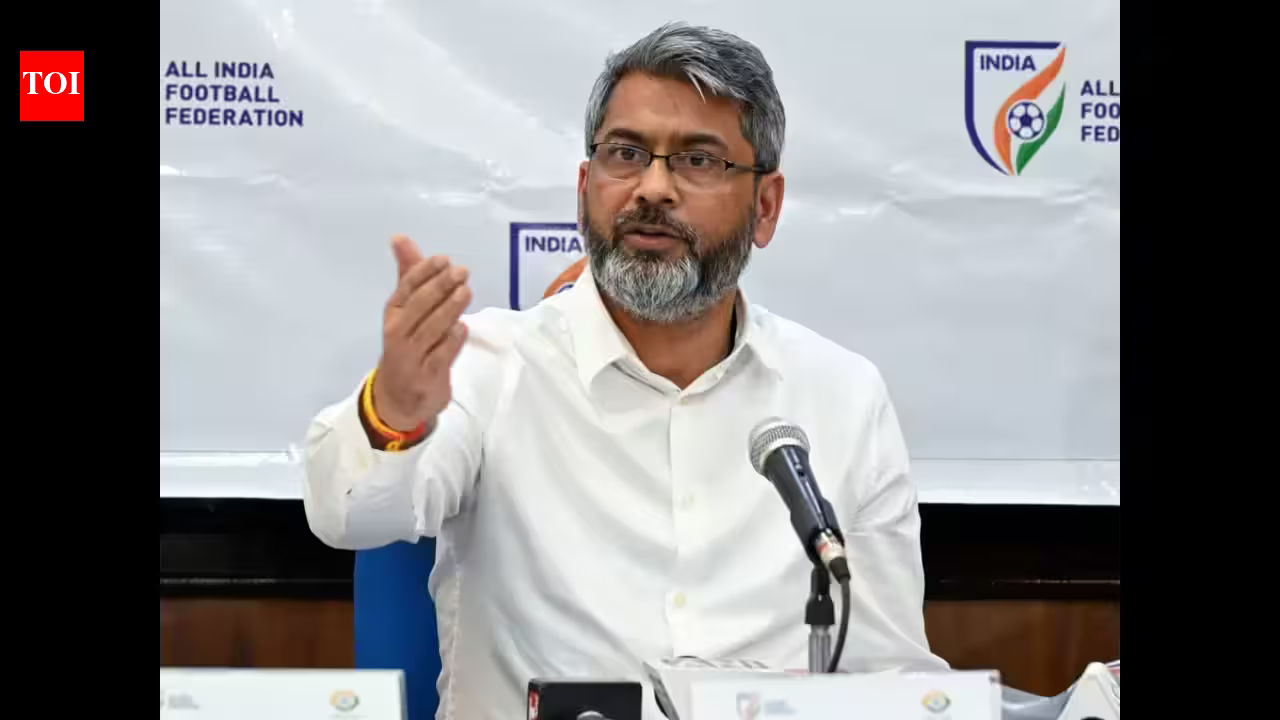
New Delhi: The high-stakes chess match surrounding the All India Football Federation (AIFF) presidency has taken a definitive turn, as incumbent President Kalyan Chaubey successfully secured a place in the electoral college just weeks ahead of the pivotal December 20 elections.
In a move that has sent ripples through the Indian footballing fraternity, the Electoral Officer has officially approved a request from the Karnataka State Football Association (KSFA) to substitute their representative, Hanif Mohammed, with Chaubey. This eleventh-hour inclusion effectively removes the primary procedural obstacle that had threatened to derail Chaubey’s bid for a second term, following his sudden exclusion from the Daman and Diu Football Association’s nominations earlier this month.
A Procedural Lifeline
The path back into the electoral race was paved with medical documentation and rigorous administrative scrutiny. The initial draft electoral college, published on November 15, listed KSFA president N.A. Haris and Hanif Mohammed as the designated representatives for Karnataka. However, the landscape shifted dramatically when the Daman and Diu Football Association withdrew their support for Chaubey, leaving the sitting president without a clear mandate to participate in the voting process.
Seizing an opportunity to maintain continuity in federation leadership, the KSFA moved to alter its representation. The catalyst for this change was a formal request from Hanif Mohammed, who cited severe medical concerns. In correspondence dated November 16, Mohammed requested his withdrawal, pointing to physical and mental strain—compounded by the rigors of long-distance travel—as reasons for stepping aside.
The Electoral Officer, Rajeev Sharma, took a cautious approach, demanding substantive proof before allowing a departure from the established voter list. Following the submission of a medical certificate from a consultant physician at Manipal Hospital, Bengaluru, which advised against travel and stress, the office granted the substitution. By November 25, the revised electoral college was made public, cementing Chaubey’s eligibility alongside N.A. Haris.
Political Overtones in the Boardroom
The confirmation of this alliance highlights an intriguing, albeit complex, political convergence within the AIFF leadership. N.A. Haris, a prominent Congress politician, and Kalyan Chaubey, who carries the backing of the BJP, have worked in tandem since the 2022 elections. That year, Chaubey famously unseated former Indian football icon Bhaichung Bhutia in a landmark victory that reshaped the federation’s hierarchy.
This unlikely partnership between representatives of opposing political ideologies has been the bedrock of the current administration. However, with the upcoming election, the stability of this alliance is once again under the microscope as rival factions eye the power shift within the federation.
The Battle for the Future of Indian Football
While the administrative hurdles are currently being cleared, the road to December 20 remains fraught with tension. The past few weeks have witnessed an escalation in public scrutiny regarding the direction of the national sport. A cohort of former India internationals, led by the persistent voice of Bhaichung Bhutia, has taken their grievances directly to the corridors of power.
In recent appeals to Sports Minister Mansukh Mandaviya, these legends have expressed deep-seated concerns regarding the day-to-day operations of the AIFF and the strategic roadmap—or lack thereof—for Indian football. These critics argue that the current leadership has failed to capitalize on the country’s potential, creating an environment of uncertainty that has trickled down to the grassroots level.
For Chaubey, the successful navigation of the KSFA nomination process is a vital tactical victory, but the real test lies in convincing the broader electoral body that his vision for the federation remains the superior choice for the sport’s development.
What Lies Ahead
With the electoral college now finalized and the names set in stone, the focus shifts entirely to the campaign trail. For the stakeholders of Indian football, the December 20 election represents more than just a vote for a president; it is a referendum on the administration’s performance over the last two years.
As the federation prepares to gather in New Delhi, the atmosphere is charged. The Electoral Officer’s decision to allow the KSFA substitution has provided a reprieve for the incumbent, but the broader debate over governance, transparency, and accountability is unlikely to quiet down anytime soon. The AIFF now finds itself at a crossroads, with the future of the beautiful game in India hanging in the balance of a vote that will define the next chapter of the federation’s history.
Whether this maneuver by the KSFA ultimately secures Chaubey another term or serves as a final chapter in his tenure, one thing is clear: the spirit of competition in Indian football is no longer restricted to the pitch—it has firmly taken root in the halls of the federation itself.
Disclaimer: This content is auto-generated for informational purposes only.
Source: Read Original News