









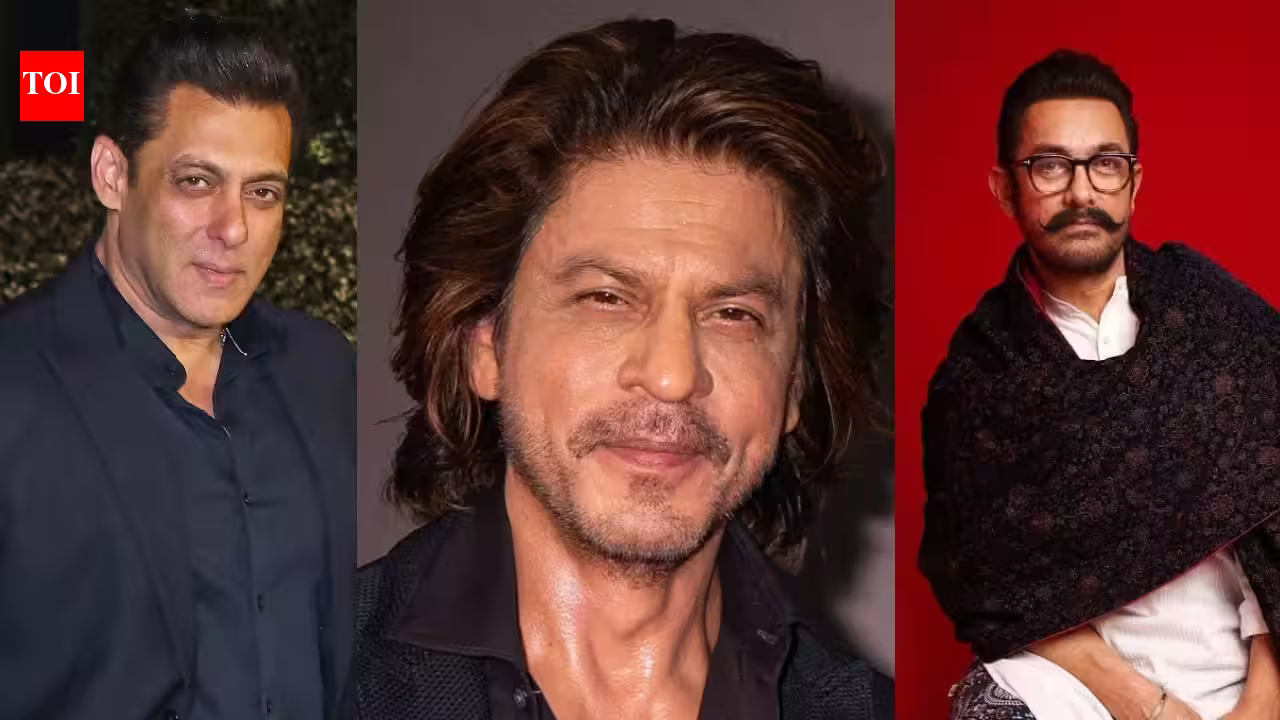
The math of Bollywood stardom has always been a subject of fascination, but rarely has the gap between the “King” and his court been framed with such staggering specificity. In a recent, high-voltage appearance on Siddharth Kannan’s popular podcast, market analyst JS Khepar—known to the online community as Jassi Tech—dropped numbers that have sent shockwaves through the industry, effectively quantifying what fans have long felt: Shah Rukh Khan isn’t just a movie star; he is a financial juggernaut operating in a league of his own.
While A-list peers like Salman Khan, Aamir Khan, and Akshay Kumar command massive fortunes, Khepar’s analysis suggests that when it comes to the sheer velocity of wealth accumulation, Shah Rukh Khan is operating at a scale nearly four times larger than his contemporaries.
The King of the Financial Kingdom
The figures shared by Khepar are enough to make any venture capitalist take note. According to the analyst, Shah Rukh Khan’s net worth sits comfortably between Rs 12,000 crore and Rs 12,500 crore. To put that in perspective, Khepar places Salman Khan’s net worth at Rs 3,000–3,200 crore, while Aamir Khan reportedly hovers between Rs 1,900 and 2,000 crore. Akshay Kumar, often cited for his relentless work ethic and broad portfolio, lands in the middle at approximately Rs 2,700–2,800 crore.
“He’s the king! I don’t think his net worth is less than Rs 12,000 crore to Rs 12,500 crore. That’s why he’s the king,” Khepar asserted during the podcast. He went on to explain that SRK’s dominance isn’t merely a byproduct of his film fees. It is the result of a calculated, aggressive diversification strategy that has seen him pivot from being a performer to a powerhouse entrepreneur.
The Business of Being SRK
Shah Rukh Khan’s wealth is not parked idly in a bank account. It is woven into the fabric of the entertainment and sports industries. At the heart of this empire is his IPL franchise, the Kolkata Knight Riders (KKR), which has seen its valuation skyrocket alongside the growth of the league itself. Then there is Red Chillies Entertainment—a production house that has become a synonym for quality—and its world-class VFX studio, which serves as a technological backbone for projects both within and outside his home banner.
But the tangible assets are just as formidable. From his legendary sea-facing residence, Mannat, which stands as a landmark of Bandra, to his prime real estate holdings in London, Dubai, and the posh enclaves of Mumbai, Khan has masterfully diversified his risk. When one looks at his portfolio, it becomes clear: while he might be the face of the film, his wealth is built on the infrastructure that makes those films (and sports) possible.
Cricket Metaphors and Career Strategies
Perhaps the most intriguing part of Khepar’s analysis was his attempt to decode the contrasting career trajectories of these four titans using cricket terminology. The analogy paints a vivid picture of how each star approaches his craft and his money.
He described Aamir Khan as a “Test player”—a man of immense patience, precision, and class. In Khepar’s view, Aamir’s “Mr. Perfectionist” moniker is earned through his deliberate, slow-burn approach, where the quality of the product reigns supreme over the frequency of releases. Conversely, he labeled Akshay Kumar as a “T20 player.” In this metaphor, Akshay is the relentless engine of the industry. His ability to churn out multiple high-impact films annually is treated as a masterclass in efficiency. “If there was a T5 format, he would have aced it too,” the analyst remarked, acknowledging the actor’s fitness and business discipline.
Meanwhile, Salman Khan is cast as a “one-day cricketer.” It’s an apt descriptor for a star who understands the rhythm of the audience better than anyone else, blending star power with a shrewd understanding of real estate markets.
Real Estate: Salman’s Midas Touch
While the conversation centered on SRK, Khepar was quick to acknowledge that Salman Khan has cultivated a unique talent for wealth preservation through real estate. Describing his approach as having a “Midas’ touch,” Khepar noted that Salman has successfully transformed his celebrity status into a portfolio of high-value assets.
From the iconic Galaxy Apartments in Bandra to his sprawling 150-acre farmhouse in Panvel, Salman’s investments are localized but massive. The logic, according to Khepar, is sound: “The whole world loves him, including real estate. There’s only money and more money in Mumbai’s real estate.” While he may not be running a global VFX conglomerate like Khan, his footprint in the physical landscape of Mumbai ensures a level of financial stability that few could replicate.
The Subjectivity of Celebrity Net Worth
It is important to approach these figures with a measure of caution. Estimating the net worth of a global celebrity is notoriously difficult; valuation methods differ wildly depending on whether one is counting liquid cash, brand value, equity in private firms, or the fluctuating market price of luxury real estate.
However, even if these figures are viewed as approximations, the message remains clear: the Indian film industry has evolved. The era of the “star” has been superseded by the era of the “star-entrepreneur.” As Shah Rukh Khan continues to dominate the box office with record-breaking global hits, the gap between the men who star in the movies and the men who own the systems behind them is becoming increasingly apparent.
Ultimately, JS Khepar’s assessment isn’t just about who has the most money in the bank; it’s about the shift in strategy. Whether it’s the methodical pace of Aamir, the T20 speed of Akshay, the real estate dominance of Salman, or the sprawling, multifaceted empire of Shah Rukh, these stars are rewriting the rulebook on how to remain relevant—and wealthy—in a volatile entertainment landscape. For the rest of us, it’s a masterclass in diversification, delivered by the people who have perfected the art of the sequel.
Disclaimer: This content is auto-generated for informational purposes only.
Source: Read Original News