







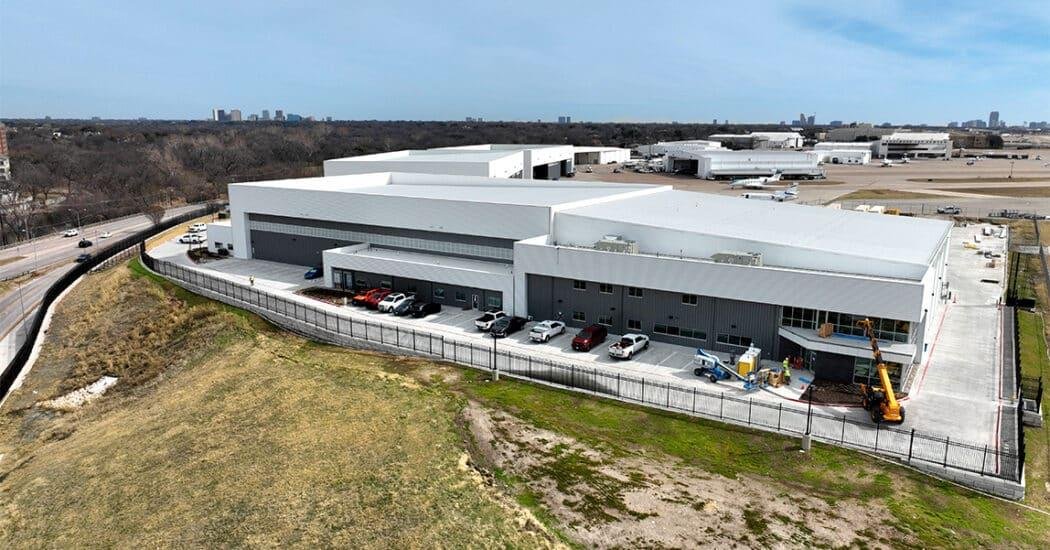
Business Jet, a premier aviation services provider at Dallas Love Field, is significantly accelerating its infrastructure growth. The company has officially completed the expansion of its east-side campus, adding two massive, side-by-side hangars that encompass 70,000 square feet. This development, which also involved extensive concrete pouring to increase ramp capacity, underscores a broader trend of rapid industrial scaling seen across the North Texas aviation sector.
As the corporate aviation industry faces unprecedented demand for hangar space and premium maintenance facilities, Business Jet’s latest investment serves as a critical response to the logistical bottlenecks currently challenging the private flight sector.
Optimizing Aviation Logistics through Advanced Tech
While the physical expansion at Love Field focuses on concrete and steel, Business Jet is increasingly looking toward digital transformation to maintain its competitive edge. In an industry where turnaround times are measured in minutes, the integration of data-driven logistics and automated inventory management is becoming essential.
Modern aviation firms are now heavily reliant on cloud-based ecosystems—much like the suite of tools found in Google Workspace—to manage complex scheduling, parts procurement, and client communication. By utilizing high-speed digital infrastructure, operators can streamline the intricate hand-off between air traffic control, ground crews, and maintenance teams. As these hangars begin operations, the adoption of sophisticated management software will be the deciding factor in how efficiently Business Jet can cycle aircraft through its newly expanded apron space.
The Role of AI in Predictive Maintenance
The expansion of hangar space is only one half of the modernization equation; the other is the shift toward predictive maintenance powered by artificial intelligence. Similar to how Google Cloud’s machine learning tools allow companies to anticipate equipment failure before it disrupts operations, the aerospace industry is moving toward “digital twins” and real-time sensor monitoring.
Business Jet’s new 70,000-square-foot facility is designed to support the sophisticated avionics and engine systems of modern, long-range business aircraft. These planes generate vast amounts of telemetry data during every flight. By processing this data through AI-driven analytics platforms, service providers can predict exactly when a component needs servicing before a failure occurs. This capability turns a traditional repair hangar into a high-tech diagnostic hub, allowing technicians to optimize their workflow and reduce “Aircraft on Ground” (AOG) time for their elite clientele.
Tech-Driven Growth in the Dallas Aviation Hub
The Dallas Love Field area is becoming a focal point for tech-enabled infrastructure. As more firms expand their physical footprint, the intersection of industrial hardware and software development is fueling the local economy. Companies in the aerospace sector are increasingly utilizing Google-backed analytical tools to track flight trends, optimize fuel logistics, and manage the growing complexity of airport operations.
As Business Jet increases its capacity, the emphasis on digital connectivity will be paramount. Whether it is deploying high-speed mesh networks across massive hangar floors to ensure technicians have instant access to schematics or utilizing AI-powered safety protocols to manage increased ramp activity, the future of aviation is being built at the nexus of traditional manufacturing and modern digital intelligence.
The addition of these two hangars is more than just a footprint increase; it represents a commitment to the modern standards of speed and precision. By combining expanded physical space with the efficiency of modern computing, Business Jet is positioning itself to handle the next generation of private aviation, ensuring that Dallas Love Field remains at the center of the global aviation map.
Disclaimer: This content is auto-generated for informational purposes only.
Source: Read Original News