








Mario Nieto MNodes: this new visual, node-based modular environment that lets you create infinite sound tools like synths, effects, and more.
In the last few months, numerous node-based modular environments have entered the market. Tim Exile released Karst just this week, for example, which follows the footsteps of Reaktor. With Msh Audio, another is about to be released.
But before that, there’s one more. Mario Nieto, developer of the Harmony Bloom plugin, has released MNodes, a modular environment that allows anyone to create their own tools without coding.

Mario Nieto MNodes
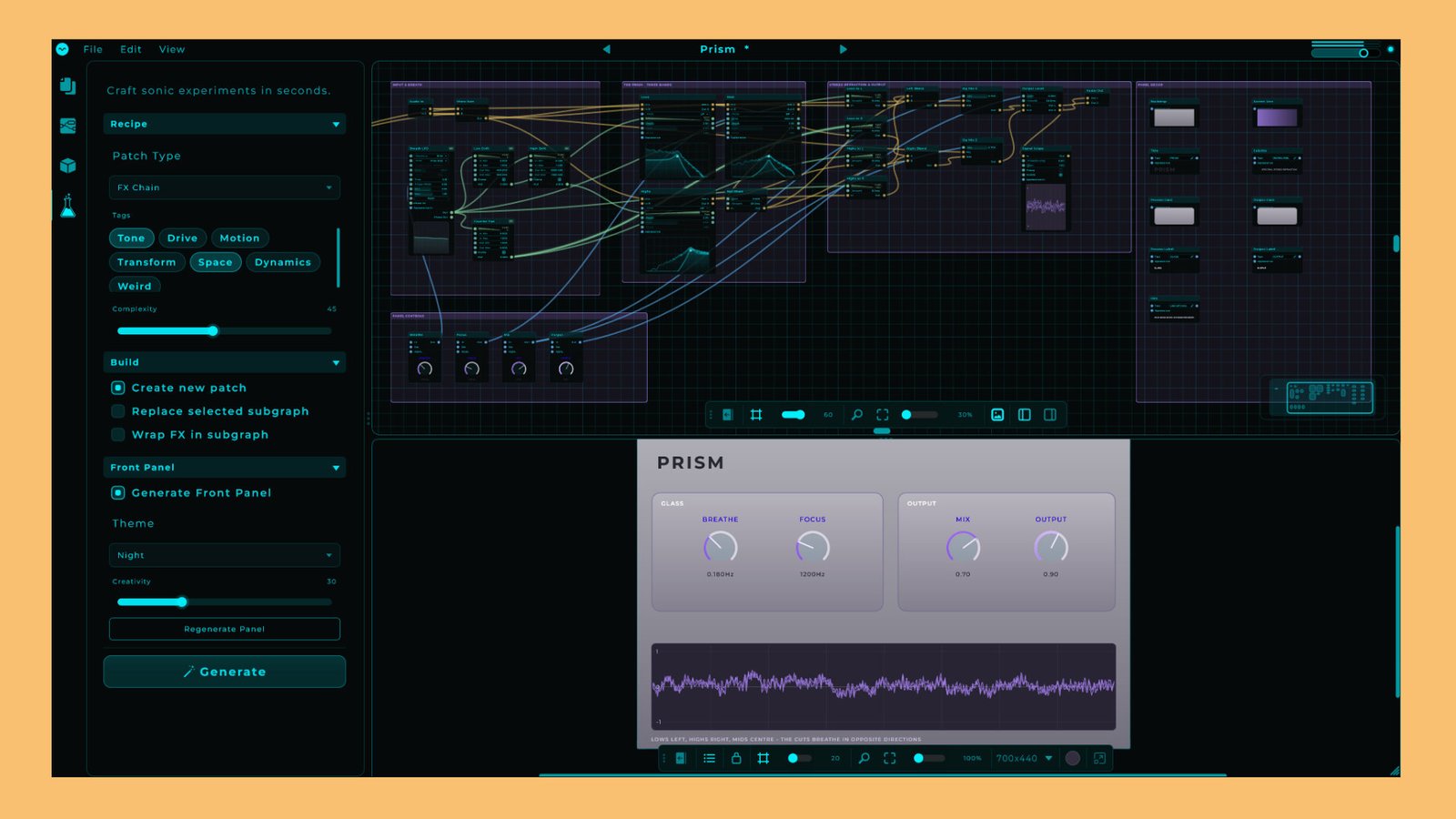
MNodes is a new visual node-based modular environment for macOS and Windows that runs as a standalone app or directly inside your DAW as a plugin.
Like Reaktor, it is a modular environment that allows you to develop complete instruments, effects, MIDI tools, and more by simply connecting nodes. No coding is required for this.
Mario Nieto has implemented over 330 specialized nodes, including oscillators (wavetable, physical modeling…), samplers, filters, sequencers, vocoders, granular FX, envelopes, LFOs, logic gates, and more.
New functions can be added to a project simply by dragging and dropping. Like in a modular synth, the nodes are connected with virtual cables. There are four specific signal paths with color-coded routing: audio, CV, MIDI, and data.

Polyphony is also onboard. Bundle complex signal networks into compact subgraphs, and build custom polyphonic engines supporting up to 16 voices.
MNodes goes a step further and allows users to host VST plugins on an existing sound network. With the dedicated plugin host, you can load instruments, effects, or MIDI generators right into the modular environment and integrate them into your patch.
From A Patch To An Instrument, Effect Or MIDI Processor
It all starts with selecting and connecting the notes. Once that’s done, you can play your creation right away. You can also enhance the visuals.
Mario Nieto MNodes comes with a front panel designer that lets you design custom interfaces with knobs, sliders, XY pads, and keyboards. They can have up to 128 automatable DAW parameters. The perform mode turns all this into a clean, live-focused layout.

If the engine is a bit too complex and overwhelming at first, you can also explore ready-made creations within the plugin.
The integrated MNodesHub is a hub where you can browse, download, and share community-created presets, modules, and full projects. For this, you don’t need to close the plugin. Something I also wish for Reaktor.
For those who like it very fast, there is also the “LAB” patch generator. It’s a kind of random patch generator that instantly generates randomized instruments, FX chains, synth patches, MIDI routines, and more with a click on a button.
First Impression
At first glance, this is a very exciting new node-based modular environment. It takes a different approach than the new Tim Exile system.
The exciting aspect here is that you can build custom instruments, effects, and MIDI tools with their own UIs that all run within the same plugin. Also, the randomizer looks like a fun way to create new tools. How deep the tools can go would need to be examined in a detailed test.
Mario Nieto MNodes is available now for 79€. It runs as a VST3 and AU plugin on macOS (native Apple Silicon + Intel) and Windows.
More information here: Mario Nieto
Available from my partner