







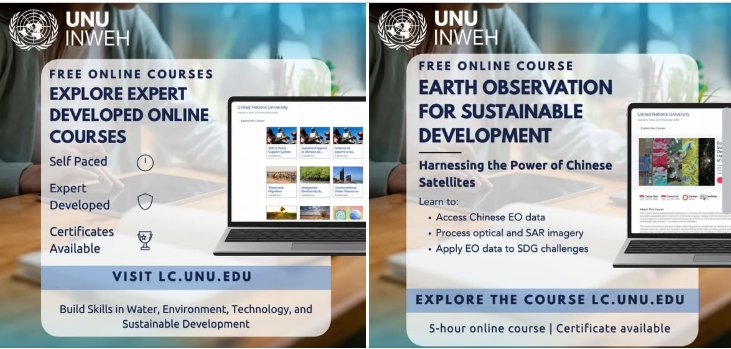
As climate change and environmental degradation continue to accelerate, the demand for professionals equipped with high-tech analytical skills has never been higher. To bridge the gap in technical expertise, the United Nations University Institute for Water, Environment and Health (UNU-INWEH) is providing a pathway for students, researchers, and practitioners to gain critical skills in geospatial technology and environmental monitoring through its free, self-paced online learning center.
The initiative is designed to address the increasing role of Earth observation, artificial intelligence (AI), and satellite data in tackling global sustainability challenges. By offering accessible, high-quality training, UNU-INWEH aims to empower individuals—particularly those in the Global South—to navigate the modern landscape of environmental science without the financial barriers often associated with professional certification programs.
The curriculum covers five core pillars of contemporary environmental science, each focusing on data-driven solutions:
- Earth Observation for Sustainable Development: This course introduces the use of satellite technologies to monitor land, agriculture, and ecosystem shifts. It is an essential foundation for those specializing in geography, climate adaptation, and natural resource management.
- Geospatial Data Analysis with ChatGPT and Google Earth Engine: Reflecting the rapid evolution of digital tools, this course integrates large-scale satellite datasets with AI. It provides a blueprint for using ChatGPT to streamline research workflows and interpret complex spatial data.
- Spatiotemporal Drought Assessment: With water scarcity rising as a primary humanitarian concern, this module teaches participants how to track drought progression across different regions. The training is tailored for professionals working in disaster risk reduction and climate resilience.
- Spatial Data Management: This course emphasizes the technical organization of geographic information, a prerequisite for success in urban planning, infrastructure development, and humanitarian response.
- Satellite Data Analysis for Surface Water and Flood Mapping: This specialized training focuses on using imagery to map water bodies and flooding—an invaluable skill for hydrologists and disaster management experts operating in areas where ground-based data collection is logistically challenging.
These courses are designed to be flexible, catering to a diverse audience ranging from university students and researchers to GIS practitioners and development professionals. Because the modules are entirely self-paced, they accommodate the busy schedules of working professionals while providing a structured learning environment. Furthermore, the availability of certificates allows learners to validate their newly acquired competencies, adding significant value to professional portfolios and LinkedIn profiles.
The integration of these skills is becoming a necessity for the modern environmental workforce. Organizations are increasingly relying on satellite imagery and AI-supported data analysis to inform policy and operational decisions. By mastering these technologies, learners gain the ability to contribute to smarter water management, more accurate disaster forecasting, and more effective sustainable development projects.
The UNU-INWEH Learning Centre serves as a critical resource for democratizing technical education in the environmental sector. Interested participants are encouraged to visit the official UNU-INWEH website to explore the curriculum and review individual course requirements. As the global community looks toward data-centric solutions to protect our planet’s future, these courses offer a practical, no-cost opportunity to build the skills that will shape the next generation of environmental leadership.
Disclaimer: This content is auto-generated for informational purposes only.
Source: Read Original News