





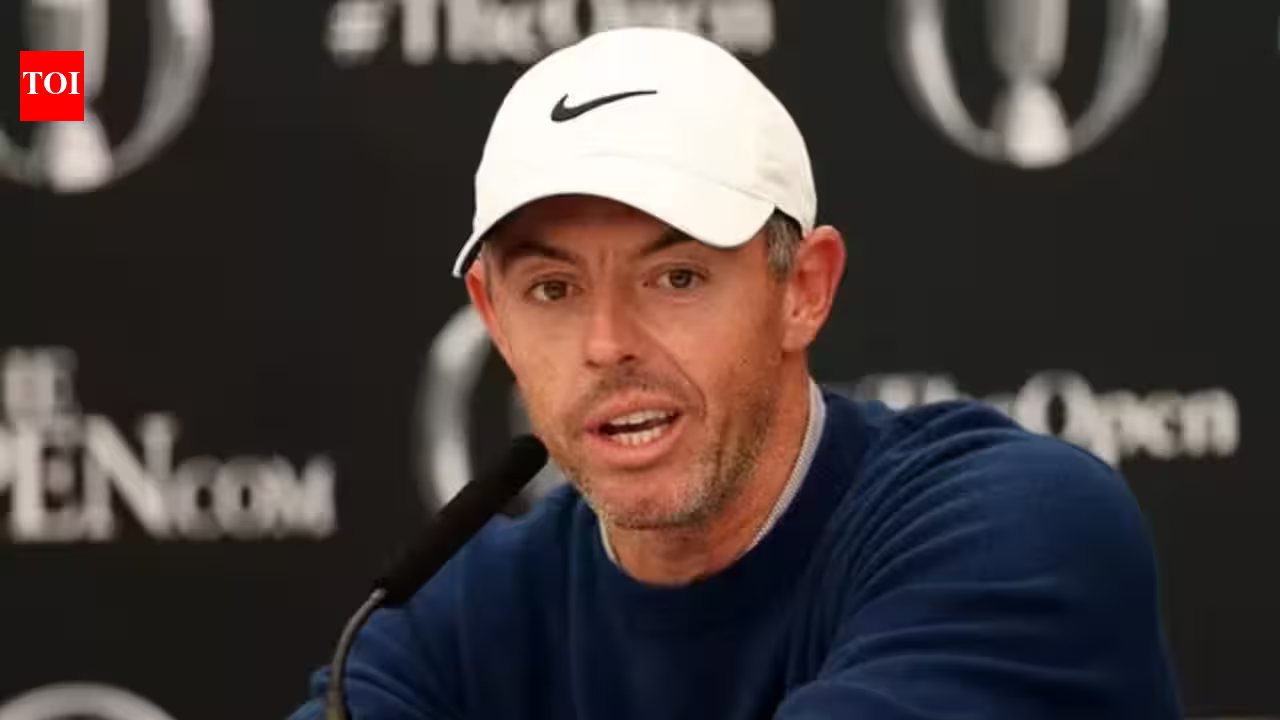
Rory McIlroy’s highly anticipated journey to New Delhi for the inaugural DP World India Championship was designed to be a landmark moment for global golf, but the event became the epicenter of a heated off-course debate after PGA Tour veteran Kevin Kisner leveled sharp accusations regarding the Northern Irishman’s motives for competing.
The tournament, held at the historic Delhi Golf Club from October 16–19, 2026, boasted a $4 million prize fund and a star-studded field, including Justin Rose, Tommy Fleetwood, Shane Lowry, and Patrick Reed. While the event was positioned as a strategic effort to capture the burgeoning Indian golf market, it sparked a provocative critique from Kisner, who suggested that the players were lured by exorbitant financial incentives rather than a genuine desire to grow the game.
McIlroy’s India appearance drew criticism from Kisner
The controversy ignited on the Fore Play Podcast, where Kisner—now a prominent lead golf analyst for NBC—did not mince words. Citing a reported $10 million appearance fee, Kisner argued that the financial windfall was the primary, if not sole, catalyst for McIlroy’s transit to India.
“That is such a dog s*** comment, but I guess for the right price we could all say that comment,” Kisner stated during the broadcast. “He doesn’t want to globally expand in India; he wants to get his $10 million bucks and go play in India.”
Kisner’s skepticism extended beyond the payday, touching on the technical challenges of the course itself. He pointedly noted that the Delhi Golf Club layout did not favor McIlroy’s strengths, specifically highlighting the fact that the four-time major champion opted not to carry his driver for the week.
“I know there’s a pile of guys that got paid for that event. How else would you get that event in India with eight billion people in the middle of the city?” Kisner remarked. “And Rory’s not even hitting a driver this week. You think he wants to go play a tournament where he can’t use his No. 1 weapon? So give me a break.”
Kisner further alleged that players were often subjected to scripted talking points to justify these high-profile appearances. “They always seem to say the right things while they’re over there,” he added. “As part of your appearance fee, ‘Here’s your script for altruism,’ which is totally fine, I’d do it too.”
McIlroy says the financial and sporting reasons can coexist
When confronted with the commentary in New Delhi, McIlroy appeared largely unruffled, questioning why his presence in a developing golf market would invite such pointed scrutiny from a peer.
“I didn’t see that. I don’t know why me being in India would make Kis need to comment on that,” McIlroy told reporters.
However, he firmly rejected the binary narrative that professional golfers must choose between financial compensation and the promotion of the sport. McIlroy argued that the two objectives are not mutually exclusive, highlighting India’s immense potential as a consumer market.
“Two things can be true at the same time,” McIlroy explained. “People can get paid to come and play at a tournament, but at the same time, do it from a place of a genuine interest of trying to bring the sport to another country, a developing country, a country where the middle class in India is larger than the whole population of the United States. It’s a huge market for golf.”
For McIlroy, who has acted as a Global Golf Ambassador for DP World since his recent multi-year partnership announcement, the trip was part of a larger, long-term vision to “push the boundaries of performance” through logistical and commercial integration.
A disappointing finish followed a promising start
Despite the external noise, McIlroy’s week on the course failed to generate the momentum he had hoped for. The tournament began with flashes of brilliance, including an eagle in his opening round and a spectacular bunker-shot eagle on the 14th hole. However, his form faltered in the third round, hampered by a string of bogeys and a costly double bogey that effectively removed him from contention.
McIlroy finished the tournament tied for 42nd at four-under par, closing with a two-over 74. He ended the week 17 strokes behind the champion, Eugenio Lopez-Chacarra, who carded an impressive 21-under total to claim the title and leapfrog Patrick Reed at the top of the Race to Dubai standings.
The result was a setback for the Northern Irishman, who arrived in India looking to secure his eighth Race to Dubai title—a milestone that would see him tie the record held by Colin Montgomerie. With the DP World Tour playoffs set to begin next month in Abu Dhabi, the pressure remains high.
While the $10 million figure cited by Kisner remains a point of speculation and controversy, the official purse for the tournament provided a stark contrast to the rumored appearance fees: the winner took home $680,000, with $440,000 for the runner-up. As McIlroy prepares to turn his attention toward the final stages of the European season, the debate over the commercialization of golf’s global expansion shows no signs of cooling down. Whether through altruism or high-stakes business, the professional game continues to test its reach, leaving players like McIlroy at the center of a complex, evolving landscape.
Disclaimer: This content is auto-generated for informational purposes only.
Source: Read Original News