









The Evolution of Personalized AI within the Household
Google has introduced a significant expansion to its experimental artificial intelligence framework, known as CC, which aims to transition intelligent assistance from a strictly individual experience to a collaborative, multi-user utility. While competitive generative AI models often focus on broad, standalone capabilities, Google is leveraging its deep integration within personal digital ecosystems to provide a unique value proposition: context-aware assistance that understands the nuances of a user’s life. By extending these capabilities to a family unit, Google is attempting to solve the fragmentation that occurs when multiple individuals manage complex, overlapping schedules and obligations.
The CC platform, currently available via Google Labs, functions as an autonomous, shared agent. This development builds upon the foundation laid by previous Google projects, specifically the technology that powers the Gemini Daily Brief. Where the earlier iterations were designed to summarize data for a single user, the new CC architecture treats the family unit as a singular entity while maintaining the individual boundaries of the participants. This represents a strategic shift toward “family-first” AI, acknowledging that the primary friction point in daily management is not a lack of information, but a lack of coordination between stakeholders who share a household.
Structural Mechanics and Data Privacy Framework
A critical challenge for any shared AI system is balancing accessibility with privacy. To address this, Google has implemented a structure where CC operates as a distinct Google account, effectively acting as an intermediary or a digital hub. This configuration allows for granular control over what information is exposed to the model. Family members can choose to opt into the system, and their participation is entirely voluntary. Crucially, the AI does not gain unrestricted access to a user’s private communications or files by default.
Instead, information must be explicitly shared with the CC account. For instance, if a parent wants the AI to stay informed about extracurricular activities, they can designate specific email addresses—such as a school district or a sports league domain—to be accessible to the agent. This “allow-list” approach ensures that the model only synthesizes data that the user deems relevant for household coordination. By funneling information through shared Google Drive folders or dedicated Google Chat interactions, the AI provides a centralized view of communal tasks without compromising the sanctity of private, non-shared communications.
The “Your Day Ahead” Collaborative Briefing
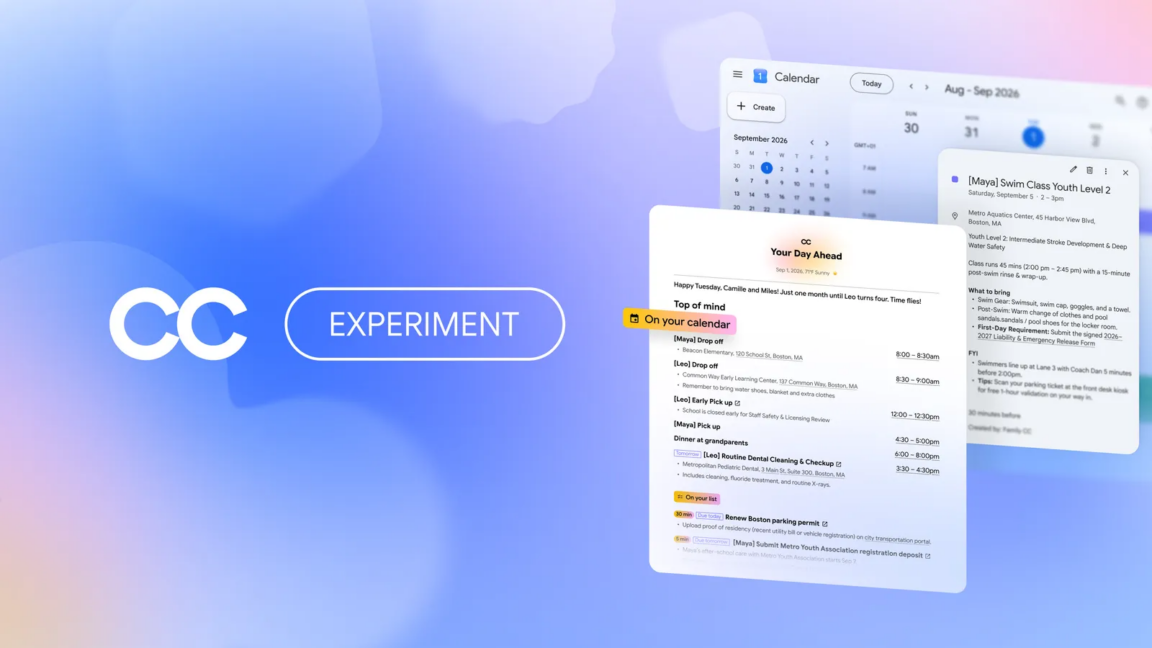
The primary interface for this technology is the “Your Day Ahead” daily email. This output serves as a synthesis of the fragmented information typically buried in individual calendars, email threads, and task lists. For a household, this means that a single briefing can consolidate dentist appointments, utility due dates, school field trips, and grocery delivery windows into a coherent, chronological summary.
Because the AI has context on the family’s collective schedule, it can perform more advanced logical operations than a standard calendar notification. It does not merely report events; it manages the state of those events. For example, if an item is moved on a shared calendar, the morning brief is automatically updated to reflect the change, ensuring that all participants are synchronized before the day begins. This functionality reduces the “mental load” of manually reconciling multiple schedules, a task that often falls to a single individual in a traditional household.
Functional Utility and Task Automation
Beyond passive notification, CC is designed to be an active participant in household management. Users can provide instructions directly to the agent, which the system then translates into actionable data. For example, if a user sends a chat message to the agent requesting a list of items to buy for a weekend project, the AI can cross-reference existing documents, create a checklist in a shared Google Drive folder, and ensure that the task is distributed among the appropriate family members.
The ability to create and edit documents collectively is a significant technical upgrade over previous standalone AI assistants. By integrating with the broader Google Workspace suite, CC serves as a bridge that keeps documents, sheets, and calendars in sync. This reduces the friction associated with updating information across different platforms. When a family member marks a task as complete, the AI registers this state change, preventing duplicate efforts and ensuring that the entire household remains aligned on common objectives.
Strategic Impact on AI Ecosystems
The introduction of the multi-user CC model signals a shift in how tech giants intend to monetize and integrate AI. By positioning the agent as a “family member” or a digital assistant for the home, Google is creating a sticky ecosystem where the value of the AI increases the more it is used by multiple people. The more data points the agent has—from shared grocery lists to school calendars—the more accurate and helpful its briefings become.
Furthermore, this experiment provides Google with valuable telemetry on how AI agents perform when navigating complex interpersonal dependencies. Unlike individual tasks, which have clear outcomes, group coordination involves negotiating conflicting schedules and managing the flow of information between parties who have different priorities. By testing this within the controlled, opt-in environment of Google Labs, the company is gathering insights that could eventually redefine how AI is deployed in corporate team environments, where the requirements for shared context and task management are functionally similar to those of a household. This move highlights the company’s clear ambition to move past the novelty of generative chatbots and into the realm of practical, automated coordination.
Disclaimer: This content is auto-generated for informational purposes only.
Source: Read Original News